- DC Circuit Definition: A DC circuit is defined as an electrical circuit that handles direct current, where the current flows in one direction.
- Series DC Circuit: In a series DC circuit, all components are connected end to end, allowing the same current to flow through each component.
- Voltage Drops in Series: The voltage drop across each component in a series DC circuit is proportional to its resistance.
- Parallel DC Circuit: A parallel DC circuit has components connected across common points, providing the same voltage drop across each component.
- Current Distribution in Parallel: In a parallel DC circuit, the total current is divided among the parallel paths, with each path’s current inversely proportional to its resistance.
What is an Electrical Circuit?
An electrical circuit is a closed path of conducting parts. Those parts may be active components or inactive components, or both.
What is a DC Circuit?
This page covers series and parallel direct current (DC) circuits, not alternating current (AC). A circuit that carries only DC is a DC circuit.
The teaching examples in this electrical DC circuit article are resistive. An AC circuit may also include reactive parts.
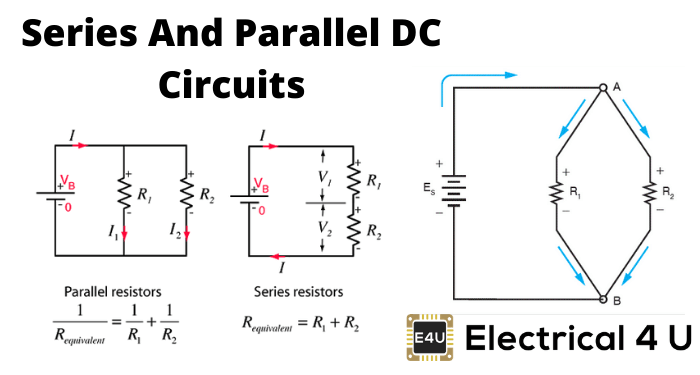
Any electrical circuit is series, parallel or a mix of the two. A DC network uses the same three groups: series DC circuit, parallel DC circuit, and series and parallel circuit.
What is a Series DC Circuit?
A series DC circuit connects every resistor end to end so there is one path for current. That end-to-end join is a series connection.
Take n resistors R1, R2, R3………… Rn joined end to end. Connect that string across a voltage source and current flows in that one path.
Current enters R1, then the same current enters R2, then R3, and finally Rn before it returns to the negative terminal of the source.
The same current therefore flows through every series resistor. In a series DC circuit that current is the same in every part of the electrical circuit.
By Ohm’s law, the voltage drop across a resistor is its electrical resistance times the current through it.
Because that current is the same in every resistor, each drop is proportional to that resistor’s resistance.
Unequal resistances therefore give unequal drops. Each resistor has its own drop in a series DC circuit.
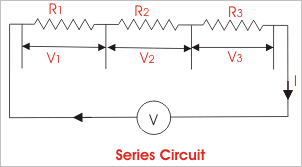
Electrical DC Series Circuit with Three Resistors
The next figure is a three-resistor DC series circuit. A moving point shows the current path as a teaching sketch, not a measured waveform.

Series DC Circuit Example
Three resistors R1, R2, and R3 sit in series across a voltage source of V volts. Current I amperes flows through the string. By Ohm’s law,
The voltage drop across resistor R1, V1 = IR1
The voltage drop across resistor R2, V2 = IR2
The voltage drop across resistor R3, V3 = IR3
The voltage drop across the whole series DC circuit,
V = Voltage drop across resistor R1 + voltage drop across resistor R2 + voltage drop across resistor R3

By Ohm’s law, the electrical resistance of the circuit is V ⁄ I, called R. Then
The equivalent resistance of the series DC circuit is  . When resistors sit in series, that equivalent resistance is the arithmetic sum of the individual resistances.
The series rules are:
- When a number of electrical components are connected in series, the same current flows through all the components of the circuit.
- The applied voltage across a series circuit is equal to the sum total of voltage drops across each component.
- The voltage drop across individual components is directly proportional to its resistance value.
What is a Parallel DC Circuit?
In a parallel DC circuit, one end of each part meets at one node and the other end meets at a second node. Current then has more than one path.
Every part then has the same drop, equal to the voltage between those two common points.
In a parallel DC circuit the source current splits among those paths, one path for each parallel part.
Each part has the same drop. By Ohm’s law that drop equals electrical resistance times the current in that part.
Because the voltage drop is the same on every parallel part, the current in each part is inversely proportional to its resistance.
Electrical DC Parallel Circuit with Three Resistors
The next image is a three-resistor DC parallel circuit. A moving point shows how current splits in a teaching sketch.

Parallel DC Circuit Examples
Three resistors R1, R2, and R3 sit in parallel across a voltage source of V volts. Total current I amperes splits into I1, I2, and I3 in R1, R2, and R3. By Ohm’s law:
The voltage drop across resistor R1, V = I1.R1
The voltage drop across resistor R2, V = I2.R2
The voltage drop across resistor R3, V = I3.R3
The voltage drop across the whole parallel DC circuit,
V = Voltage drop across resistor R1 = voltage drop across resistor R2 = voltage drop across resistor R3
⇒ V = I1.R1 = I2.R2 = I3.R3


Thus when a number of resistors are connected in parallel, the reciprocal of the equivalent resistance is given by the arithmetic sum of the reciprocals of their individual resistances.
The parallel rules are:
- Voltage drops are the same across all the components connected in parallel.
- Current through individual components connected in parallel is inversely proportional to their resistances.
- Total circuit current is the arithmetic sum of the currents passing through individual components connected in parallel.
- The reciprocal of equivalent resistance is equal to the sum of the reciprocals of the resistances of individual components connected in parallel.
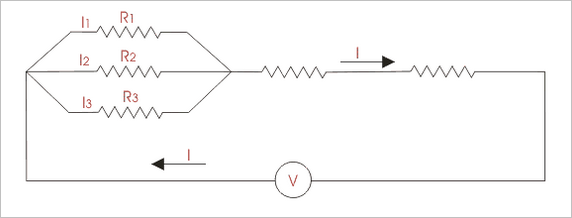
Series and Parallel Circuits Combined
Real circuits usually mix series and parallel parts rather than using only one arrangement.
A mixed series and parallel circuit is solved by applying Ohm’s law and the rules for series and parallel circuits to each part of the network.
Series and Parallel Circuit