

- Varmeter Definition: A varmeter is defined as an instrument used to measure the reactive power in an electrical circuit.
- Single Phase Varmeter: In single-phase varmeters, the pressure coil voltage leads the coil current by 90 degrees, and the reading represents the reactive power.
- Polyphase Varmeter: Polyphase varmeters use two auto-transformers in an open delta configuration to create a phase shift for measuring reactive power.
- Reactive Power Measurement: Reactive power is crucial to measure because high reactive power leads to a poor power factor and increased losses.
- Harmonics Limitation: Single-phase varmeters may not measure reactive power accurately if harmonics are present in the circuit.
An instrument that measures reactive power is called a varmeter. For single-frequency sinusoidal voltage and current, reactive power is Q = VI sin φ, where V and I are rms values and φ is their phase difference.
Reactive power is measured in volt-amperes reactive, or var. For a given active-power transfer and voltage, a larger reactive-current component increases apparent power and line current. That can reduce the electrical power factor and increase resistive losses. Historical electromechanical varmeters can be grouped as
- Single phase varmeters
- Polyphase varmeters.
The circuits below explain the ideal sinusoidal operation of single-phase and polyphase electrodynamometer varmeters.
Single Phase Varmeter
In a single-phase electrodynamometer varmeter, the current coil carries the load current. A highly inductive pressure-coil circuit makes its current lag the applied voltage by approximately 90 degrees at the design frequency. If the load current differs from the voltage by φ, the average operating torque is proportional to VI sin φ.
The scale can therefore indicate reactive power for the rated frequency and sinusoidal waveform.
The protected image below shows the historical single phase varmeter circuit.
The phasor diagram uses the supply voltage as its reference axis.
At the rated frequency, the pressure-coil current is designed to lag that voltage by about 90o. Coil resistance, inductance and frequency determine the actual phase shift and calibration.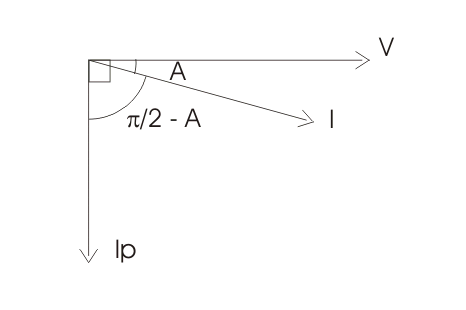
This analogue phase-shift method can have error when frequency differs from its rating or when voltage and current contain harmonics. For distorted waveforms, reactive-power definitions and calculations are not limited to one VI sin φ value. A power analyser must state its selected method, bandwidth and harmonic treatment.
Polyphase Varmeter
The illustrated polyphase instrument uses two tapped auto-transformers in an open-delta phase-shifting network. The current coils of the two wattmeter elements are connected in lines 1 and 3. The phase-shifting connections make each element respond to a reactive-power component rather than ordinary active power.
The pressure-coil connections are shown below.
In this historical network, the auto-transformers have taps marked 57.7%, 100% and 115.4% of the reference voltage. Those values define the illustrated vector construction and depend on its tap reference. Other networks and transformers can use different ratings. The connections apply a voltage to each pressure coil that is intended to be equal in magnitude to the relevant line voltage and displaced by 90o. The second element uses the corresponding 90o shift. With the specified phase sequence, polarity, frequency and calibration, the algebraic sum of the two element readings represents total reactive power for the circuit supported by that instrument. Reversing a connection or phase sequence can change the sign or reading.
A single wattmeter can be used to derive reactive power only for a balanced, sinusoidal three-phase circuit with the specified phase sequence. The connection is shown below.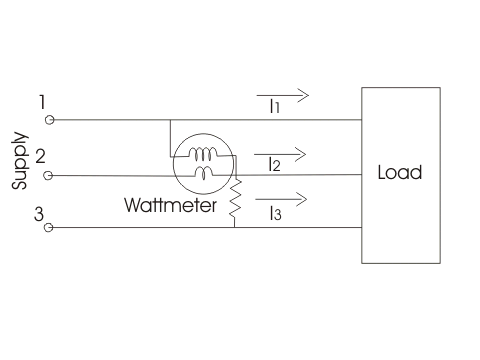
The current coil is in one line and the pressure coil is connected across the other line-voltage pair as shown. The wattmeter indication has magnitude V_L I_L sin φ for the correct connection. Total three-phase reactive power is Q = √3 times that indication, with sign determined by polarity and phase sequence. An unbalanced load requires another measurement method.


