

- Temperature Coefficient of Resistance Definition: The temperature coefficient of resistance measures how a material’s electrical resistance changes with temperature.
- Formula for Resistance Change: The resistance at different temperatures is calculated using the initial resistance, temperature change, and the temperature coefficient.
- Effect on Metals: Metals have a positive temperature coefficient, meaning their resistance increases with temperature.
- Effect on Non-Metals: Non-metals and semiconductors have a negative coefficient, meaning their resistance decreases with temperature.
- Material-Specific Coefficients: Different materials have specific temperature coefficients, which determine how they respond to temperature changes.
As explained in resistance variation with the temperature, the electrical resistance of a material can change when its temperature changes. The size and direction of that change depend on the material and the temperature range.
What is the Temperature Coefficient of Resistance?
Consider a conductor with resistance R0 at 0oC and resistance Rt at toC.
The linear resistance-temperature relation gives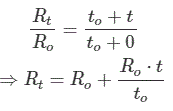
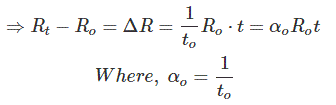
Here, αo is the temperature coefficient of resistance referenced to 0oC.
Within the range where this linear approximation is valid, the change in electrical resistance depends mainly on three factors:
- the resistance at the initial temperature,
- the change in temperature, and
- the temperature coefficient of resistance, αo.

The value of αo differs among materials, so equal temperature changes do not produce equal resistance changes in every material.
Under the linear model, the temperature coefficient of resistance at 0oC is the reciprocal of the material’s extrapolated zero-resistance temperature.
Some materials increase in resistance as they get hotter, while others have an electrical resistance that decreases as temperature rises.
In a metal, higher temperature increases vibration in the crystal lattice. Conduction electrons then undergo more frequent scattering.
This additional scattering impedes current flow, so most pure metals have a positive temperature coefficient and their resistance rises with temperature.
In many semiconductors, however, heating increases the number of mobile charge carriers.
Thermal energy can excite electrons that were previously bound within the crystal, creating additional mobile electrons and holes.
As temperature rises, more electrons gain enough energy to cross the band gap from the valence band into the conduction band.
The extra charge carriers can reduce resistance as temperature rises. Pure silicon, germanium and carbon therefore have a negative temperature coefficient of resistance near room temperature. Semiconductor behaviour is generally nonlinear and also depends on doping, so one constant coefficient does not describe every temperature range.
If resistance changes only slightly over the operating range, the coefficient is close to zero. Constantan and manganin are alloys made to have very small temperature coefficients.
The coefficient is defined at a reference temperature. Its value can also vary with temperature, material purity and physical condition.
When 0oC is the reference temperature, the coefficient is written as αo. In the linear model, it equals the reciprocal of the extrapolated zero-resistance temperature.
A coefficient referenced to another temperature is not generally equal to αo at 0oC. The conversion below follows from the same linear resistance-temperature model and should be used only across a range where that model remains suitable.
If the temperature coefficient at t°C is αt, it can be calculated from:
The coefficient at t2oC can also be written in terms of its value at t1oC: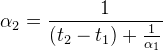
Review the Concept of Temperature Coefficient of Resistance
The electrical resistance of conductors such as silver, copper, gold and aluminum is affected by the scattering of conduction electrons within the material.
Higher temperature increases lattice vibration and electron scattering. The resistance of most metallic conductors therefore rises as their temperature rises.
Suppose a conductor has resistance R1 at t1oC and resistance R2 at t2oC.
For a positive coefficient, the resistance increase (R2 – R1) caused by the temperature increase (t2 – t1) depends on the following quantities:
Combining these terms gives:

Here, α is the material’s temperature coefficient of resistance at the reference temperature t1oC.
Rearranging Equation (1) gives:
If the resistance and temperature coefficient of resistance are known at a reference temperature, Equation (2) estimates the resistance at another temperature within the material’s linear range.
The Temperature Coefficient of Resistance of some Materials or Substances
Representative temperature coefficient of resistance values near 20oC are listed below. Exact values can vary with purity, composition, physical condition and temperature range.
| Sl. No. | Material/Substances | Chemical Symbol/Chemical composition | Temperature coefficient of resistance /oC (at 20oC) |
| 1 | Silver | Ag | 0.0038 |
| 2 | Copper | Cu | 0.00386 |
| 3 | Gold | Au | 0.0034 |
| 4 | Aluminum | Al | 0.00429 |
| 5 | Tungsten | W | 0.0045 |
| 6 | Iron | Fe | 0.00651 |
| 7 | Platinum | Pt | 0.003927 |
| 8 | Manganin | Cu = 84% + Mn = 12% + Ni = 4% | 0.000002 |
| 9 | Mercury | Hg | 0.0009 |
| 10 | Nichrome | Ni = 60% + Cr = 15% + Fe = 25% | 0.0004 |
| 11 | Constantan | Cu = 55% + Ni = 45% | 0.00003 |
| 12 | Carbon | C | – 0.0005 |
| 13 | Germanium | Ge | – 0.05 |
| 14 | Silicon | Si | – 0.07 |
| 15 | Brass | Cu = 50 – 65% + Zn = 50 – 35% | 0.0015 |
| 16 | Nickel | Ni | 0.00641 |
| 17 | Tin | Sn | 0.0042 |
| 18 | Zinc | Zn | 0.0037 |
| 19 | Manganese | Mn | 0.00001 |
| 20 | Tantalum | Ta | 0.0033 |
Effect of Temperature on Temperature Coefficient of Resistance of a Material
A material’s temperature coefficient of resistance can change with temperature.
If αo is the material’s temperature coefficient at 0oC, Equation (2) gives its resistance at toC:
Here, R0 is the material’s resistance at 0oC.
Similarly, if the material’s temperature coefficient at toC is αt, Equation (2) gives its resistance at 0oC:
Here, Rt is the material’s resistance at to C.
Combining Equations (3) and (4) gives: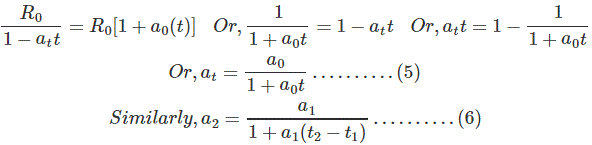
Here, α1 and α2 are the material’s temperature coefficient of resistance values at t1oC and t2oC, respectively.
Equation (6) converts a known temperature coefficient of resistance at one reference temperature to another reference temperature within the assumed linear range.
Most pure conducting metals have a positive temperature coefficient of resistance. Their resistance therefore rises as temperature rises.
Many semiconductors have a negative temperature coefficient over a specified range, so their resistance falls as temperature rises. The value and its temperature range depend strongly on the material and its doping.
Alloys such as manganin and constantan have a very small temperature coefficient of resistance.
Their resistance changes only slightly as temperature changes.
This stability makes these alloys useful in precision resistors and measuring instruments.


