

- Rotor Resistance Control Definition: Rotor resistance control is defined as a method to manage the speed of an induction motor by adjusting the resistance in its rotor circuit.
- Induction Motor Basics: An induction motor, commonly used globally, operates on the principle that the motor speed can be adjusted by changing the rotor’s resistance.
- Speed Control of Induction Motor: Speed control is crucial for applications requiring variable motor speeds and can be achieved efficiently through modern electronics.
- Technology Utilized: Techniques like Pulse Width Modulation (PWM) offer precise control over the rotor resistance, enhancing the motor’s performance and energy efficiency.
- Operational Limitations: Although effective for varying motor speed, the method incurs energy losses and heat generation, making it unsuitable for continuous high-demand applications.
A poly phase induction motor develops torque from the difference between synchronous field speed and rotor speed. Most induction motors use a squirrel-cage rotor, but external rotor-resistance control is available only on wound-rotor or slip-ring machines because their rotor terminals are accessible. In this method, the speed control of poly phase induction motor is obtained by adding resistance to the rotor circuit. The added resistance increases the operating slip for a given load torque, so the rotor runs more slowly.
A traditional controller uses a three-phase rheostat connected through the slip rings. A static controller replaces manual adjustment with a rectifier, chopper and power electronics devices. This gives smoother electrical control, but the external resistor still dissipates slip power as heat.
Basic Concept
For a simplified induction-motor equivalent circuit, the torque equation is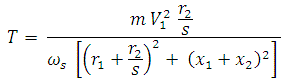
Under the normal low-slip approximation r2/s≫ r1, x1, the equation reduces to
For approximately constant torque in the normal operating region, this form shows that slip is approximately proportional to effective rotor resistance. Increasing resistance raises slip and lowers rotor speed. External resistance can be connected only to a wound rotor induction motor with accessible rotor terminals.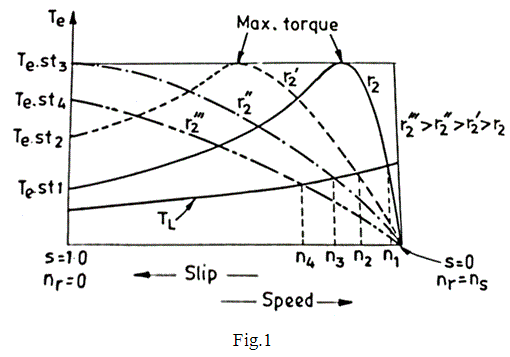
Figure 1 shows how rotor resistance shifts the motor’s torque-speed curve.
Near the normal operating point, torque changes approximately linearly with slip. For a fixed load curve, the operating speed can move from n1 to n4 as resistance increases. In the simplified constant-voltage model, maximum torque remains approximately constant while its position moves to higher slip. The curve marked r2” places that maximum near starting. Starting torque rises until the maximum-torque point reaches standstill; adding still more resistance reduces starting torque.
Characteristics
Under the simplified constant-voltage model, maximum torque is approximately independent of rotor resistance, as shown by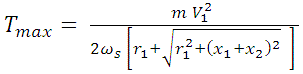
This speed-control method is most suitable for starting, intermittent duty or a limited period of low-speed operation because losses increase with slip.
Its practical drawbacks include:
- If the rheostat is not adjusted equally in all three phases, it can unbalance the rotor currents.
- The external resistors dissipate rotor slip power as heat, reducing drive efficiency and increasing cooling needs.
- A large machine needs a physically large resistor bank with an adequate power and thermal rating, so the equipment is not readily portable.
- Slip rings, brushes and the rheostat require inspection and maintenance, which adds operating cost.
- Manual rheostat adjustment does not readily support industrial automation, although a correctly designed electronic controller can automate the resistance change.
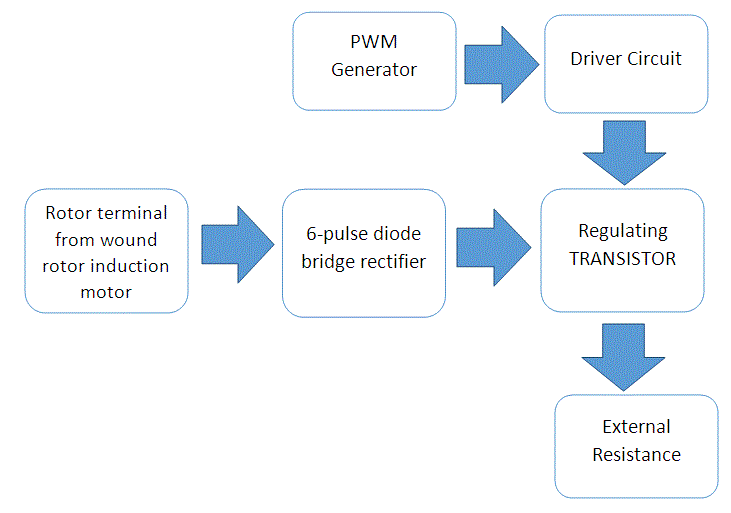
Pulse Width Modulation (PWM), also called Pulse Duration Modulation (PDM) in this application, can replace manual rheostat adjustment when used with a bridge rectifier and a switching transistor.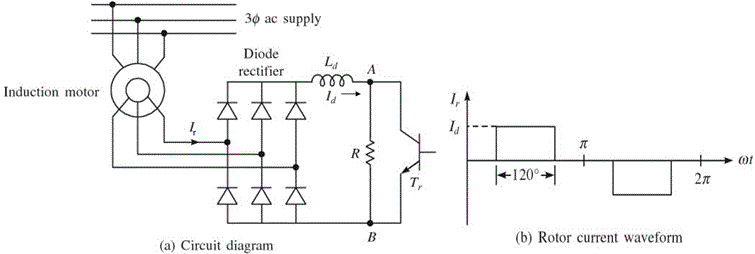
In figure (a), the wound rotor’s three-phase output is rectified by a diode bridge rectifier. The dc output feeds a fixed resistor R in parallel with a semiconductor switching transistor Tr. Changing the transistor duty ratio changes the effective resistance RAB across terminals A and B. The transistor Tr bypasses the resistor while on and sends dc-link current through it while off. An Inductance is added to smooth ripple and help keep dc-link current Id continuous. Under the continuous-current approximation shown in figure (b), the rms value of rotor current is
The resistance between A and B is nearly zero while the transistor is on and R while it is off. Its average switched value is therefore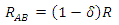
Here, δ is the transistor duty ratio.
The Electrical power dissipated by RAB, expressed per rotor phase in this model, is
This result refers the dc-side resistance to each rotor phase as an added resistance of 0.5(1-δ)R. The factor depends on the shown rectifier topology and the assumption of nearly continuous dc-link current.
Thus the model’s total effective rotor resistance varies from Rr at δ = 1 to the base rotor resistance plus 0.5R at δ = 0.
Advantages of Speed Control of Induction Motor Using Static Devices
- The duty ratio provides smooth, stepless adjustment of effective rotor resistance.
- The electronic controller can operate from a close loop control signal instead of manual rheostat adjustment.
- Semiconductor switching gives a quick control response within the motor and controller ratings.
- A correctly designed three-phase rectifier and power electronics devices avoid the phase mismatch caused by unequal rheostat adjustment.
Conclusion
Rotor-resistance control provides below-synchronous speed adjustment and can improve the starting torque of a wound-rotor induction motor. It also converts slip power into heat, so efficiency falls as resistance and slip increase. The method is therefore often used for starting or intermittent low-speed duties such as overhead cranes. Continuous operation is possible only within the motor, rectifier, transistor, resistor and cooling ratings; a variable-frequency drive or slip-power-recovery system may be better for sustained efficient speed control. Rotor and dc-link circuits can carry hazardous voltage and current, so the controller must follow the motor and drive manufacturers’ data and site electrical-safety requirements.


