

- Torque Equation Definition: Torque in a three-phase induction motor is calculated based on rotor current, magnetic flux, and power factor.
- Rotor Current: Rotor current is essential for generating torque and is influenced by the rotor’s induced EMF and impedance.
- Starting Torque: When the motor starts, the torque equation of a DC motor shows that starting torque, also known as standstill torque, is maximum because slip equals one.
- Maximum Torque Condition: Maximum torque is achieved when slip equals the ratio of rotor resistance to rotor reactance, highlighting the importance of rotor design.
- Slip and Speed: The slip value is critical in determining the motor’s speed and efficiency, with lower slip values generally leading to higher efficiency.
Torque in a three phase induction motor depends on three quantities:
rotor current, the flux that cuts the rotor and induces emf in the induction motor rotor, and the rotor power factor.
The torque equation from those quantities is:
Where T is the torque produced by the induction motor,
φ is flux responsible for producing induced emf,
I2 is rotor current,
cosθ2 is the power factor of rotor circuit.
The flux φ produced by the stator is proportional to stator emf E1 when frequency is held constant.
i.e φ ∝ E1
The transformation ratio K is the ratio of secondary voltage (rotor voltage at standstill) to primary voltage (stator voltage).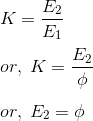
Rotor current I2 is the rotor induced emf under running conditions, sE2, divided by the rotor impedance Z2,
and total impedance Z2 on rotor side is given by ,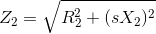
Putting this value in above equation we get,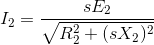
s = slip of induction motor
Rotor power factor is rotor resistance divided by rotor impedance:
Putting the value of flux φ, rotor current I2, power factor cosθ2 in the equation of torque we get,
Combining like terms we get,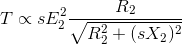
Removing the proportionality constant we get,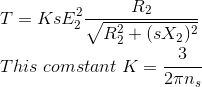
Where ns is synchronous speed in rps, ns = Ns / 60. So the equation of torque becomes,
How the constant K is derived in the torque equation.
In a three phase induction motor, the rotor also has copper loss. That rotor copper loss is written here as
Pc = 3I22R2
In this derivation R² means rotor resistance R2, not R squared. Rotor current is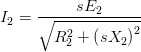
Substitute this value of I2 in the equation of rotor copper losses, Pc. So, we get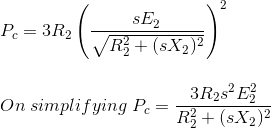
The ratio of P2 : Pc : Pm = 1 : s : (1 – s)
Where P2 is the rotor input,
Pc is the rotor copper losses,
Pm is the mechanical power developed.
Substitute the value of Pc in above equation we get,
On simplifying we get,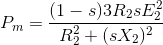
The mechanical power developed Pm = Tω,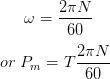
Substituting the value of Pm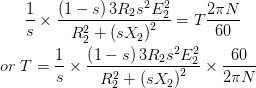
We know that the rotor speed N = Ns(1 – s)
Substituting this value of rotor speed in above equation we get,
Ns is speed in revolution per minute (rpm) and ns is speed in revolution per sec (rps) and the relation between the two is
Substitute this value of Ns in above equation and simplifying it we get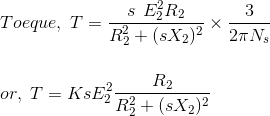
Comparing both the equations, we get, constant K = 3 / 2πns
Working Principle of Three Phase Induction Motor – Video
Equation of Starting Torque of Three Phase Induction Motor
Starting torque is the torque produced by an induction motor at switch-on. At that instant rotor speed N is zero and slip s is 1.
Put s = 1 in the running torque equation to get starting torque:
The starting torque is also known as standstill torque. It equals maximum torque only when R2 = X2.
Maximum Torque Condition for Three-Phase Induction Motor
In the equation of torque,
Rotor resistance, rotor inductive reactance and synchronous speed stay constant. The supply voltage to the three phase induction motor is usually the rated value, so stator emf is constant. The transformation ratio is rotor emf divided by stator emf, so rotor standstill emf is then constant too.
To find a maximum, differentiate the torque with respect to slip s and set the derivative to zero.
So, for torque to be maximum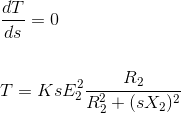
Differentiate by the quotient rule. After the derivative is set to zero we get,
Neglecting the negative value of slip we get
So when slip s = R2 / X2, the torque is maximum. That slip is the breakdown (maximum-torque) slip, rotor resistance divided by rotor reactance.
NOTE: At starting S = 1, so starting torque is largest when rotor resistance equals rotor reactance.
Equation of Maximum Torque
The equation of torque is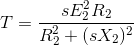
The torque will be maximum when slip s = R2 / X2
Substituting the value of this slip in above equation we get the maximum value of torque as,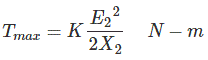
On a wound-rotor machine, extra resistance can be added in the rotor at start and cut out as the motor speeds up. A cage rotor has no slip rings for that resistor.
Conclusion
From the maximum-torque equation:
- The maximum torque is directly proportional to the square of rotor induced emf at standstill.
- The maximum torque is inversely proportional to rotor reactance.
- The maximum torque does not depend on rotor resistance. The slip at which that peak occurs does.
- The slip at which maximum torque occurs depends on rotor resistance, R2. By varying rotor resistance, that peak can be placed at a chosen slip.


