

- Parallel RLC Circuit Definition: A parallel RLC circuit consists of a resistor, inductor, and capacitor connected parallel to a voltage source, with each component maintaining the same voltage across it.
- Voltage and Current Relationship: The voltage across each component in a parallel RLC circuit is constant, whereas the current varies according to each component’s impedance.
- Kirchhoff’s Law in Action: In parallel RLC circuits, Kirchhoff’s current law confirms that the sum of currents entering a node is equal to the sum leaving, crucial for understanding circuit flow.
- Understanding Admittance: In parallel RLC circuits, total admittance is calculated by adding the admittance values of individual components, which helps simplify analysis.
- Resonance Characteristics: At resonance, a parallel RLC circuit’s impedance is at its maximum, and the circuit acts purely resistive, achieving a unity power factor.
In an ideal parallel RLC circuit, the resistor, inductor and capacitor form separate branches across the same sinusoidal voltage supply, VS. The branch voltage is therefore the same, while each branch draws a different current.

In a series RLC circuit, the same current flows through all three components. In a parallel RLC circuit, the source current divides among the branches according to their admittances. This makes admittance the most direct quantity to use for analysis.
The source current, IS, is the phasor sum of the resistive, inductive and capacitive branch currents. Their magnitudes cannot be added as ordinary numbers because the currents do not all have the same phase.
Applying Kirchhoff’s current law at the source node gives the following phasor-current relationship:
Phasor Diagram of Parallel RLC Circuit
Let V be the supply-voltage phasor.
IS is the total source-current phasor.
IR is the resistor-branch current.
IC is the capacitor-branch current.
IL is the inductor-branch current.
θ is the phase angle of the source current relative to the supply voltage.
Use the common branch voltage as the phasor reference. The currents IR, IC and IL are drawn relative to V. The resistor current IR is in phase with V. An ideal capacitor current leads V by 90o, so IC is above the reference by 90o. The ideal inductor current IL lags V by 90o, so IL is below the reference by 90o. The phasor sum of IR, IC and IL gives the source current IS. When the capacitor current is larger than the inductor current, the source current leads and the circuit is net capacitive. When the inductor current is larger, the source current lags and the circuit is net inductive.
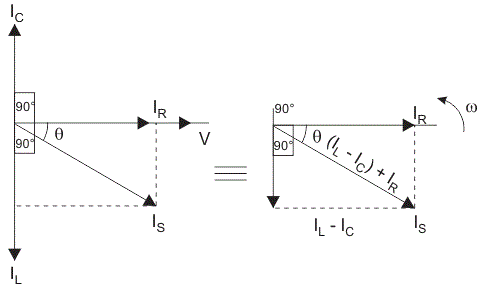
The reactive branch currents oppose each other, so their net component is the difference between the capacitor and inductor currents. Combining that component with the resistor current gives the magnitude of the source current:
Impedance of Parallel RLC Circuit
The phasor diagram gives the following source-current magnitude: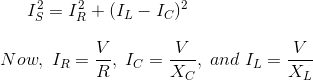
Substituting the ideal values of IR, IC and IL gives: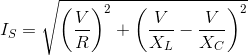
Dividing by the common voltage and simplifying gives the impedance magnitude:
In complex form, the total admittance is Y = 1/R + j(ωC – 1/(ωL)), and the input impedance is Z = 1/Y. Adding branch admittances first avoids the repeated reciprocal calculations needed when parallel impedances are combined directly.
Admittance Triangle of Parallel RLC Circuit

Admittance has a real part called conductance (G), where G = 1/resistance (R), and an imaginary part called susceptance (B). Susceptance is related to reactance (X), but its sign matters: capacitive susceptance is positive and inductive susceptance is negative. The admittance triangle shows the vector relationship among G, B and the magnitude of Y.
Resonance in Parallel RLC Circuit
For the ideal parallel RLC circuit, resonance occurs when the magnitude of inductive reactance equals the magnitude of capacitive reactance, so the inductive and capacitive susceptances cancel. The resonant angular frequency is ω0 = 1/√(LC). At this frequency, input impedance is maximum and source current is minimum, not zero, because the resistor branch still draws current. The input is purely resistive and has unity displacement electrical power factor. Below resonance the ideal circuit is net inductive; above resonance it is net capacitive. Real inductor resistance and source or load impedance change the peak impedance and can shift the practical resonant frequency.


