

- Magnetic Circuit Definition: A magnetic circuit is defined as a closed path in which magnetic flux circulates, using permanent magnets or electromagnets and confined by ferromagnetic materials.
- Magneto Motive Force (MMF): MMF is the force that creates magnetic flux in a circuit, similar to how voltage creates current in an electrical circuit.
- Air Gap Purpose: The air gap in a magnetic circuit is used to prevent core saturation, which allows higher magnetic field strength and increased saturation current.
- Magnetic Reluctance: Magnetic reluctance is the resistance to magnetic flux, determined by the circuit’s length, cross-sectional area, and material permeability.
- Effects of Air Gap: The air gap influences the magnetic circuit by adding reluctance, causing flux fringing, and storing magnetic energy due to its low permeability.
Magnetic Circuit
A magnetic flux path through a core and any gaps forms a magnetic circuit. The magnetic field is represented by flux lines that close on themselves. A Magnetic Circuit may be driven by a permanent magnet or a coil, while a core made from ferromagnetic materials provides a low-reluctance part of the path.
Magneto Motive Force (MMF)
Magneto Motive Force (MMF) is the magnetic potential that drives flux around a magnetic circuit. A coil with N turns carrying electric current I supplies MMF = NI, measured in ampere-turns.
MMF plays a role analogous to electromotive force or voltage, while reluctance limits flux as resistance limits current. If the flux divides between branches, the paths form a parallel magnetic circuit. A single closed flux path forms a series magnetic circuit.
Air Gap in Magnetic Circuit
An air gap adds reluctance to a magnetic circuit. It lowers effective permeability and inductance, but allows a gapped inductor to carry more current before the core reaches saturation. Air is an electrical insulator; it does not insulate magnetic flux. A non-magnetic spacer, gas or vacuum can form the gap.
In a transformer, an air gap does not correct excessive applied volt-seconds or a flux imbalance. Core area, turns, frequency and drive waveform still have to keep peak flux below the material limit.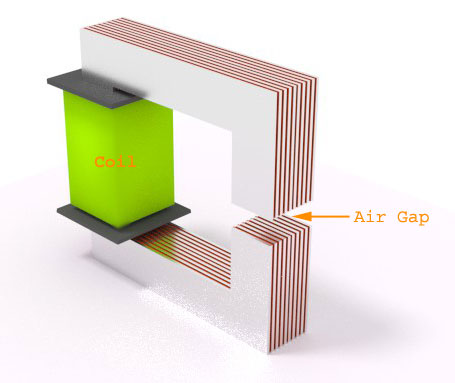
The gap is a low-permeability section in series with the core, so the same main flux crosses both sections. Mechanical clearance in motors and actuators also lets parts move without contact.
Magnetic resistance is called reluctance. Reluctance rises with path length and falls as cross-sectional area or permeability increases. For a uniform section, it is the path length divided by permeability and area.
Magnetic Reluctance (R) = L/Aμμo
L = Length of circuit
A = Cross-sectional area of the circuit
μ = Permeability
μo = Relative magnetic permeability
A gap is used when DC bias or stored energy would otherwise drive the core toward magnetic saturation. The gap changes the effective B-H slope and raises the current required to reach the core’s flux-density limit. It lowers inductance for the same turns and increases the usable current range of the magnetic inductor.
Most flux follows the intended core path, while a smaller part closes through surrounding air as leakage flux. At a discrete gap, field lines spread into nearby air. This fringing makes the gap flux density non-uniform and can increase winding loss or radiated field near the gap. A wider gap generally produces more fringing. The high-permeability core guides flux, while most of the inductor’s magnetic energy is stored in the low-permeability gap. The required MMF is therefore dominated by the gap before core saturation.


