- Electrical Impedance Definition: Electrical impedance is defined as the measure of opposition that a circuit presents to a current when a voltage is applied, involving both resistance and reactance.
- Impedance vs. Resistance: Unlike resistance, impedance varies with the frequency of the applied voltage and has both magnitude and phase.
- Reactance Effects: In an inductive circuit, current lags the voltage by 90 degrees, while in a capacitive circuit, current leads the voltage by 90 degrees.
- Series and Parallel Circuits: Impedance in series and parallel RL and RC circuits can be calculated using specific formulas that combine resistance and reactance.
- Practical Applications: Understanding impedance is crucial for designing and analyzing circuits in AC systems where both resistance and reactance affect performance.
What is Electrical Impedance?
Electrical impedance Z is the complex ratio of voltage to current at a stated frequency. In sinusoidal steady-state analysis, the voltage and current are represented by phasors, so Z = V/I in ohms. This extends Ohm’s law to linear alternating current circuits and records both the magnitude ratio and phase difference.
An ideal electrical resistance has impedance R with zero phase angle. Inductive and capacitive terms make impedance frequency dependent. Real components also contain parasitic elements, so their measured impedance depends on the circuit’s frequency, signal level, bias and temperature.
For ideal components in sinusoidal steady state, current lags voltage by 90 degrees in a pure inductor, leads voltage by 90 degrees in a pure capacitor and is in phase in a pure resistor. A direct current circuit needs a separate steady-state or transient analysis. At DC steady state, an ideal inductor approaches a short circuit and an ideal capacitor approaches an open circuit; the blanket statement that impedance equals resistance is therefore not valid for every network.
In a practical circuit, inductive reactance, capacitive reactance and resistance combine as complex quantities. The sign and size of the net reactance determine whether current leads or lags the applied voltage. Component losses and parasitic elements can alter both parts of the measured impedance.
For a series resistance and net reactance in sinusoidal steady state, impedance combines reactance and resistance. The magnitude of impedance is represented as: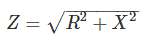
Here R is resistance and X is signed reactance, both measured in ohms.
The phase angle between voltage and current is
Inductive reactance is positive and capacitive reactance is negative under the usual engineering sign convention.
In rectangular complex form, impedance is written as follows.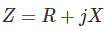
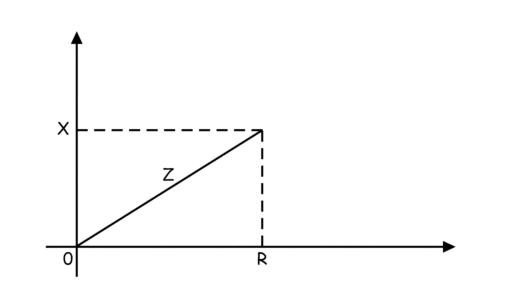
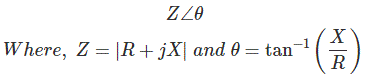
The real part is resistance R and the imaginary part is reactance X. The same impedance can be written in polar form as magnitude |Z| and phase angle θ.
Apply sinusoidal voltage Vsinωt to an ideal inductor with inductance L henry.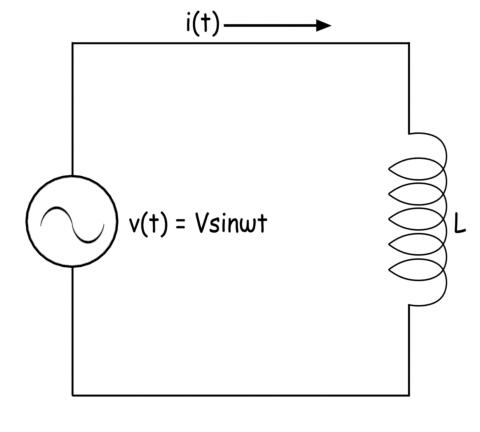
The current through the inductor is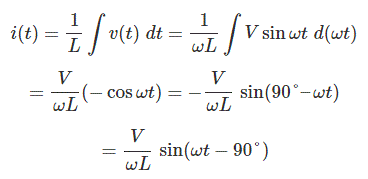
For positive angular frequency ω, ZL = jωL and the current lags the applied voltage by 90°.
Apply the same sinusoidal voltage Vsinωt to an ideal capacitor with capacitance C farad.
The current through the capacitor is
For positive angular frequency ω, ZC = 1/(jωC) and the current leads the applied voltage by 90°.
Apply the same voltage to an ideal resistance R ohm.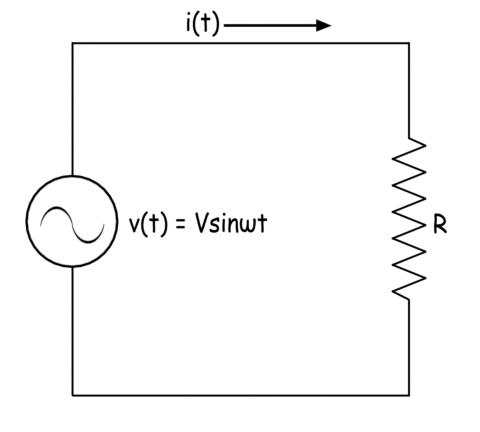
The current through the resistance is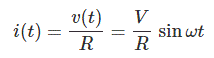
Because ZR = R is real, the current and applied voltage are in phase.
Impedance of a Series RL Circuit
In a series RL circuit, resistance R and ideal inductance L carry the same current. The inductor impedance is jωL, so the complex impedances add.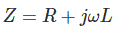
The magnitude of the series RL impedance is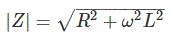
Impedance of a Series RC Circuit
For resistance R in series with ideal capacitance C, the capacitor impedance is 1/(jωC) = −j/(ωC). Series impedances add as shown.
The magnitude of the series RC impedance is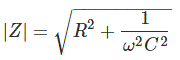
Impedance of a Parallel RL Circuit
When a resistor and inductor are connected in parallel, their branch admittances add: Y = 1/R + 1/(jωL). Equivalent impedance is the reciprocal of that total admittance.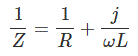
The resulting parallel RL circuit impedance is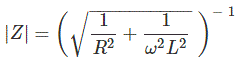
Impedance of a Parallel RC Circuit
For an ideal capacitor and resistor in parallel, the admittances add: Y = 1/R + jωC. This form keeps the capacitive sign explicit.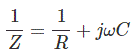
The equivalent parallel RC impedance is the reciprocal of Y.
Impedance of a Series RLC Circuit
For ideal resistors, capacitors and inductors in series, the impedances add. Inductive reactance is positive and capacitive reactance is negative, so they partially or fully cancel at a given frequency. The series RLC circuit impedance is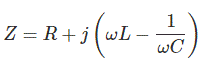
Impedance of a Parallel RLC Circuit
For an ideal resistor, capacitor and inductor in parallel, calculate total admittance by adding the three branch admittances. The equivalent parallel RLC circuit impedance is the reciprocal of that sum.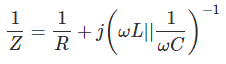
Polar Representation of Impedance