

- Weston Frequency Meter Definition: The Weston frequency meter measures frequency by using the deflection of a magnetic needle caused by perpendicular currents in two coils.
- Construction: It includes two coils, three inductors, and two resistors arranged in a specific configuration.
- Working Principle: The meter works by detecting changes in the magnetic field strength, which moves the needle towards the stronger magnetic field.
- Circuit Diagram: The diagram shows Coil 1 with a series resistor (R1) and reactance coil (L1), and Coil 2 with a series reactance coil (L2) and parallel resistor (R2).
- Behavior with Frequency Changes: The needle moves left with higher frequencies and right with lower frequencies, reflecting the change in the current through the coils.
The Weston type frequency meter is an electromechanical ratio-type instrument. When current flows through its two perpendicular coils, the coils produce magnetic fields that act on a soft-iron needle. The needle settles according to the relative strength of each magnetic field, and the pointer position is calibrated in hertz. The circuit uses two coils, three inductors, and two resistors.
Given below is the circuit diagram for the weston type frequency meter.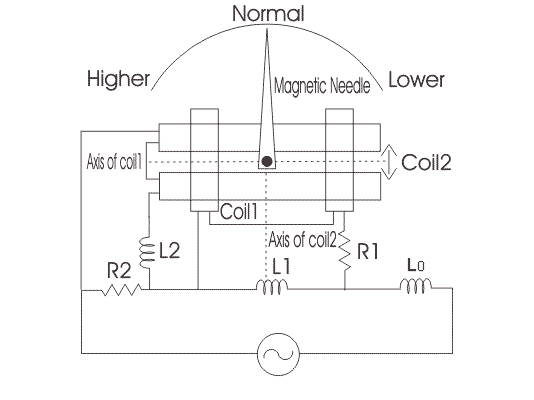
The axes of the two coils are marked in the diagram. At the reference frequency, the pointer rests at the normal mark, shown at 45o on this particular scale. Coil 1 has resistor R1 and reactance coil L1. Coil 2 has reactance coil L2 and resistor R2. Inductor L0 is connected in series with the supply to reduce the instrument’s response to higher harmonics. It limits harmonic error but does not make the reading independent of waveform distortion.
When rated voltage is applied at the reference frequency, the pointer rests at the normal mark. A frequency change alters the balance between the two coil fields, so the pointer moves towards the higher or lower marking on the scale. The physical direction depends on the scale layout and should be read from the instrument markings.
The operating balance comes from the frequency-dependent impedance of the resistor-inductor network. The inductive reactance and associated voltage drop change with frequency. As the applied frequency increases, the voltage distribution across the network containing inductor L1 changes. The complete network then redistributes current so that one coil field becomes stronger and the other becomes weaker.
The pointer follows the resultant field towards the higher-frequency part of the calibrated scale. When frequency falls, the current ratio changes in the opposite direction and the pointer moves towards the lower-frequency part.


