- Soft Magnetic Materials Definition: Soft magnetic materials are defined as materials that can be easily magnetized and demagnetized, requiring only small energy for these processes.
- Properties: These materials have high permeability, low coercive force, low hysteresis loss, small remanent induction, and high saturation magnetization.
- Examples: Examples include pure iron, silicon iron alloys, and nickel iron alloys (Hypernik), each with specific uses based on their properties.
- Hysteresis Loop: The hysteresis loop for soft magnetic materials is small, indicating minimal energy loss during magnetization and demagnetization.
- Applications: Soft magnetic materials are used in various AC and DC applications such as transformers, electric motors, magnetic shielding, and electromagnetic pole-pieces.
Soft magnetic materials magnetise and demagnetise with little energy. The quantities used to describe them are below.
- Remanent Induction:
It is actually the value of induction which residue, once the material is magnetized and then the magnetizing field is decreased to zero. It is denoted by Br. - Coercive Force:
It is the amount of negative magnetic field which is essential to decrease the remanent induction to zero. It is denoted by Hc. - The total area of the hysteresis loop = the energy which is dissipated when a material of unit volume is magnetized during a cycle of operation.
- Growth of domains and rotation of domains take place during magnetization. Both can be reversible or irreversible.
- Magnetic materials are mainly classified (based on the magnitude of coercive force) into two- hard magnetic materials and soft magnetic materials,

Soft magnetic materials can be easily magnetized and demagnetized because they require very little energy. Their coercive field is very small, less than 1000 A/m.
Their domains grow readily. The usual job is to raise flux or to give a path for flux from an electric current. The figures that matter are permeability, coercive force, electrical conductivity and saturation magnetisation.
Hysteresis Loop
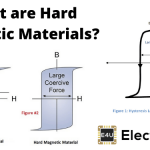
It is actually a loop which is traced by the material which is magnetized when subjected to an alternating magnetic field. For soft magnetic materials, the loop will be of small area (figure 2). So, hysteresis loss is minimum.
Properties of Soft Magnetic Materials
- Utmost permeability.
- Slight coercive force.
- Small hysteresis loss.
- Small remanent induction.
- High saturation magnetisation
Some of the significant soft magnetic materials are the following:
Pure Iron
Pure iron contains very little carbon (> 0.1%). It can be refined for high permeability and low coercive force, making it a soft magnetic material. However, it has low resistivity, leading to eddy current loss at high flux densities. Therefore, it is used in low-frequency applications like electrical instrument components and electromagnet cores.
Silicon Iron Alloys
This material is most commonly used soft magnetic material. The addition of silicon will make increase in permeability, low eddy current loss due to increase in resistivity, low hysteresis loss. They are used in electrical rotating machine, electromagnet, electrical machine and transformer.
Nickel Iron Alloys (Hypernik)
Nickel iron alloys (Hypernik) are used in communication equipment like audio transformers, recording heads, and magnetic modulators due to their high initial permeability in weak fields. They also have low hysteresis and eddy current losses.Grain oriented sheet steel: used to make transformer cores.
Mu-metal: used in miniature transformers meant for circuit applications.
Ceramic magnets: used for making memory devices for microwave devices and computer.
Application of Soft Magnetic Materials
There are mainly two sorts of applications for soft magnetic materials – AC application and DC applications.
| DC Application | AC Application |
| The material is magnetised to carry out an operation and demagnetised at the last part of the operation. | The material will be always in magnetised state throughout the time of operation. It is done by being magnetised in one direction to other as a continuous cycle. |
| For material selection, the main consideration is permeability.High permeability is required for good material. | For material selection, the main consideration is the energy loss in the system.The energy loss occurs because the material is cycled around the hysteresis loop. A good material should have small energy loss. |
| Used in field of magnetic shielding, electromagnetic pole-pieces, to activate the solenoid switch, permanent magnet uses this material to make a path for flux lines | Used in power supply transformer, DC-DC Converter, electric motors, for making a path for flux in permanent magnetic motors etc. |