

- Power System Stability Definition: Power system stability is defined as the ability of an electrical system to return to steady-state operation after a disturbance.
- Importance of Stability: Ensuring power system stability is crucial for maintaining a reliable and uninterrupted power supply.
- Synchronous Stability: This is the system’s ability to maintain synchronism between all generators and the grid during disturbances.
- Steady State Stability: Refers to the system’s ability to recover from small disturbances, such as minor load changes.
- Transient Stability: Refers to the system’s ability to remain stable after significant disturbances, like sudden load changes or faults.
Power system stability is part of electrical engineering analysis for generation, transmission and distribution networks. The system operating point changes continually as loads, generators, controls and network connections change.
Power system stability is the ability of an electric power system, from a given initial condition, to regain an operating equilibrium after a physical disturbance while the main system variables remain bounded and the system stays substantially intact. This definition covers more than a quick return to the original state because protection and controls may establish a different acceptable equilibrium.
Before connection in power plants, synchronous generators must be synchronised with the grid for phase sequence, frequency, voltage magnitude and phase angle. Once connected, rotor-angle stability describes whether synchronous machines remain in synchronism after a disturbance. A transfer limit is tied to a stated operating condition, contingency and acceptance criterion, not one fixed power value for every system state.
Stability studies for a power system are classified by the physical variable, disturbance size and time scale. Modern classifications include rotor-angle, voltage, frequency, converter-driven and resonance stability. The protected list and diagram below show an older three-part rotor-angle terminology.
- Steady state stability.
- Transient stability.
- Dynamic stability.
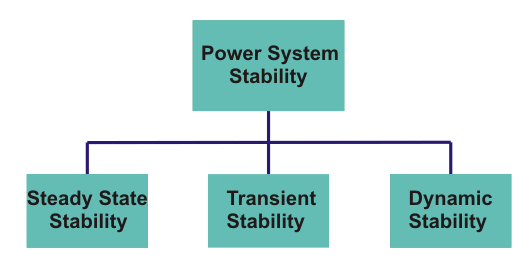
Steady State Stability of a Power System
The older term steady-state stability generally refers to rotor-angle behaviour under small or gradual changes. Modern work usually calls this small-signal rotor-angle stability. It examines whether small deviations decay or grow under the action of machine dynamics and controls such as an automatic voltage regulator.
As transfer increases, synchronising torque and oscillation damping can weaken. A machine or coherent group may then develop growing angle swings. A reported limit must identify the model, dispatch, network condition and damping criterion used to assess steady state stability. Thermal, voltage or protection limits may constrain transfer before an angle-stability limit is reached.
Transient Stability of a Power System
Transient stability of a power system is rotor-angle stability after a large disturbance. Examples include a short circuit, a major switching event or the trip of a line or generator. The study follows nonlinear machine motion during and after fault clearing to determine whether synchronism is maintained. A transient stability limit applies only to the specified initial condition, disturbance, clearing sequence and study criteria. Loss of synchronism is an unstable outcome, not a temporary stable condition.
Dynamic Stability of a Power System
Dynamic stability is a legacy term and should not mean that controls make an inherently unstable system stable. In older usage it describes small-disturbance behaviour with generator and control-system dynamics included. Modern studies normally use small-signal stability and state the oscillation mode, model and time window instead of applying a universal 10-to-30-second range.


