- Steady State Stability Definition: Steady state stability is the ability of a power system to remain in synchronism after small, gradual changes in operating conditions.
- Importance of Steady State Stability: It determines the maximum load a power system can handle without losing synchronism.
- Factors Affecting Stability: Important factors include mechanical power (Pm), electrical power (Pe), load angle (δ), inertia constant (H), and synchronous speed (ωs).
- Conditions for Stability: The system must maintain maximum power transfer without losing stability, keeping voltage (|Vt|) constant for each load.
- Improving Stability: Methods to improve stability include reducing reactance (X), increasing excitation voltage (|E|), and using parallel lines in high reactance transmission lines.
Power system stability is the capability of an interconnected network to return to its steady operating condition after a disturbance while every machine stays in synchronism. A synchronous generator tied to a grid illustrates power system stability: the generator and its connected bus share one phase sequence, voltage and frequency, so the machine runs in step with everything around it. Engineers sort this field by disturbance size into Transient Stability, Dynamic Stability and Steady State Stability.
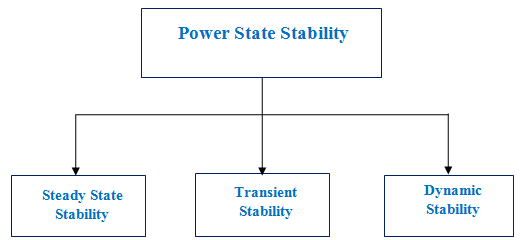
Transient Stability: the study of power systems subjected to sudden major disturbances.
Dynamic Stability: the study of power systems subjected to small continuous disturbances.
Steady State Stability
Steady state stability concerns small, gradual changes in the operating state, such as normal load fluctuations. The study finds the maximum load a machine can carry before losing synchronism, and it does so by increasing the load slowly.
The highest power that can be delivered to the receiving end without loss of synchronism is the steady state stability limit.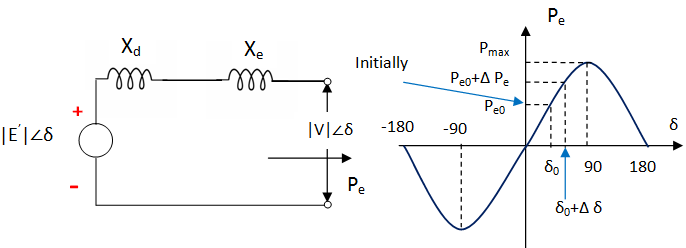
Rotor motion under an imbalance between mechanical and electrical power follows the swing equation:
Pm → Mechanical power
Pe → Electrical power
δ → Load angle
H → Inertia constant
ωs → Synchronous speed
Suppose the system shown above operates at a steady power transfer of 
Increase the electrical power by a small step Δ Pe, and the rotor angle moves to 
from δ0.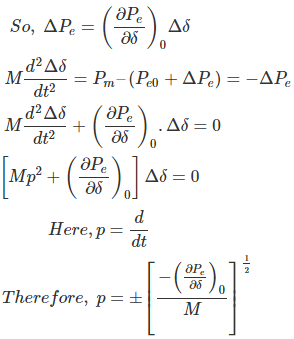
p → frequency of oscillation.
Solving this characteristic equation decides whether the system stays stable after such small changes.
Conditions for System Stability
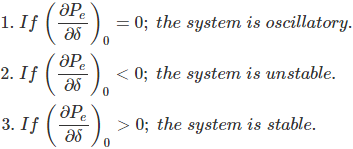

With stability retained, the maximum power transfer is:
Operation below the steady state stability limit prevents pole slipping, yet light damping can still leave long power oscillations that threaten system security. To hold the steady state stability limit, the terminal voltage (|Vt|) is kept constant for each load by adjusting the excitation.
- Sustained operation can never exceed the steady state stability limit, but it may sit above the transient stability limit, because that limit is almost always lower and it applies to sudden disturbances rather than gradual loading.
- Reducing the reactance X, raising the internal emf |E|, or increasing the terminal voltage |V| raises the steady state stability limit.
- Two excitation measures raise the limit: a quick (fast-acting) excitation system and a higher excitation voltage.
- For a high-reactance transmission line, paralleling circuits reduces the effective X between its two ends.