

- Induction Type Meters Definition: Induction type meters are devices used to measure electrical energy in homes and industries by using the interaction of fluxes and alternating currents.
- Working Principle: These meters operate by generating torques from two alternating currents, causing a metallic disc to move.
- Types of Induction Meters: The two main types are single phase and three phase induction meters.
- Single Phase Meter Components: Key parts include the driving system with electromagnets, a floating aluminum disc in the moving system, a braking system with a permanent magnet, and a counting system to record revolutions.
- Advantages: Induction type meters are inexpensive, have a high torque-to-weight ratio, and are accurate across different temperatures and loads.
An induction type meter is an electromechanical integrating meter for AC energy. A voltage electromagnet and a current electromagnet produce alternating fluxes through a conducting disc. Each flux induces eddy current in the disc, and its interaction with eddy current produced by the other flux creates driving torque. This operating current and flux arrangement works only with alternating quantities.
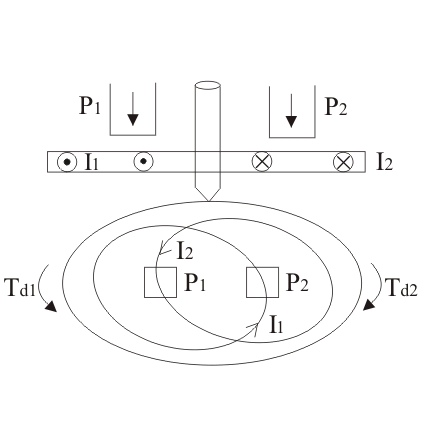
The second flux and the eddy current induced by the first flux create an opposing component of torque. The difference between the two components gives a net torque proportional to the product of flux magnitudes and the sine of their phase displacement.
This is the operating principle of induction type meters. Let the fluxes at points one and two be F1 and F2. Their instantaneous values are:

Fm1 and Fm2 are the maximum values of the fluxes F1 and F2, and B is their phase difference.
The induced emfs at point one can be written as
and similarly at point two. The eddy-current expression at point one is
Here K groups disc impedance and geometry terms, while f is frequency.
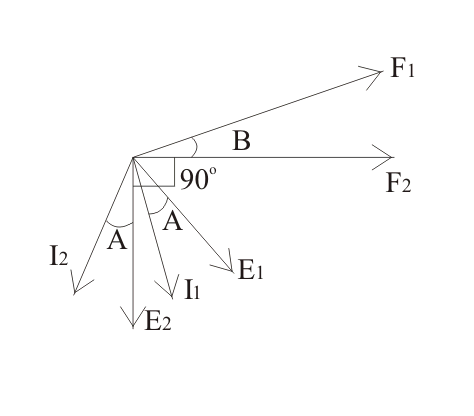
The phasor diagram shows F1, F2, E1, E2, I1 and I2. In the simplified disc model, I1 and I2 lag their induced emfs E1 and E2 by angle A.
The phase angle between F1 and F2 is B. The diagram gives angle (90-B+A) between F2 and I1, and angle (90+B+A) between F1 and I2. The first torque component is
The second component Td2 is
The total driving torque is Td1 – Td2. Substituting Td1 and Td2 gives
This is the general driving-torque expression for induction type meters. Practical active-energy meters use single-phase or polyphase measuring elements:
- Single-phase type.
- Three-phase type.

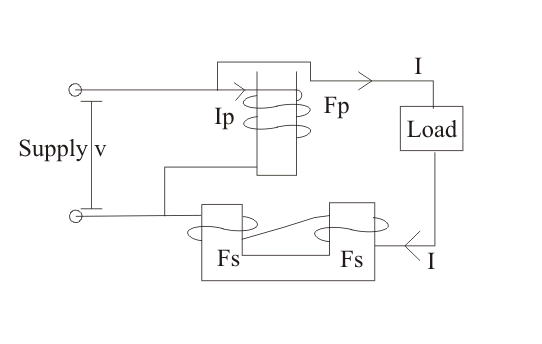
The diagrams show a single-phase induction meter.
A single-phase induction energy meter contains four functional systems:
Driving System:
Two laminated electromagnets carry the current and pressure coils. The current coil is in series with the load. The pressure coil is connected across the supply voltage. Shading bands adjust the pressure-magnet flux so it is close to 90 electrical degrees behind the applied voltage at rated frequency.
Moving System:
A light aluminium disc is mounted on a spindle and rotates in the air gaps of the two magnets. Bearings may use jewels, magnetic suspension or another low-friction construction. A floating-shaft design is one implementation, not a requirement for every induction meter.
Braking System:
A permanent magnet near the disc rim induces eddy currents that produce breaking torque opposing rotation. This braking torque is approximately proportional to disc speed, so steady speed is proportional to active power.
Counting System:
A gear train or pulse pickup counts disc revolutions. Because the disc speed follows power, total revolutions are proportional to energy. The meter constant states watt-hours or kilowatt-hours per revolution, or revolutions per kilowatt-hour.
The pressure coil is highly inductive and has many turns. Its current Ip lags the applied voltage, and the magnetic design adjusts the useful pressure flux towards quadrature. The diagram divides Flux F into Fg and Fp.
- Fg follows the lower-reluctance leakage path across the side gaps.
- Fp crosses the disc and contributes to driving torque. It follows the working air-gap path and is approximately in phase with pressure-coil current. The alternating Fp induces disc emf Ep and disc current Ip. Load current in the series magnet produces the other alternating flux and associated eddy current. Cross-interaction between each flux and the other induced current creates two opposing torque components. Their difference is the net driving torque, represented here with Fp.
Advantages of Induction Type Meters
Following are the advantages of induction type meters:
- The mature mechanism is robust and was economical for mass-produced energy metering. Unlike moving iron type instruments, it integrates energy by disc rotation rather than indicating an instantaneous quantity.
- The induction movement can provide a useful torque-to-moving-mass ratio.
- Properly compensated and calibrated meters can meet their stated accuracy class over specified current, voltage, frequency and temperature ranges. Accuracy is not independent of these conditions, friction, braking-magnet strength or installation position.


