

- Moving Iron Instrument Definition: A moving iron instrument is a type of measuring device that uses the magnetic properties of iron to measure electrical quantities.
- Types of Moving Iron Instruments: There are two main types, attraction and repulsion, which function based on the magnetic interactions of iron pieces with a magnetic field.
- Construction: These instruments typically consist of an iron disc pivoted near a coil, with movements indicating changes in electrical measurements.
- Principle of Operation: The operation involves magnetic forces acting on iron pieces, where changes in current alter the magnetic field strength and thus the movement of the iron.
- Application Insight: Moving iron instruments are crucial for electrical measurements and are used in various technological and educational applications.
Moving iron instruments are basic yet essential tools for measurement and relaying. There are two main types: attraction and repulsion.
Whenever a piece of iron is placed nearer to a magnet it would be attracted by the magnet. The force of this attraction depends upon the strength said magnetic field. If the magnet is electromagnet then the magnetic field strength can easily be increased or decreased by increasing or decreasing current through its coil.
Accordingly the attraction force acting on the piece of iron would also be increased and decreased. Depending upon this simple phenomenon attraction type moving iron instrument was developed.
When two iron pieces are placed side by side, bringing a magnet close causes them to repel each other. This repulsion results from identical magnetic poles being induced on the same sides of the iron pieces by an external magnetic field.
This repulsion force increases if field strength of the magnet is increased. Like case if the magnet is electromagnet, then magnetic field strength can easily be controlled by controlling input current to the magnet. Hence if the current increases the repulsion force between the pieces of iron is increased and it the current decreases the repulsion force between them is decreased. Depending upon this phenomenon repulsion type moving iron instrument was constructed.
Construction of Moving Iron Instrument
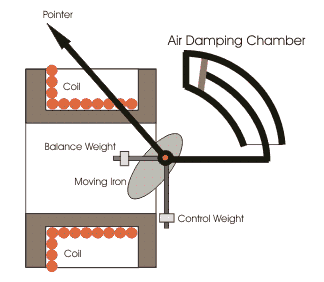
The basic construction of attraction type moving iron instrument is illustrated bellow
A thin disc of soft iron is eccentrically pivoted in front of a coil. This iron tends to move inward that is from weaker magnetic field to stronger magnetic field when current flowing through the coil. Older attraction moving iron instruments used gravity control, but modern versions now use spring control. Adjusting the balance weight achieves null deflection of the pointer.
Damping in these instruments is achieved through air friction, typically using a moving piston within an air syringe as illustrated in the figure.
Theory of Attraction Type Moving Iron Instrument
Suppose when there is no current through the coil, the pointer is at zero, the angle made by the axis of the iron disc with the line perpendicular to the field is φ. Now due current I and corresponding magnetic field strength, the iron piece is deflected to an angle θ. Now component of H in the direction of defected iron disc axis is Hcos{90 – (θ + φ) or Hsin (θ + φ). Now force F acting on the disc inward to the coil is thus proportional to H2sin(θ + φ) hence the force is also proportional to I2sin(θ + φ) for constant permeability. If this force is acting on the disc at a distance l from the pivot, then deflection torque,
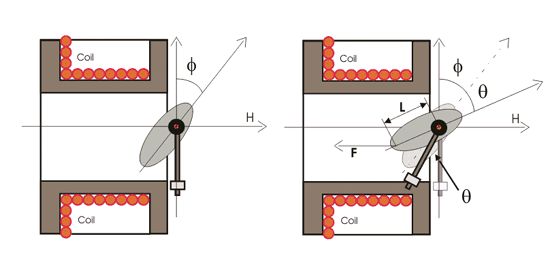

Since l is constant.
Where, k is constant.
Now, as the instrument is gravity controlled, controlling torque will be
Where, k’ is constant.
At steady state condition,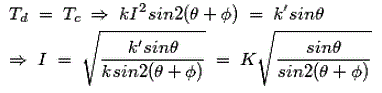
Where, K is constant.


