

- Diode Bridge Rectifier Definition: A diode bridge rectifier is defined as a circuit that uses four diodes to convert AC voltage to DC voltage.
- Working Principle: The diodes conduct in pairs (D1 and D3, D2 and D4) during alternate half-cycles of the AC input, providing continuous current flow.
- Capacitor Filter: A capacitor smooths the output by filtering out ripple frequencies, resulting in a more stable DC voltage.
- Advantages: The diode bridge rectifier is efficient, requires no center-tap transformer, and has a high transformer utilization factor (TUF).
- Disadvantages: The main drawback is the higher cost due to the need for four diodes.
Power grids distribute AC, while many electronic circuits need DC. A bridge rectifier uses diodes to steer both halves of an AC waveform in the same output direction. This is a common input stage in computer power supplies and battery chargers built with semiconductor devices.
A rectifier converts an alternating voltage into a unidirectional output. A bridge produces pulsating DC before a filter or regulator smooths and controls the voltage.
A bridge is one of several full-wave rectifier circuits. It uses four diodes, needs no centre-tapped secondary and makes effective use of the full transformer winding. Its trade-off is that load current passes through two diodes during every half-cycle.
Principle of Diode Bridge Rectifier
The circuit shown uses four diodes after a transformer. The transformer sets the required AC voltage, and the load connects across the bridge output. When one end of the secondary winding is positive, diodes D1 and D3 carry current through the load. On the opposite half-cycle, diodes D2 and D4 conduct. The load current therefore keeps the same direction even though the input polarity reverses.
A capacitor across the output charges near each voltage peak and supplies the load between peaks. This reduces ripple rather than changing its frequency. A voltage regulator can follow the filter when the load needs a controlled DC voltage.
The diagram below shows the bridge with a capacitor filter. Ripple falls as capacitance increases or load current decreases, while the ripple frequency remains twice the AC supply frequency.
Mathematical Analysis of Diode Bridge Rectifier
Peak load current when each diode has forward resistance RF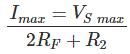
The expression includes twice the forward resistance because two matched diodes conduct in series during each half-cycle.
Average output current
Here,
Idc is the average current through the load, and Im is the peak load current.
Average DC output voltage
Here,
Vdc is the average output voltage, Idc is the average load current, and R is the load resistance.
RMS output current
RMS output voltage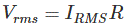
Form factor and crest factor
Form factor,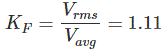
Here, Vavg is the average DC voltage.
Output frequency
Here, fout is the ripple frequency, and fin is the AC supply frequency.
Rectification efficiency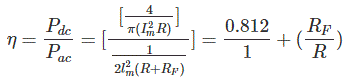
Ripple factor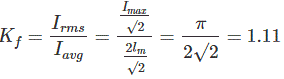

TUF or transformer utilization factor
Advantages of Diode Bridge Rectifier
- A full-wave bridge uses both input half-cycles and has higher rectification efficiency than a half-wave rectifier.
- The ripple frequency is twice the input frequency, which reduces the filtering needed for a given load and ripple target.
- Transformer utilization is higher than in a centre-tapped full-wave rectifier.
- No centre-tapped transformer secondary is required.
- For the same DC output, each diode needs about half the peak inverse voltage rating required in a centre-tapped rectifier.
Disadvantages of Diode Bridge Rectifier
A bridge needs four diodes, and two conduct in series on every half-cycle. Their combined forward-voltage drop reduces the load voltage and increases power loss, which matters most in low-voltage, high-current supplies.


