

- Blavier Test Definition: The Blavier Test is used to find earth fault locations in underground cables by measuring resistance at different points.
- Murray Loop Test Process: This test uses a Wheatstone Bridge to locate faults by comparing resistances in known cable lengths.
- Varley Loop Test Definition: The Varley Loop Test finds underground cable faults using a Wheatstone Bridge without relying on cable lengths, by adjusting and measuring variable resistors.
- Varley Loop Test Considerations: Uniform cable sections and lower current are needed to ensure accurate results due to temperature effects.
- Fisher Loop Test Definition: The Fisher Loop Test uses two healthy cables of the same length and cross-sectional area as the faulty one to locate faults by comparing bridge connections.
Blavier’s Test estimates the location of a conductor-to-earth fault from one accessible end when a sound return conductor is unavailable. The cable must be isolated, proved dead and tested under an approved procedure. Measure resistance from the test end to earth first with the far end open and then with the far end connected to earth.
Call the two readings R1 and R2. The fault provides a shunt path from the conductor to earth with fault resistance g.
In Blavier’s test, let L be the sound end-to-end conductor resistance, x the resistance from the test end to the fault and y the resistance from the fault to the far end.
The series relation is L = x + y.
With the far end open, the measured resistance is the series combination of x and fault path g, giving R1 for the connection shown.
With the far end earthed, y forms a parallel path with g and the second measurement is R2 for the circuit shown.
Solving the three relations for x eliminates g and y:
The result is resistance from the test end to the fault. Convert it to distance with verified conductor resistance per unit length at the test temperature. Blavier’s test loses accuracy when g changes between readings or is too high to produce a useful difference. Joint resistance, temperature and uncertain cable data add further error.

Murray Loop Test
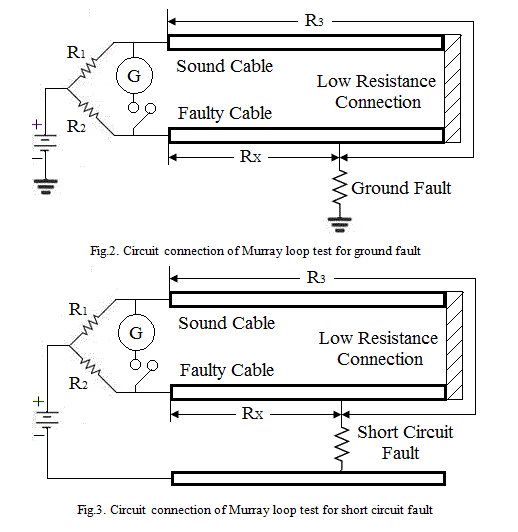
The Murray method forms a Wheatstone Bridge from the faulty conductor, a sound return conductor and two ratio arms. The Murray loop test can pre-locate an earth fault or a conductor-to-conductor fault when the required return path and far-end link are available, as shown in figures 2 and 3.
Connect the faulty and sound conductors at the far end with a low-resistance link. Link resistance should be measured or negligible within the error budget.
The adjustable resistors R1 and R2 form the bridge ratio arms. Adjust the variable resistors until galvanometer G indicates a null. [R3 + RX] represents the loop portions formed by the sound and faulty cable conductors. At balance, the displayed ratio applies: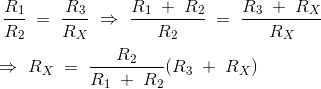
For the simple distance relation, both conductors must have known and equal resistance per unit length, or the calculation must correct for their difference. If LX is distance from the test end to the fault and L is the combined loop length, then LX follows from the bridge ratio as shown: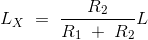
A Murray Loop Test can be accurate for a stable low-resistance fault, but high or changing fault resistance reduces null sensitivity. Apply only the approved test voltage and limit test duration. Heating changes conductor resistance and biases the calculated distance.
Varley Loop Test

The Varley loop test also uses a bridge, but its ratio arms remain fixed and a calibrated series resistor is adjusted for balance. Figures 4 and 5 show connections for earth and conductor-to-conductor faults. The method measures the total loop resistance as part of its procedure; it still needs conductor resistance per unit length to convert a result to distance.
The faulty cable and a sound return conductor are joined by a low-resistance far-end link. Switch S changes the bridge configuration, and the series variable resistor provides the null adjustment.
With S in position 1, adjust R to balance and record the value as RS1. The first bridge relation is:
This balance determines [R3 + RX] from known R1, R2 and RS1 under the diagram’s stated arm convention.
Move S to position 2, rebalance the same variable resistor and record RS2:
Combining the two balance equations gives: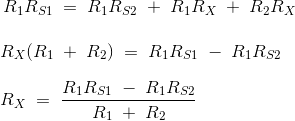
The unknown conductor resistance RX then follows as shown: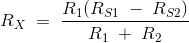
A Varley Loop Test assumes stable fault resistance and known loop characteristics. Unequal conductors, joint or link resistance, leakage and temperature changes create error. Use the lowest approved current that gives a reliable null and record the conductor temperature.
Fisher Loop Test
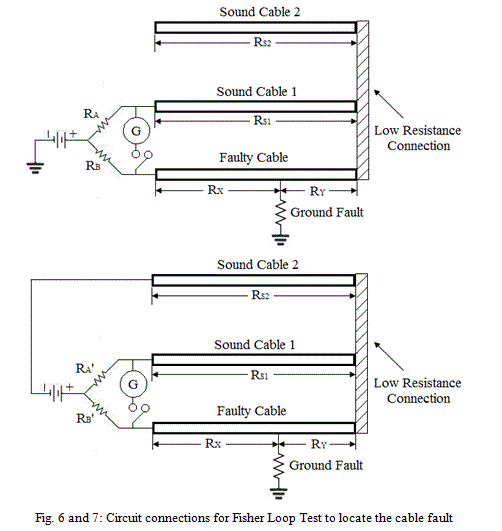
A Fisher Loop Test uses two sound auxiliary conductors when the faulty cable has no usable sound conductor. Both auxiliaries must terminate at the same endpoints as the faulty cable. They do not have to share its cross-sectional area or resistance, provided their resistances are measured and used in the two-test calculation. Figures 6 and 7 show the low-resistance far-end connections.
In figure 6, the source return is earth. The bridge arms use RA, RB, RX and [RS1 + RY]. In figure 7, the source return changes to Sound Cable 2.
The second bridge uses RA‘, RB‘, RS2 and [RX + RY]. The diagram assumes [RS1 = RS2] for the corresponding sound-conductor quantities. Two independent balances are required. The first gives: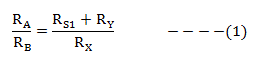
The second gives: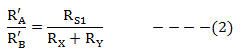
Combining equations (1) and (2) produces:
If the bridge arms are equal, or [(RA + RB) = (RA‘ + RB‘)], equation (3) simplifies as shown: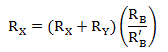
When the faulty conductor’s resistance per unit length is known and uniform, fault distance LX follows from:
Here L is the total length of the faulty cable. If bridge-arm ratios differ between the tests, use the general expression for LX: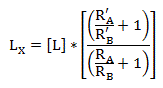
The Fisher Loop Test result remains sensitive to conductor data, connection resistance, temperature and balance uncertainty.


