

- Electronic Polarization Definition: Electronic polarization is defined as the number of dipole moments per unit volume in a material, caused by the displacement of positive and negative charges in an atom.
- Effect of External Electric Field: When an external electric field is applied, the nucleus moves towards the negative field intensity, and the electron cloud moves towards the positive field intensity, causing charge separation.
- Dipole Moment: The dipole moment is the product of the nucleus charge and the displacement distance between the nucleus and the electron cloud.
- Equilibrium of Forces: At a certain distance, the forces from the external electric field and Coulomb’s law balance each other, creating an equilibrium.
- Factors Influencing Polarization: Electronic polarization depends on the size of the atom and the number of atoms present in a unit volume of the material.
Electronic polarisation is the induced dipole that appears when an external field shifts an atom‘s electron cloud one way and its nucleus the other. Take an atom of atomic number Z. Each proton carries +e and each electron -e, so the nucleus is +Ze and the electron cloud is -Ze, treated as a uniform sphere of radius R. With no external electric field, those two centres coincide. An applied field E (V/m) pulls the nucleus toward the negative side and the cloud toward the positive side of the same atom.
Due to the external electric field, the centers of the nucleus and the electron cloud separate, creating an attractive force between them according to Coulomb’s law. At a separation distance of x, equilibrium is reached, where the forces due to the electric field and Coulomb’s law are equal and opposite. The radius of the nucleus is much smaller than that of the electron cloud, so the nucleus can be considered a point charge. The electrostatic force on the nucleus is +E.Z.e. Thus, the nucleus shifts from the center of the electron cloud by a distance x.
According to Gauss’s theorem, the force from the negative electron cloud on the positive nucleus comes only from the part of the cloud within a sphere of radius x. The portion outside this sphere does not affect the nucleus. The volume of the sphere with radius x is (4/3)πx³, and the volume of the sphere with radius R is (4/3)πR³.
Now total negative charge of the electron cloud is -Ze and we have already considered that it is uniformly distributed throughout the volume of the cloud.
Hence, the quantity of negative charge enclosed by the sphere of radius x is,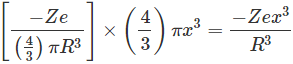
Only this much charge will apply coulombic force on the nucleus. So, according to Coulomb’s law, the force would be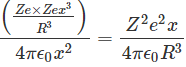
At equilibrium condition,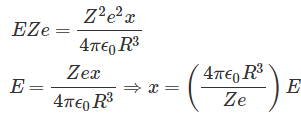
Now the dipole moment of the nucleus is Zex as dipole moment is the product of charge of the nucleus and the distance of displacement. Now, putting the expression of x in the expression of dipole moment, we get,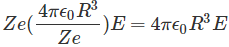
The polarization is defined as the number of dipole moments per unit volume of the material. If N is the number of dipole moments per unit volume, the polarization would be,
From this, we find that electronic polarization depends on the atom’s radius (or volume) and the number of atoms in a unit volume of the material.


