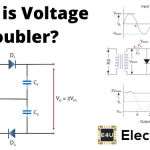
- Voltage Multiplier Definition: A voltage multiplier is a circuit that produces a DC voltage much higher than the AC input peak voltage by using capacitors and diodes.
- Half-Wave Voltage Doubler: Charges capacitors alternately during positive and negative cycles, resulting in an output of twice the input peak voltage.
- Full-Wave Voltage Doubler: Charges capacitors during both positive and negative cycles, providing a doubled voltage output with better high-frequency ripple filtering.
- Voltage Tripler and Quadrupler: By adding more diodes and capacitors, these circuits multiply the voltage to three or four times the input peak voltage.
- Applications: Used in devices needing high voltage but low current, like cathode ray tubes, X-ray systems, lasers, and ion pumps.
A voltage multiplier is a diode-capacitor circuit that produces a DC output voltage two or more times the AC peak input. The circuits below are full-wave and half-wave voltage doublers, voltage triplers and quadruplers.
Half Wave Voltage Doubler
Figure 1 shows the input, the circuit and the output. During the positive half-cycle, forward-biased D1 conducts and diode D2 is off. In that interval the capacitor (C1) charges to VSmax (peak 2o voltage). During the negative half-cycle, forward-biased D2 conducts and D1 is off, so C2 starts charging.

In the next positive half-cycle, D2 is reverse-biased (open-circuited), causing C2 to discharge through the load, reducing the voltage across it.
But when there is no load across this capacitor, then both the capacitors will be at charged condition. That is C1 is charged to VSmax and C2 is charged to 2VSmax. Throughout the negative half cycle the C2 gets charged yet again (2VSmax). In the next half cycle, a half wave which is filtered by means of capacitor filter is obtained across the capacitor C2. Here, ripple frequency is same as the signal frequency. The DC output voltage of the order of 3kV can be obtained from this circuit.

Full Wave Voltage Doubler
The input waveform of full-wave voltage doubler is shown below.
The circuit diagram and output waveform is shown in figure 3. Here; all through the positive cycle of input voltage, the diode D1 will be in forward biased condition and capacitor C1 will gets charged to VSmax(peak voltage). At this time, D2 will be in reverse biased condition. All through the negative cycle of input voltage, the D2 diode will be in forward biased condition and the capacitor C2 gets charged. If the load is not connected across the output terminals, the total voltages of both the capacitors  are obtained as the output voltage. If some load is connected across the output terminals, then output voltage
  .
.
We can see that, both the half-wave and full-wave voltage doubler will give 2VS MAX as output. It does not require any centre-tapped transformer. The peak inverse voltage rating of diodes will be equal to 2VS MAX. When compared to half wave voltage doubler, the full-wave voltage doubler can simply filter high frequency ripples and output ripple frequency will be equal to twice the supply frequency. But the problem in full-wave voltage doubler is that; in between the input and output, the common ground is absent.
Voltage Tripler and Quadrupler
By extending the half-wave voltage doubler, voltage triplers and quadruplers can be created. With small capacitor leakage and load, these circuits can achieve very high DC voltages using multiple sections to increase the voltage.
Here; all through the first positive and negative half cycle is same as that of half-wave voltage doubler. Throughout the next positive half cycle, D1 and D3 conducts and C3 charges to 2VSmax. Throughout the next negative half cycle, D2 and D4 conducts and C4 charges to 2VSmax. When more diodes and capacitors are added, every capacitor will get charged to 2VSmax. At the output; odd multiples of VSmax can be attained, if measured from the top of transformer 2o winding and even multiples of VSmax can be attained, if measured from bottom of 2o winding of transformer.
Application of Voltage Multiplier
- Cathode ray tubes.
- Cathode ray tubes in oscilloscope, Television receivers, Computer display.
- X-Ray systems
- Lasers
- Ion pumps
- Copy machines
- Electrostatic systems
- Photomultiplier tubes
- Travelling wave tubes (TWT)
- And several other devices which involves low current and high voltage applications.