

- Torque Definition: Torque in a DC motor is defined as the force’s tendency to cause or change rotational motion.
- Torque Equation: The torque equation of a DC motor, τ = F * R * sin(θ), shows how force, radius, and angle affect torque.
- Voltage and Power Equations: Voltage equation (E = Eb + Ia * Ra) and power equation (Pm = Tg * ω) are essential to derive the torque equation.
- Simplified Torque Equation: The simplified torque equation, Tg = (P * φ * Z * N) / (2 * π * A), relates torque to motor parameters.
- Torque Variation: The torque equation of a DC motor indicates that torque varies with flux (φ) and armature current (Ia).
The torque equation of a DC motor gives the electromagnetic torque from air-gap flux and armature current. When the machine is loaded as a motor or as a generator, rotor conductors carry current in the air-gap magnetic field. Each conductor feels a force at a common radius, so a torque appears at the rotor surface and the rotor turns. Torque is the moment of a force that produces or changes rotation, as Hugh D. Young defined it.

The mechanical torque of a force at a radius is
Where F is the linear force,
R is the radius of the rotating body,
and θ is the angle between F and the R vector.
A DC motor is a rotating machine, so its running torque matters. The torque equation of a DC motor is the relation used for that torque.
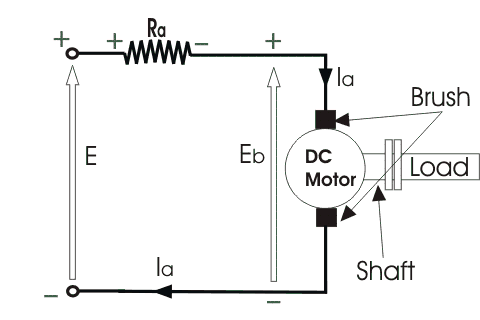
Start from the DC motor circuit and its voltage equation.
In the diagram, E is supply voltage, Eb is back emf, and Ia and Ra are armature current and armature resistance. The voltage equation is then

To form the torque equation of a DC motor, multiply both sides of the voltage equation by Ia.
Here Ia2.Ra is armature copper loss. The remaining converted mechanical power, which produces the machine torque, is
Mechanical power Pm and electromagnetic torque Tg are related by
where ω is speed in rad/s.
Equating (4) and (5) gives
To simplify the DC motor torque equation, substitute
where P is the pole count,
φ is flux per pole,
Z is the number of conductors,
A is the number of parallel paths,
and N is the speed of the DC motor.
Substitute (6) and (7) into (4):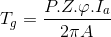
That result is electromagnetic torque. Shaft torque is this value minus mechanical and rotational loss.
Therefore,
This is the DC motor torque equation. It also reduces to: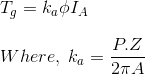
For one machine that factor is constant, so torque varies with flux φ and armature current Ia.
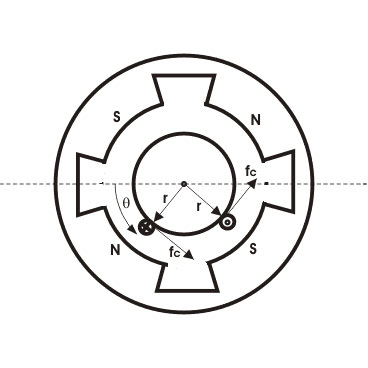
The same Torque equation of a DC motor follows from the conductor-force figure below.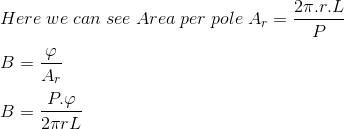
Current per conductor Ic = Ia/A
Therefore, force per conductor = fc = BLIa/A
Now torque Tc = fc. r = BLIa.r/A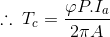
The total developed torque of the DC machine is then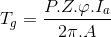
This torque equation of DC motor also reduces to: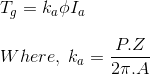
For one machine that factor is constant, so torque of a DC motor varies with flux φ and armature current Ia.


