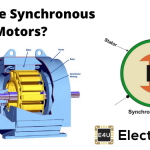
- Synchronous Motor Overview: A synchronous motor is designed to operate at the same speed as the AC power supply’s frequency, ensuring consistent performance.
- Starting Process: Synchronous motors are not self-starting; they initially operate like induction motors or use an external motor to reach near synchronous speeds before activating the DC field.
- Synchronous Motor Working Principle: The working principle involves a DC-powered rotor creating a magnetic field that synchronizes with the stator’s rotating field to achieve synchronous speed.
- Dynamic Braking: This method involves disconnecting the motor from its power supply and using it as a generator to dissipate kinetic energy through resistors, effectively slowing the motor.
- Pull-In Technique: Proper timing of the DC field activation is crucial for minimizing speed difference and ensuring smooth acceleration to synchronous speed.
In steady operation, synchronous motors run in step with the stator field, so speed is set by supply frequency and pole count. A wound-field rotor needs excitation, while permanent-magnet and reluctance machines do not use a rotor DC winding. A variable-frequency drive controls frequency, voltage and torque during starting, pull-in and braking. Efficiency depends on the complete motor and drive system rather than synchronism alone.
Starting Synchronous Motors
A line-connected wound-field synchronous motor does not produce continuous starting torque from its DC field alone. It needs a damper cage, a separate starting motor or a controlled-frequency supply.
The three-phase stator resembles that of induction motors. Rotor construction may use a DC-excited field winding, permanent magnets or magnetic saliency, so a rotor DC supply is not universal.

When line voltage is applied to stationary wound-field synchronous motors, the stator creates rotating magnetic flux at synchronous speed. The DC-excited rotor sees torque that reverses rapidly as successive stator poles pass it. Its average starting torque is therefore zero unless another starting mechanism produces acceleration.
A damper cage can accelerate the rotor as an induction motor using slip relative to the rotating magnetic field. Near synchronous speed, field excitation is applied and synchronising torque pulls the rotor into step. Converter-fed motors instead start by increasing electrical frequency from zero while controlling current and rotor angle.
An external or pony motor can also start synchronous motor drives. It turns the rotor of the synchronous motor close to synchronous speed before the stator is synchronised and the DC field is established. Available starting torque depends on the pony motor and load, so it is not inherently low. This method adds equipment and control steps and is now application-specific.
Pull in of Synchronous Motors
During line starting, pull-in begins when field excitation is applied near synchronous speed. Success depends on slip, rotor angle, field current, load torque, combined inertia and the motor’s pull-in capability. Poor timing can cause torque pulsation or pole slipping rather than successful synchronisation. Modern field application equipment uses measured speed, slip or phase conditions instead of relying only on the highest induction-motor speed. The motor is in synchronism when the rotor field locks to the stator field and remains within its stability limit.
Braking of Synchronous Motors
Synchronous drives can use regenerative braking, dynamic braking or controlled deceleration, depending on the converter and power path. Regeneration is practical for synchronous motors when the converter and supply can accept returned energy. Plugging can create high current and torque transients, so modern drives normally use controlled negative torque instead. With resistor braking, the motor generates and a converter braking chopper sends energy to a rated resistor. A line-connected machine can also operate as a synchronous generator feeding a load bank, but the excitation, switching and protection must suit that arrangement.