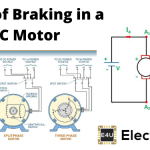
- Braking Definition: Braking is the process of reducing the speed of a rotating machine, either mechanically or electrically.
- Electrical Braking: Electrical braking uses changes in flux and torque directions to slow down machines, making it different from mechanical braking.
- Regenerative Braking: Regenerative braking occurs when a motor exceeds synchronous speed, acting as a generator and reversing current and torque.
- Plugging Type Braking: Plugging type braking reverses the motor’s supply terminals to create opposing torque, which reduces speed but wastes power.
- Dynamic Braking: Dynamic braking disconnects the motor from the power source and uses a resistor to reverse current flow and torque, slowing the motor.
Braking applies controlled torque or force to reduce speed, stop motion or hold equipment after it stops. In a drive system, the answer to what is braking depends on whether kinetic and potential energy are dissipated, returned to a supply or retained by a mechanical brake. Two broad classes are:
- Mechanical braking
- Electrical braking
Mechanical brakes create friction or another physical holding force. Electrical braking uses the motor and drive to produce electromagnetic torque opposite shaft motion. It does not always reverse the magnetic flux. The types of braking differ mainly by circuit connection and the path taken by the machine’s energy.
In this context, what is braking? It is controlled deceleration of a rotating machine. Electrical braking can slow industrial drives, traction motors and other machines, but a separate mechanical brake may still be needed for holding or safety.
Types of Braking
Motor braking circuits differ among DC motors, induction motors, synchronous motors and single-phase motors. Regenerative, plugging and dynamic braking are useful broad categories, but not every method applies unchanged to every machine. Safety and holding duties may still require mechanical brakes.
- Regenerative Braking.
- Plugging type braking.
- Dynamic braking.
Regenerative Braking
Regenerative braking makes the machine generate and sends energy to a receptive supply or DC bus. In a fixed-frequency induction motor, this occurs when the rotor runs above synchronous speed. A variable-frequency drive can lower synchronous speed, so regeneration can occur at lower shaft speeds. DC and synchronous motors have different regeneration conditions. The current and torque signs reverse relative to motoring under the chosen sign convention. The drive must return, share or dissipate the energy while the machine remains within its mechanical speed limit.
Plugging Type Braking

Plugging type braking reverses armature polarity or stator phase sequence relative to the existing motion, producing counter-torque. Supply voltage and internally generated voltage can add, causing high current and thermal stress. Some circuits use external resistance, while converter systems use current control. The supply must be disconnected near zero speed unless shaft reversal is intended. Energy from both the supply and rotating system is dissipated as heat.
Dynamic Braking

Dynamic braking makes the rotating motor generate after normal motoring power is removed. A DC motor may connect its armature to a resistor while maintaining field excitation. A converter-fed AC drive can route energy from the DC link through a braking chopper and resistor, while DC-injection braking dissipates energy in the motor. The generated current creates counter-torque. Rated resistances and thermal protection must handle the braking duty. Torque usually falls as speed approaches zero, so this method does not replace a holding brake.