

- Synchronous Condenser Definition: A synchronous condenser is defined as a synchronous motor running without a mechanical load, used to improve the power factor of power systems.
- Improving Power Factor: It draws a leading current when over-excited, which helps balance the lagging current from inductive loads.
- Three-Phase System Usage: In a three-phase system, the synchronous motor operates at no load to improve the overall power factor by adjusting the current angle.
- Economic Considerations: Synchronous condensers are economical for large power networks but less so for systems below 500 kVAR, where capacitor banks are preferred.
- Smooth Control: Synchronous condensers provide smooth, continuous power factor adjustment, unlike capacitor banks, which adjust in steps.
A synchronous condenser is an over-excited synchronous motor that runs with no shaft load. Like a capacitor bank, it raises a poor power factor on a power system. The VAR output can be varied smoothly.
The over-excited machine draws a leading current from the source. That leading current offsets lagging load current.
In a three-phase network the machine is a three-phase synchronous motor run at no load.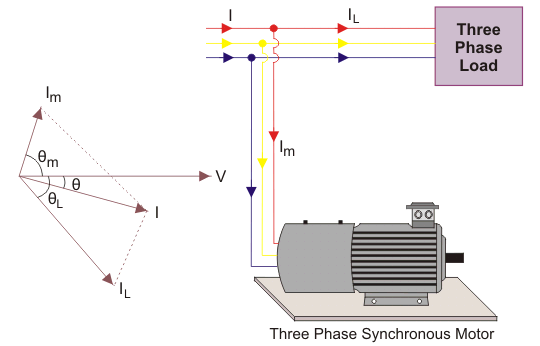
If a reactive load on the power system draws current IL from the source at a lagging angle θL to the voltage, the motor draws IM from the same source at a leading angle θM. The total current from the source is the vector sum of IL and IM. The resultant I has an angle θ to the voltage. Angle θ is smaller than θL, so the power factor cosθ is higher than cosθL before the synchronous condenser was connected.
A synchronous condenser gives smoother VAR control than a switched capacitor bank. Below about 500 kVAR, textbooks often prefer capacitors on cost. That 500 kVAR split is a rule of thumb, not a current market law. Large networks still use synchronous condensers for inertia and dynamic voltage support as well as power factor. Smaller plants usually use a capacitor bank or a static VAR device.
One advantage of a synchronous condenser is smooth, continuous power-factor control. A switched capacitor bank changes the power factor in steps.
The armature winding of a synchronous motor is also built for a high short-circuit current. That fault contribution must be allowed for in the network study.
A synchronous condenser system also has drawbacks. The machine rotates continuously, so it makes noise and needs bearings, excitation and running losses to be managed.
An ideal unloaded synchronous motor would draw leading current at 90o(electrical). Real machines have losses, so the current leads by a little less than 90 electrical degrees.


