

- Pole Pitch Definition: Pole pitch is defined as the peripheral distance between the centers of two adjacent poles in a DC machine, measured in armature slots.
- Coil Span Definition: Coil span, or coil pitch, is the distance between the two sides of a coil in a DC machine, measured by the number of armature slots between them.
- Full-Pitched Winding: A full-pitched winding has a coil span equal to the pole pitch, resulting in induced EMFs that are 180 degrees out of phase, summing directly.
- Fractional-Pitched Winding: A fractional-pitched winding has a coil span less than the pole pitch, leading to a phase difference of less than 180 degrees and a vector sum of EMFs.
- Commutator Pitch Definition: Commutator pitch is defined as the distance between two commutator segments connected to the same armature coil, measured in commutator bars or segments.
Armature-winding diagrams for a DC generator use several related distances. The main terms are pole pitch, coils, and coil span.
What is Pole Pitch?
Pole pitch gives the circumferential distance from the centre line of one pole to the centre line of the next pole, commonly expressed in winding layouts as armature slots per pole or conductors per pole.
In slot units, pole pitch equals the total number of armature slots divided by the number of poles. The result need not be a whole number, so a practical coil span may be the nearest suitable integer.
For example, an armature with 96 slots and 4 poles has 96/4 = 24 slots per pole. Its pole pitch is therefore 24 slot pitches.
When the distance is stated in slots, pole pitch is also called armature slots per pole. A physical pole pitch can instead be stated as an arc length or mechanical angle, so the unit should always be shown.
The formula for pole pitch and a worked example is discussed in the video below:
What is a Coil?
An armature coil consists of one or more turns of insulated conductor. One closed turn is a single-turn coil. Two or more series turns form a multi-turn coil.
A single-turn coil has one active conductor on each side. A multi-turn coil has several conductors on each side. In a conventional drum winding, each complete coil side occupies one slot position or layer.
The conductors that form one coil side stay together in one slot position. The return side occupies another slot, displaced around the armature by the selected coil span. In a two-layer winding, the other layer of each slot belongs to a different coil.
The video below shows how coil sides and coil span appear on a developed winding diagram.
What is Coil Span (Coil Pitch)?
Coil span (also known as coil pitch) gives the circumferential separation between the two sides of one coil, normally measured as the number of slot pitches from one side to the other.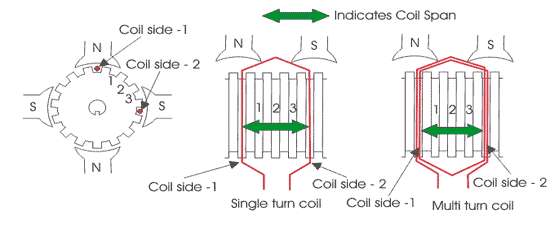
If coil span equals pole pitch, the armature winding is full-pitched. Its two active sides then lie under adjacent poles of opposite polarity.
The conductor EMFs in the two full-pitched sides are separated by 180 electricalo. Their instantaneous directions are opposite along the two conductors, but the coil end connections place them in series so their terminal contributions add.
If coil span is less than pole pitch, the winding is short-pitched or chorded. The two side EMFs are separated by less than 180 electricalo, so the fundamental coil voltage is the vector sum and is lower than for a full-pitched coil with the same turns.
The chosen short pitch is a design value, not a universal fraction. Slight chording can shorten end connections, reduce copper and help with improving commutation, but it also changes induced EMF.
Pitch of Armature Winding

Back Pitch (Yb)
The back pitch gives the separation between the two coil sides joined at the back end of the armature, normally expressed as the difference between their conductor numbers and set close to one pole pitch.
Front Pitch (Yf)
The separation between coil sides connected together at the commutator or front end is the front pitch.
In a developed winding diagram, front pitch is measured from the second side of one coil to the first side of the next series-connected coil.
Its value is the difference between conductor numbers joined at the front end, not the back end. The signs and relative values of front and back pitch determine whether lap and wave windings progress clockwise or anticlockwise.
Resultant Pitch (Y)
Resultant pitch is the distance from the beginning of one coil to the beginning of the next coil connected in series with it. It records the net progression produced by the front and back connections.
Back, front and resultant pitch are usually stated in armature-conductor or coil-side positions. Coil span may be stated in slots. Commutator pitch has its own unit, commutator segments, so these values are not interchangeable without the winding layout.
Commutator Pitch
Commutator pitch gives the signed separation, measured in commutator bars or segments, between the two segments connected to the ends of the same armature coil. Its magnitude and sign identify the winding type, multiplicity and progressive or retrogressive direction.
Single Layer Armature Winding
In a single-layer winding, each armature slot contains one coil side across its usable depth.
Each coil side therefore occupies its own slot, and the number of coil sides equals the number of slots.
Two Layer Armature Winding
In a two-layer armature winding, every slot contains two coil sides. One occupies the upper layer and the other occupies the lower layer.
The upper side of a coil is paired with its return side in the lower layer of another slot one coil span away. The two sides sharing a slot normally belong to different coils.


