

- QAM Definitio: QAM (Quadrature Amplitude Modulation) is defined as a modulation technique that combines phase and amplitude modulation to transmit information.
- Working Principle: QAM changes both the amplitude and phase of a carrier wave to double the effective bandwidth.
- Analog vs Digital QAM: Analog QAM is used in traditional TV systems, while Digital QAM, known as Quantized QAM, is used in modern digital communications like Wi-Fi and cellular networks.
- QAM Formats: Different QAM formats, such as 16-QAM, 32-QAM, and 64-QAM, vary in the number of bits they can transmit per symbol, represented in constellation diagrams.
- Applications of QAM: QAM is used in many communication systems, including radio, microwave, optical fiber, and digital cable television, enhancing data rates and bandwidth efficiency.
What is QAM (Quadrature Amplitude Modulation)?
QAM (Quadrature Amplitude Modulation) combines phase and amplitude modulation on one radio channel. It sends data by changing both the amplitude and the phase of a carrier. Two carriers that sit 90 degrees apart share that channel, so more bits fit in the same bandwidth. An older name for the method is quadrature carrier multiplexing.
A QAM signal modulates two carriers that are in quadrature. “Quadrature” means the two carriers differ by 90 degrees and share the same frequency.
One carrier is the in-phase I signal. The other is the quadrature Q signal. One can be written as a sine wave (i.e.  ) and the other as a cosine wave (i.e.
  ).
).
The two modulated carriers are sent together. At the receiver they are separated by coherent detection, which recovers I and Q independently.
The I and Q waveforms are shown below.

Analog vs Digital QAM
Analog QAM
Analog QAM can carry more than one baseband signal on one RF carrier. It is like AM, except two carriers share the same frequency and sit 90 degrees apart.
Analog QAM carries colour information in PAL and NTSC analog television. The I and Q signals hold the colour components.
PAL (Phase Alternating Line) is the analog video standard that was common in much of Europe and Asia. NTSC (National Television Standards Committee) is the analog colour television standard that was common in North America and parts of South America.
Digital QAM
Digital QAM, also called quantized QAM, is used in radio systems such as cellular links and Wi-Fi. For a given symbol rate it can carry more bits than a one-dimensional amplitude or phase scheme of the same order.
Digital QAM maps each symbol to a point with a chosen amplitude and phase. That map is a constellation diagram: the set of allowed message points.
A common QAM constellation places points on a square grid with equal horizontal and vertical spacing. The shortest gap between neighbouring points is the Euclidean distance.
Digital data is usually binary, with states 0 and 1, so the number of constellation points is usually a power of 2: 2, 4, 8, 16, 32 and so on. Common formats are 16-QAM (24), 32-QAM (25), 64-QAM (26), 128-QAM (27) and 256-QAM (28).
The bit mapping for 16-QAM is shown in the constellation diagram below. Each point has a four-bit label. A continuous bit stream is split into four-bit groups and each group is sent as one of those 16 points.

16-QAM is often treated as the lowest named QAM order because 2-QAM matches BPSK (Binary Phase Shift Keying) and 4-QAM matches QPSK (Quadrature Phase Shift Keying). 8-QAM is uncommon because its error-rate behaviour is close to 16-QAM.
What Are QAM Channels?
QAM channels here means the named QAM orders used in radio and data links. A given standard picks one or more of those orders.
Suppose each symbol carries 4 bits. Then N=4 and there are 24 = 16 possible symbols. That system is 16-QAM: the carrier can take any of 16 amplitude-and-phase states.
Other common orders are 16-QAM, 32-QAM, 64-QAM, 128-QAM and 256-QAM.
The number of QAM symbols or states is set by the number of binary bits in each symbol, not by the bit rate alone.
The number of possible symbols is

Here, a symbol is one amplitude-and-phase state.
By bits per symbol, the named QAM orders are:
| Name | Bits per symbol | Number of symbols |
| 16 QAM | 4 | 24 = 16 |
| 32 QAM | 5 | 25 = 32 |
| 64 QAM | 6 | 26 = 64 |
| 128 QAM | 7 | 27 = 128 |
| 256 QAM | 8 | 28 = 256 |
16 QAM
In 16-QAM the carrier takes one of 16 amplitude-and-phase states.
How many bits per symbol can be transmitted using 16-QAM?
16-QAM sends 4 bits in each symbol.
32 QAM
In 32-QAM the carrier takes one of 32 amplitude-and-phase states.
How many bits per symbol can be transmitted using 32-QAM?
32-QAM sends 5 bits in each symbol.
64 QAM
In 64-QAM the carrier takes one of 64 amplitude-and-phase states.
How many bits per symbol can be transmitted using 64-QAM?
64-QAM sends 6 bits in each symbol.
128 QAM
In 128-QAM the carrier takes one of 128 amplitude-and-phase states.
How many bits per symbol can be transmitted using 128-QAM?
128-QAM sends 7 bits in each symbol.
256 QAM
In 256-QAM the carrier takes one of 256 amplitude-and-phase states.
How many bits per symbol can be transmitted using 256-QAM?
256-QAM sends 8 bits in each symbol.
Bandwidth of QAM System
The power spectral density of this QAM model is shown below.

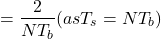
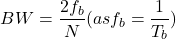
On that plot the main lobe runs from –fs to +fs. For this null-to-null model the bandwidth is

QAM vs QPSK vs BPSK vs OOK
The table below compares QAM with QPSK, BPSK and OOK using the same symbols as the formulas above.
| Parameter | QAM | QPSK | BPSK | OOK or BASK |
| Information is transmitted by change in | Amplitude and phase | Phase | Phase | Amplitude |
| Number of bits (N) per symbol | N | N=2 | N=1 | N=1 |
Number of possible symbol  | | Four | Two | Two |
| Minimum bandwidth in Hz |  |  |  | |
Symbol duration  |  |  |  | |
| Minimum Euclidean distance |  for M=16 for M=16 |  | |  |
Euclidean distance here is the gap between two points on the constellation diagram.
Under the table’s bandwidth model, 16-QAM (N=4) can send four times the bit rate of BPSK in the same bandwidth. That is why QAM is used when spectral efficiency matters.
Advantages of QAM
Useful properties of QAM include:
- Low-order QAM can be more robust than a dense constellation on the same channel, because its points sit farther apart.
- Error rate stays low when the signal-to-noise ratio is high enough for the chosen order.
- QAM can carry several bits in each symbol, which raises the data rate on a fixed symbol-rate channel. That is why it is common in wireless systems.
- Two orthogonal carriers share one channel, so the bit rate can rise without doubling the occupied bandwidth.
- Using both a sine carrier and a cosine carrier on one channel gives two independent baseband paths, so the information rate can be twice that of a single sine or cosine carrier of the same bandwidth.
Disadvantages of QAM
Limits of QAM include:
- Because QAM also changes amplitude, it is more exposed to amplitude noise than a constant-envelope phase scheme.
- A constant-envelope phase or frequency signal can use a non-linear transmitter amplifier. QAM has an amplitude component, so the transmitter needs a linear amplifier to keep the constellation intact. Those linear amplifiers are less efficient and draw more power.
- Higher-order QAM packs more bits into each symbol, but the constellation points sit closer together and a smaller noise shift can create a symbol error.
- A dense constellation is harder for the receiver to decide correctly. Higher-order QAM is used only when the signal-to-noise ratio is high enough.
Applications of QAM
QAM is used in these systems:
- Radio links use QAM when they need a higher bit rate in a limited channel.
- Uses run from short-range wireless links to longer telephone and access systems such as DSL.
- Microwave and other telecommunication bearers use QAM to send payload data.
- 64-QAM and 256-QAM are used on digital cable television and cable-modem downstream channels, including DOCSIS plants.
- Coherent optical fiber systems use QAM to raise the bit rate on a wavelength.
- It is used in Wi-Fi, Digital Video Broadcast (DVB) and WiMAX, among other standards.


