

- Battery Cells Definition: A battery is defined as a device where chemical reactions produce electrical potential, and multiple cells connected together form a battery.
- Series Connection: In a battery in series, cells are connected end-to-end, increasing the total voltage.
- Parallel Connection: In parallel batteries, all positive terminals are connected together, and all negative terminals are connected together, keeping the voltage the same but increasing the total current.
- Mixed Grouping: Series-parallel batteries combine both series and parallel connections to achieve desired voltage and current.
- Internal Resistance: Internal resistance in a battery reduces the terminal voltage when the battery is supplying current.
Battery Cells
A battery is a device in which chemical reactions produce an electrical potential. Each cell reaction can create only a limited electric potential difference between its two electrodes.
Battery cells are the places where that reaction happens. To reach a higher voltage, cells are connected in series, so a battery is a group of cells. A nickel-cadmium cell is about 1.2 V. A lead acid battery cell is about 2 V, so a 12 V lead-acid battery usually has six cells in series.
EMF of Battery
The potential difference between a battery’s terminals with no load connected is called electromotive force (EMF) or no-load voltage. No current flows through the battery in that condition.
Terminal Voltage of Battery
Terminal voltage of battery is the potential difference across its terminals while current is being drawn. A connected load causes current to flow through the battery. The battery has electrical resistance inside it. That internal resistance of battery causes voltage drops inside the cell. The terminal voltage of battery under load is therefore the EMF minus that internal drop.
If E is the EMF or no-load voltage and V is the loaded terminal voltage, then E – V is the internal voltage drop.
By Ohm’s law, that drop is the product of the battery’s internal resistance and the current through it.
Internal Resistance of Battery
The total resistance met by current as it passes through a battery from the negative terminal to the positive terminal is the internal resistance of battery.
Series Parallel Batteries
Battery cells can be connected in series, in parallel or in a mix of series and parallel.
Series Batteries
In a series battery, the positive terminal of one cell joins the negative terminal of the next cell. The overall EMF is the sum of the cell voltages. The discharge current of that single string stays the same as the current of one cell.
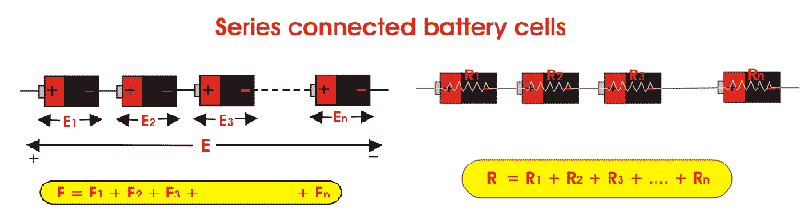
If E is the overall EMF of n cells and E1, E2, E3, …………… En are the EMFs of the individual cells,
If r1, r2, r3, …………… rn are the internal resistances of those cells, the internal resistance of the series battery is their sum:
Parallel Batteries
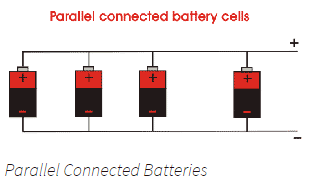
When all positive terminals are joined together and all negative terminals are joined together, the cells are in parallel. That arrangement is a set of parallel batteries. If the cells have the same EMF, the EMF of n cells in parallel equals the EMF of one cell. The resultant internal resistance is
The current delivered by the battery is the sum of the currents from the individual cells.
Mixed Grouping of Batteries or Series Parallel Batteries
Cells can also be grouped in both series and parallel. That mix is a series parallel battery . A load may need more voltage and more current than one cell can supply. Series strings set the voltage. Parallel strings of those series groups raise the available current. Let m series strings, each of n identical cells, be connected in parallel.
If each cell has EMF E and internal resistance r, each series string and the battery have EMF nE. Each string has resistance nr. With m strings in parallel, the equivalent internal resistance of the series and parallel battery is nr/m.


