- Nature of Electricity Definition: Electricity is defined as the flow of electrons through a conductor due to an electrical potential difference.
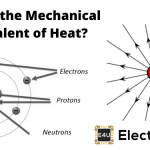
- Atomic Structure: An atom is made of a nucleus with protons and neutrons, surrounded by electrons.
- Free Electrons: Electrons that are loosely bonded and can move from one atom to another are called free electrons.
- Conductors: Materials with many free electrons, like copper and aluminum, are good conductors of electricity.
- Insulators: Materials with few free electrons, like glass and mica, are poor conductors of electricity.
Nature of Electricity and Concept of Electricity
Electricity is the behaviour of electric charge in matter. A body can hold extra charge, or charge can move from atom to atom. Every substance is built from molecules, and molecules are built from atoms.
Substances are elements or compounds. An element has molecules made of one kind of atom. A compound has molecules made of more than one kind of atom. The nature of electricity is easier to follow once those atomic structures are clear.
Structure of Atom
An atom has one central nucleus. The nucleus contains positive protons and uncharged neutrons. Electrons occupy orbits around that nucleus. Each electron has a negative charge of – 1.602 × 10– 19 coulomb and each proton has a positive charge of +1.602 × 10 – 19 coulomb. Opposite charge produces an attractive force between the nucleus and the orbiting electrons. An electron has a much smaller mass than the nucleus. A proton has about 1836 times the mass of an electron, often rounded to 1840 in teaching texts.

A neutral atom has the same number of electrons and protons because the magnitude of each electron charge equals the magnitude of each proton charge. The atom becomes a positive ion when it loses electrons and a negative ion when it gains electrons.
Atoms can hold loosely bound electrons in their outer orbits. Those free electrons need little energy to leave their parent atom and move to a neighbour. A substance is electrically charged when its electron count does not match its proton count. Extra electrons make it negative. Extra protons make it positive.

The basic nature of electricity is this: when a negatively charged body is joined to a positively charged body through a conductor, excess electrons move from the negative body to the positive body until the imbalance falls.
That flow is the working concept of electricity in a circuit. Some materials have many free electrons at room temperature. Silver, copper, aluminium and zinc are common examples. Those free electrons can be steered in one direction when an electrical potential difference is applied across the material. The large free-electron population gives them high electrical conductivity, so they are called good conductors. The drift of electrons in one direction is the current. Electrons move from lower potential (-Ve) toward higher potential (+Ve). Conventional current is drawn from the higher-potential point toward the lower-potential point, so it is opposite to electron flow. In materials such as glass, mica, slate and porcelain, the outer shell holds its electrons tightly, so almost no free electrons are present.
Those materials conduct poorly and count as non-conductors or electrical insulator. The nature of electricity is that charge flows through a conductor when an electrical potential difference is applied across it, and does not flow through an insulator even when a high potential difference is applied.