

- Three Phase Power Measurement Definition: Three phase power measurement involves using different methods to determine the total power in a three-phase circuit, depending on the number of wattmeters used.
- Three Wattmeters Method: Uses three wattmeters connected to each phase and neutral line in a four-wire system to measure total power by summing individual readings.
- Two Wattmeters Method: Employs two wattmeters and can be used for both star and delta load connections, summing the readings to determine total power.
- One Wattmeter Method: Suitable only for balanced loads, using one wattmeter and switching between phases to measure power.
- Balanced Load Limitation: The one wattmeter method cannot be used for unbalanced loads, making it less versatile.
The connection used for measurement of three phase power depends on whether the three phase circuits have three or four wires and whether phase values are needed. The diagrams below use electrodynamometer wattmeters, but the same measurement-element principles apply to a suitable power analyser:
Total active power is always the algebraic sum of the measurement-element readings. A negative element reading must keep its sign.
Measurement of Three Phase Power by Three Wattmeters Method

The protected diagram shows a three-phase four-wire connection.
Each current coil is in one phase, and each pressure coil is connected from that phase to neutral. Each wattmeter measures one phase’s active power from phase current and phase-to-neutral voltage. The algebraic sum of all three readings gives total active power for a balanced or unbalanced four-wire load.
Measurement of Three Phase Power by Two Wattmeters Method
The two-wattmeter method applies to a three-phase three-wire circuit. It does not require a load neutral and works with either of these load connections:
- Star connection of loads
- Delta connection of loads.
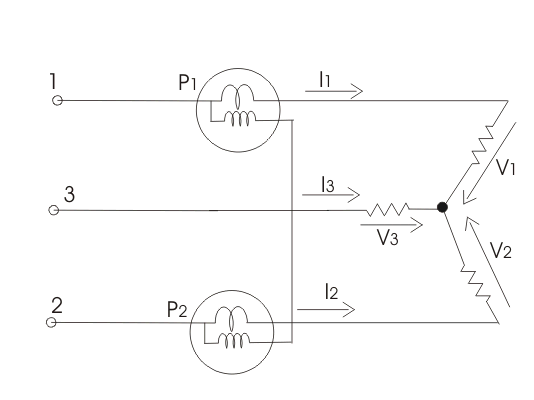
The protected diagram first shows a star-connected load.
One wattmeter combines its line current with the corresponding voltage difference (V1-V3). The other combines the second measured line current with (V2-V3). Because the three line currents in a three-wire circuit sum to zero, the algebraic sum of these two readings equals the instantaneous power in all three phases. This result does not require a balanced load. The protected equations express that identity.
The current-sum relationship shown next eliminates the unmeasured line current:  , giving
  .
.

The resulting total active power is  .
.
The next protected diagram shows a delta-connected load.
The first element reading follows the voltage and current references in the drawing:
The second element reading is:

Using the three-wire current relationship  reduces the sum to
  . The same two-wattmeter principle measures total active power for balanced or unbalanced star and delta loads, provided there is no neutral current outside the measured three conductors.
Measurement of Three Phase Power by One Wattmeter Method
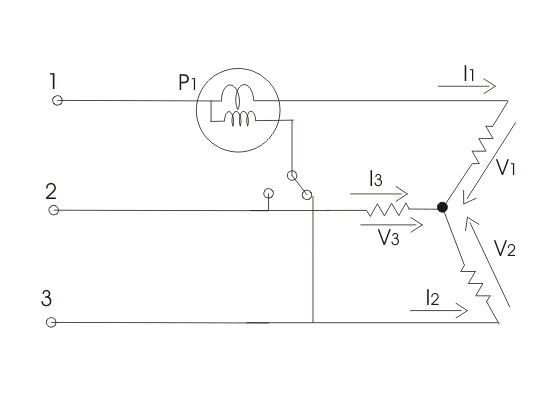
The switched one-wattmeter method assumes a balanced load, so the phase magnitudes satisfy the relationship shown here:  .
.
The protected diagram shows one wattmeter taking the two measurements in sequence.
The selector positions are labelled 1-3 and 1-2. Position 1-3 gives the first reading:
Position 1-2 gives the second reading: The algebraic sum gives total active power only if the balanced load remains stable between readings. Use a switching arrangement rated for the measuring circuits; never open a live current-transformer secondary.


