- Irradiance Definition: Irradiance is defined as the radiant flux received by a detector area, measured in W/m².
- Inverse Square Law: Irradiance follows the inverse square law, decreasing with the square of the distance from the light source.
- Illuminance Definition: Illuminance is defined as the luminous flux received per unit area of the detector, measured in lux (lm/m²).
- Illuminance vs Irradiance: Illuminance can be derived from irradiance using the conversion factor, highlighting the relationship between the two.
- Luminous Flux and Angle: Illuminance on a surface depends on the angle of incidence of the light.
Irradiance is the radiant flux received per unit detector area, in watts per square metre (W/m²). Illuminance is the matching photometric quantity: luminous flux per unit area, in lux. Spectral irradiance is written Ee,λ.
φs is the radiant flux on the detector. AD is the detector area.
For a point source, irradiance follows the inverse-square law. Two equal areas A1 and A2 sit at distances r1 and r2.
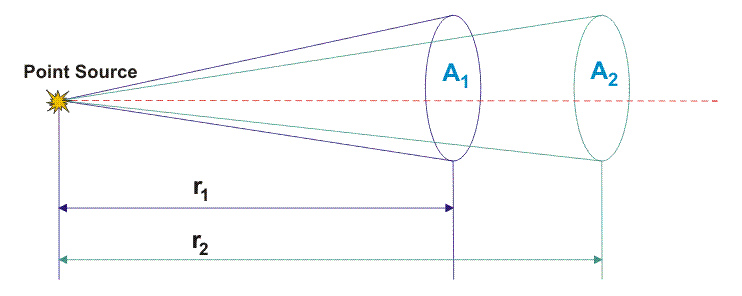
The flux on the nearer surface is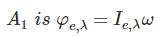
The flux on the farther surface is 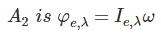
Ie,λ is radiant intensity. ω is solid angle.
The radiant flux per unit area on A1 and A2 is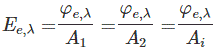
A1 and A2 are equal.
Substitute φe,λ = Ie,λ ω and the inverse-square result follows: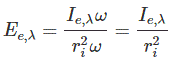
That is the inverse-square law of irradiance for a point source facing the surface.
Monochromatic irradiance at 555 nm converts to Illuminance with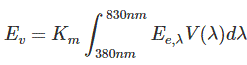
Km is the CIE photopic maximum luminous efficacy, 683 lm/W at 555 nm. Broadband light needs the luminous-efficiency function V(λ), not this single factor on total irradiance.
Illuminance is the luminous flux received per unit detector area.
The unit is the lux, or lumen per square metre (lm/m²).
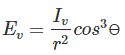
A point source of light follows the same inverse-square law:
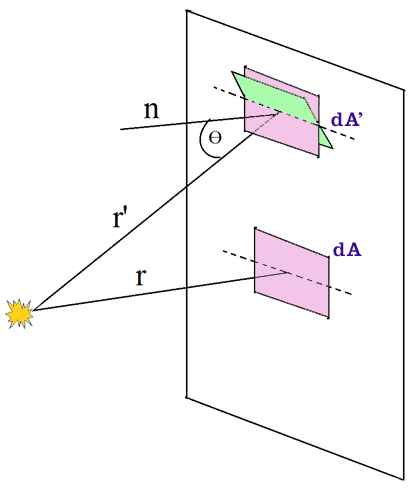
Ev is illuminance on dA when the luminous flux arrives at right angles.
E’v is illuminance on the tilted area dA’ at angle θ to that plane.
From the figure,
In general,