- Radiant Flux Definition: Radiant flux is defined as the rate at which radiant energy is emitted, reflected, transmitted, or received by an object per unit of time.
- Measurement of Radiant Flux: Radiant flux is measured using instruments called radiometers, which convert electromagnetic radiation into electrical signals.
- Calculation of Radiant Flux: Radiant flux can be calculated using various formulas and models, such as Planck’s law and the inverse-square law.
- Relation to Other Quantities: Radiant flux is related to other radiometric quantities like irradiance and radiance, and photometric quantities like luminous flux.
- Applications of Radiant Flux: Radiant flux is used in many applications, including lighting, solar energy, remote sensing, and laser technology.
Radiant flux is the rate at which radiant energy is emitted, transferred or received. Its SI unit is the watt (W), equal to one joule per second. Radiant power is a synonym; optical power is common when the radiation lies in an optical system’s stated spectral range.
Radiometry describes optical radiation without weighting it for human vision. A complete measurement states the spectral range and geometry. Flux can then be distributed by direction, projected area or receiving area to derive radiant intensity, radiance, irradiance or radiant exitance.
Photometry answers a different question. It weights visible radiation with a defined CIE visual-response function and reports quantities such as luminous flux in lumens.
What is Radiant Flux?
For radiant energy Qe transferred during time t, radiant flux is Φe = dQe/dt. Average flux over a finite interval is ΔQe/Δt.
Where:
- Φe is radiant flux in watts (W)
- Qe is radiant energy in joules (J)
- t is time in seconds (s)
Flux can refer to radiation leaving a source, crossing an aperture or arriving at a detector. State the boundary and direction in the measurement definition. Reflection, transmission and absorption divide incident flux according to wavelength, material, angle and polarisation.
Radiant flux is normally reported as a non-negative magnitude for a specified beam or path. A signed energy balance may assign positive and negative directions by convention, but the convention must be stated. A measured 10 W represents 10 J of radiant energy per second through the defined boundary.
Total radiant flux does not identify how power is distributed with wavelength. Spectral distribution matters because detector response and material interaction vary across the spectrum. Individual photon energy is hν, so a higher-frequency photon carries more energy, but total watts also depend on photon rate.
Spectral radiant flux density is Φe,λ = dΦe/dλ in W/m, or Φe,ν = dΦe/dν in W/Hz. Integrating either density over its matching wavelength or frequency interval gives radiant flux. Do not integrate a per-wavelength density over frequency without the required variable conversion.
Where:
- λ is wavelength in metres (m)
- ν is frequency in hertz (Hz)
- λ1 and λ2 are the wavelength limits used with Φe,λ
- ν1 and ν2 are the frequency limits used with Φe,ν
How is Radiant Flux Measured?
A radiometer combines a detector with optics, an aperture or field stop, signal conditioning and calibration. The detector output becomes a flux result only after applying responsivity and defining the spectral band and collection geometry. An integrating sphere is often used for total source flux; a power meter can measure a beam that fits its aperture.
Thermopiles respond through heating, while photodiodes and photomultiplier tubes use photon-generated charge. Selection depends on spectral responsivity, linearity, dynamic range, noise, damage threshold, response time and stability. Calibration must match the detector, electronics and geometry.
Raw volts, amperes or counts are detector signals, not radiant-flux units. A calibrated instrument reports watts with a stated uncertainty and conditions. Resolution alone does not establish accuracy.
Some examples of radiometers are:
- Pyranometer: measures hemispherical solar irradiance on a stated plane, commonly global horizontal irradiance
- Pyrheliometer: measures direct-normal solar irradiance through a restricted field of view while tracking the sun
- Pyrgeometer: measures broadband longwave irradiance over its calibrated spectral and angular response
- Optical power meter: measures flux in a beam that lies within its wavelength, aperture and power ranges
- Spectroradiometer: measures a stated spectral radiometric quantity, such as spectral irradiance or radiance, with defined geometry
- Photometer: measures a photometric quantity with spectral response matched or corrected to the specified CIE visual function
How is Radiant Flux Calculated?
Choose a model that matches the source, spectrum, medium and receiver geometry. Most laws below calculate a spectral density, surface density, direction or transfer factor rather than total flux by themselves:
- Planck’s law: gives the spectral radiance of an ideal blackbody at a stated thermodynamic temperature; area and angular integration are needed for flux
- Stefan-Boltzmann law: gives total hemispherical radiant exitance σT⁴ for a blackbody; multiply and integrate over emitting area for total emitted flux
- Lambert’s cosine law: describes a surface with direction-independent radiance, whose flux contribution contains the cosine of the angle from the surface normal
- Inverse-square law: relates irradiance to distance for a point source in a non-attenuating medium when source intensity and receiver orientation are known
- Beer-Lambert law: models spectral attenuation in a homogeneous medium under its assumptions; broadband flux requires spectral integration
- Fresnel equations: give reflection and transmission coefficients at an ideal interface for specified angle, polarisation and refractive indices
- Snell’s law: gives the refracted direction from refractive indices and incidence angle; it does not determine transmitted flux magnitude
- Rayleigh scattering: applies to particles much smaller than the wavelength and gives angular and spectral scattering behaviour from particle properties
- Mie theory: solves scattering by spherical particles using size, complex refractive index and wavelength; geometry is still needed for received flux
How does Radiant Flux Relate to Other Radiometric and Photometric Quantities?
Radiometric quantities distinguish total power, direction, area and time:
- Radiant intensity Ie: directional density of emitted radiant flux with respect to solid angle, in W/sr. The definition holds strictly for a point source.
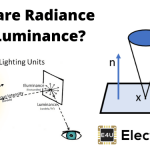
- Radiance Le: directional flux density with respect to projected area and solid angle, in W/(m²·sr).
- Irradiance Ee: incident flux density with respect to area, in W/m². Radiant exposure He accumulates incident radiant energy per area over time and uses J/m².
- Radiant exitance Me: exiting radiant flux density with respect to surface area, in W/m². Use emissivity for the material property, not emittance as a substitute for every context.
- Radiosity: in heat-transfer and rendering conventions, total radiation leaving a surface can include emitted and reflected parts, in W/m². State the convention because this is not a substitute for the CIE radiant-exitance definition.
For photopic vision, photometric quantities weight the spectral radiometric quantity by the CIE V(λ) function. The SI fixes Kcd at 683 lm/W for monochromatic radiation of 540 THz. For a broadband source, luminous flux is Φv = Kcd ∫Φe,λ(λ)V(λ)dλ, so there is no single conversion from total radiant watts without the spectrum.
- Luminous flux Φv: spectrally weighted radiant flux, in lumens (lm).
- Luminous intensity Iv: directional density of luminous flux with respect to solid angle, in candela (cd = lm/sr).
- Luminance Lv: luminous flux density with respect to projected area and solid angle in a specified direction, in cd/m².
- Illuminance Ev: incident luminous flux density with respect to area, in lux (lx = lm/m²). Luminous exposure Hv accumulates illuminance over time and uses lx·s.
- Luminous exitance Mv: exiting luminous flux density with respect to surface area, in lm/m².
- Terminology note: luminosity has specialised meanings in astronomy and other fields. Do not use it as the name for luminous exitance plus reflected illuminance.
What are some Applications and Examples of Radiant Flux?
The required radiometric quantity follows the measurement objective:
- Lighting: total radiant flux supports optical and thermal analysis, while luminous flux and luminous efficacy describe photopic light output. Spectrum, intensity distribution and colour metrics are separate.
- Solar energy: pyranometers and pyrheliometers measure irradiance. Panel area, angle, spectrum, temperature and conversion efficiency then affect electrical output.
- Remote sensing: calibrated spectral radiance at the sensor supports retrieval of surface or atmospheric properties after geometry, spectral response and propagation are modelled.
- Optical communication: launched and received optical power enter the link budget. Bandwidth, noise, modulation, loss and detector response determine data performance.
- Laser technology: radiant power measures total beam watts. Irradiance, pulse energy, duration, divergence, wavelength, polarisation and beam profile are separate specifications for processing or safety.
Conclusion
Radiant flux is radiant energy per unit time, measured in watts. A useful value always names the spectral band, path and collection geometry. Irradiance, exposure, intensity, radiance and exitance describe different distributions of that energy. Photometric quantities add a specified visual weighting and use lumens, candela or lux. Select and calibrate the instrument for the exact quantity instead of treating detector signal, watts and lumens as interchangeable.