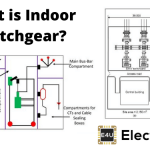
- GIS Definition: Gas Insulated Switchgear is defined as a metal-enclosed switchgear that uses SF6 gas as the primary insulation between live parts and the earthed metal enclosure.
- High Dielectric Strength: The use of SF6 gas allows GIS to operate at higher voltages without breakdown, providing efficient and reliable power system management.
- Space Efficiency: GIS reduces the physical footprint required for switchgear by up to 90%, making it ideal for space-constrained environments.
- Safety Features: By encapsulating its components in a sealed metal enclosure, GIS enhances safety by minimizing exposure to live parts and reducing arc flash hazards.
- Versatile Applications: GIS is versatile, used in diverse applications from urban energy distribution to supporting power needs of railways and data centers, demonstrating its adaptability in various infrastructure projects.
Gas-insulated switchgear (GIS) is metal-enclosed equipment whose insulation relies at least partly on a pressurised gas or gas mixture. Sulphur hexafluoride (SF6) has been widely used, while newer designs also use alternative gases and vacuum interruption. GIS controls part of a power system through enclosed busbars, circuit breakers, disconnectors, earthing switches, instrument transformers and surge arresters. Its compact clearances suit medium- and high-voltage sites where land or building space is constrained.
This article explains GIS construction, switching, applications and design trade-offs. High-voltage GIS above 52 kV is covered by IEC 62271-203, while metal-enclosed assemblies up to 52 kV fall under IEC 62271-200 and related product standards. The project specification and local rules determine the applicable edition.
What is Gas Insulated Switchgear?
GIS uses an insulating gas or gas mixture other than air at atmospheric pressure between live conductors and the earthed enclosure. SF6 provides strong dielectric performance and can also serve as an interrupting medium in a gas circuit breaker. The insulating medium and interrupting medium are not necessarily the same: some modern GIS uses a vacuum interrupter inside a gas-insulated enclosure.

Common GIS components include:
- Circuit breakers: A protection system commands the breaker to interrupt fault current. The interrupter may use vacuum, SF6 or another specified technology according to the voltage and duty.
- Disconnectors: These provide an isolating gap after a circuit breaker has interrupted load or fault current. They must not be used to break current beyond their rated switching duty, and their position is controlled by interlocks.
- Bus bars: These enclosed conductors connect bays and feeders. Designs can use single-phase or three-phase enclosures, with gas zones selected for service continuity and fault containment.
- Transformers: Separate power transformers normally connect through bushings, cables or gas-insulated bus rather than sitting inside a GIS bay. Integrated instrument transformers, including current and voltage transformers, provide measurement and protection signals.
- Earth switches: These earth an isolated section under an approved switching procedure. Interlocks prevent unsafe operation, and high-speed earthing switches have a separately specified making duty.
- Surge arresters: Metal-oxide arresters can be installed in gas-insulated modules to limit specified lightning and switching overvoltages. Insulation coordination determines their rating and location.
Earthed metal enclosures contain one or more sealed gas compartments. Gas-tight barriers can limit the amount of gas affected by maintenance or a leak and can support a defined service-continuity plan. Filling connections and valves allow controlled gas handling, but separate compartments are not left in free communication during normal service.
Density or pressure monitoring, position indication, interlocks and protection support operation. These features do not by themselves make every switching action safe. The installation must also provide earthing, pressure relief, internal-arc protection, ventilation and access controls appropriate to its classification and gas.
How Does Gas-Insulated Switchgear Work?
Traditional high-voltage GIS often uses SF6 for insulation and in the circuit-breaker interrupter. Other products separate these functions by using an alternative insulating gas with vacuum interruption. SF6 has useful electrical properties:
- At its specified density and field conditions, it can support much smaller clearances than air at atmospheric pressure.
- Its molecular mass is much higher than that of air. Thermal performance depends on gas circulation, enclosure design, conductor losses and the selected gas mixture; low molecular weight is not the reason for GIS compactness.
- Its electron-attaching behaviour supports rapid dielectric recovery after current interruption in a properly designed gas circuit breaker.
These properties enabled compact, proven GIS designs. SF6 is also a potent and persistent greenhouse gas, so equipment owners must prevent emissions, monitor leaks and recover gas during service and decommissioning. New projects must check current local restrictions and available lower-impact alternatives.
A three-phase circuit breaker illustrates switching operation. Under normal service, its contacts carry current. When protection detects a fault within its zone and issues a trip, the mechanism separates the contacts. An arc forms in each interrupting pole while current continues until interruption.
The arc is a hot, electrically conductive path containing ionized particles. The interrupter controls its energy and must withstand the transient recovery voltage after current zero. Required breaking duty comes from system fault studies and the switchgear rating.
For an AC gas circuit breaker, successful interruption requires both adequate cooling around current zero and fast dielectric recovery across the opening contacts.
Thermal interruption: The interrupter removes energy from the arc as the alternating current approaches a natural zero. Arc resistance rises as the conductive channel cools. Interruption will fail if the post-arc channel receives enough energy to become conductive again.
Dielectric interruption: After current zero, the contact gap must regain dielectric strength faster than the recovery voltage rises. Gas flow, electron attachment, contact motion and interrupter geometry control this process. A vacuum interrupter uses a different physical mechanism.
After interruption, the breaker contacts remain open. They close only after a separate manual or automatic command and after the protection logic permits energisation. Density monitoring alarms or blocks operation at defined thresholds; trained personnel use approved recovery equipment for gas sampling, filling and maintenance.
Gas-Insulated Switchgear Applications
GIS is used where compact, enclosed high-voltage equipment offers a project benefit. Common settings include:
- Urban or industrial areas: Indoor or outdoor GIS can reduce land and clearance requirements at constrained sites. Underground, rooftop or offshore use requires a specific structural, ventilation, access, fire and gas-management design.
- Power generation and transmission: GIS can form generator, transformer, line and busbar bays in a substation. The connected lines and transformers transmit or change voltage; the GIS performs switching, isolation, measurement and earthing duties.
- Renewable energy integration: Compact switchgear is used in offshore wind platforms and constrained renewable substations. It connects and protects circuits, while converters, generators and system controls provide voltage or frequency regulation.
- Railways and metros: GIS can fit traction and auxiliary substations with restricted space. Losses and operational safety depend on the full traction-power design, protection, earthing and maintenance system.
- Data centres and factories: GIS can support compact incoming substations for critical facilities. Redundancy, fault tolerance, harmonics and electromagnetic interference are system-level design matters rather than automatic properties of GIS.
Gas Insulated Switchgear Vs Air Insulated Switchgear
GIS offers multiple advantages over the conventional air-insulated switchgear (AIS), including:
- Space saving: Gas insulation normally needs much smaller phase and earth clearances than AIS. The actual site reduction depends on voltage, bus scheme, cable or line interfaces, maintenance access and building layout.
- Safety: Earthed enclosures reduce accidental contact with high-voltage conductors. Internal arcs, pressure release, induced voltages and gas by-products remain hazards, so use the specified internal-arc classification, interlocks and operating procedures.
- Environmental protection: The enclosed insulation is less exposed to salt, dust and airborne contamination than AIS. Seals, mechanisms, insulators and interfaces still age and require condition-based attention.
- Maintenance planning: Long inspection intervals may be possible for sealed primary equipment. Mechanisms, gas density, partial-discharge indicators and auxiliary systems still need the manufacturer’s scheduled checks.
However, GIS also has some disadvantages compared to AIS, such as:
- Cost: GIS equipment often has a higher purchase price, while a smaller site or building can offset part of it. Compare civil work, interfaces, spares, gas obligations, maintenance and outage risk across the asset life.
- Specialised work: Assembly, high-voltage testing, gas handling and internal repairs require trained personnel, clean conditions and manufacturer procedures. Expansion interfaces need early coordination.
- Repair time: An internal failure can contaminate a gas compartment and require factory support. Compartment boundaries, spare modules, bypass arrangements and loss-of-service-continuity design determine the outage impact.
The GIS or AIS decision should follow a documented comparison of ratings, insulation coordination, service continuity, internal-arc safety, site constraints, environmental obligations and life-cycle cost. Personal preference is not an engineering criterion.
Advantages and Disadvantages of Gas-Insulated Switchgear
The main GIS benefits are strongest when the project specification uses them deliberately:
- Space saving: Compact clearances can reduce the substation footprint or allow indoor, multi-storey and underground layouts. Required access and pressure-relief routes still occupy space.
- Safety: Metal enclosures screen live parts during normal service. They do not eliminate internal-arc, gas-pressure or switching hazards, so ratings and procedures must match the installation.
- Reliability: Factory-assembled modules and enclosed insulation reduce exposure to environmental contamination. Reliability evidence must match the offered duty and show relevant service experience.
- Maintenance: Sealed primary parts can reduce routine cleaning. Monitoring supports condition assessment, but it does not replace mechanism checks, leak response or planned outages.
However, GIS also has some disadvantages compared to AIS, such as:
- Cost: Specialised equipment and testing can raise the initial price. A fair comparison includes the land, building, installation, maintenance and decommissioning costs of both options.
- Complexity: Interfaces between primary modules, protection, controls, earthing, pressure relief and gas zones require detailed coordination and controlled site assembly.
- Availability: Internal repair can take longer than work on exposed AIS. The bus arrangement and compartmentalisation must support the required maintenance and fault-outage strategy.
Procurement should state measurable requirements for ratings, service continuity, internal-arc performance, gas emissions, extension, testing and maintenance. Vendors can then offer comparable GIS or AIS solutions.
Types and Models of Gas-Insulated Switchgear
Manufacturers use several enclosure and integration arrangements. Terminology is not fully uniform, so the single-line diagram and gas-compartment drawing are more reliable than a product label:
- Isolated phase GIS: Each phase has a separate metal enclosure. This increases enclosure count and can limit a fault to one phase, although protection and repair strategy determine the final impact.
- Integrated three-phase GIS: Three phase conductors share an enclosure. It can be more compact, but the claimed space reduction depends on the complete bay design and cannot be fixed at one-third.
- Hybrid GIS: Hybrid switchgear normally combines gas-insulated switching modules with air-insulated bus or connections. It can reduce space while retaining conventional external interfaces.
- Compact GIS: Several functions may share a module or enclosure. Integration reduces interfaces and footprint, while compartment boundaries must still support the specified service continuity.
- Highly integrated system (HIS): This is used as a product-category term for compact hybrid high-voltage assemblies. It does not mean every item in a substation shares one enclosure or that external connections disappear.
Product ranges change as manufacturers add lower-impact gases and revise ratings. The following names are starting points only; verify the current data sheet, standard compliance and regional availability:
- Siemens Energy: The Blue GIS portfolio includes SF6-free products at several voltage classes. Confirm the offered 8V series model, insulating medium, breaker technology and ratings in the current regional catalogue.
- Hitachi Energy: ELK and EconiQ GIS cover multiple transmission ratings, including SF6-free variants. Select the exact bay family from current short-circuit, current, interface and environmental requirements.
- CHINT: XGN product names have been used for medium-voltage gas insulated switchgear and related assemblies. Confirm the applicable metal-enclosed category because an XGN unit may be GIS or a ring-main unit. Then verify its current rating and standard.
- ABB: The ZX family covers medium-voltage primary GIS, with insulation media and ratings that differ by model and market. Current portfolios include SF6 and SF6-free variants, so use the exact offered data rather than a historic family list.
Model names do not establish project suitability. Compare certified ratings, internal-arc classification, loss-of-service-continuity category, gas system, dimensions, extension method and local technical support.
Conclusion
GIS places switching and bus functions inside earthed metal enclosures with pressurised gas insulation. SF6 remains common in installed equipment, while alternative gases and vacuum interruption are increasingly available. Instrument transformers can be integrated; power transformers normally connect at a defined interface.
GIS can reduce space and shield insulation from pollution. Its trade-offs include specialised installation, difficult internal repair and gas-management obligations. Metal enclosure does not remove internal-arc or switching risk.
Utilities, industry, transport and renewable projects use GIS where compact equipment fits the site and outage strategy. The voltage rating, short-circuit duty, bus scheme, interfaces and service conditions determine the required assembly.
A responsible selection compares GIS, AIS and hybrid options against the same technical and life-cycle criteria. For SF6 equipment, include leakage monitoring, trained gas recovery, reporting duties and end-of-life handling. Check current law because restrictions on fluorinated gases now vary by jurisdiction and commissioning date.