- Equal Area Criterion Definition: The equal area criterion is a graphical method to determine the transient stability of a single or two-machine system against an infinite bus.
- Transient Stability: This criterion helps in understanding if a power system can maintain synchronism after a large disturbance.
- Fault Impact: When a fault occurs, the load angle increases due to the rotor’s acceleration.
- Critical Clearing Angle: The critical clearing angle is the point at which the system can recover from a fault without losing stability.
- Power Angle Curve: The power angle curve is used to analyze the system’s stability by comparing accelerating and decelerating areas.
The equal area criterion is a graphical energy test for first-swing power stability after a large disturbance. In a classical synchronous-machine power system model, it compares the rotor’s accelerating energy during the disturbance with the decelerating energy available after clearing. This is a direct transient stability method for one machine against an infinite bus or for an equivalent two-machine system. A steady state stability study instead concerns response to small changes near an operating point.
For a specified fault and switching sequence, the Equal Area Criterion indicates whether the first rotor-angle swing has a turning point before the post-fault unstable equilibrium. It does not replace numerical simulation for a general multimachine network.
Equal Area Criterion for Stability
For the classical lossless single-machine model, the electrical power-angle relation is 
Before the disturbance, mechanical input and electrical output are equal at the initial rotor angle. During the assumed fault, the transfer relation becomes 
Protection clears the fault by opening the required circuit breaker. Clearing time depends on fault detection, relay operation and breaker performance, so it must be calculated or measured for the actual protection scheme.
The classical first-swing model treats mechanical input power as constant over the short disturbance because turbine and governor response is much slower than the electrical transient. The power system is transiently stable when the machine remains in synchronism and its rotor angle reaches a finite first-swing maximum after fault clearing.
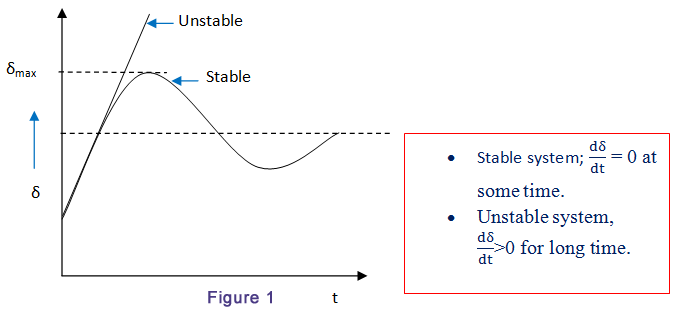
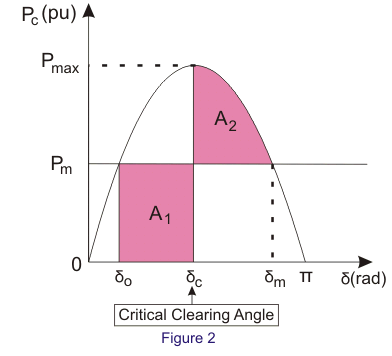
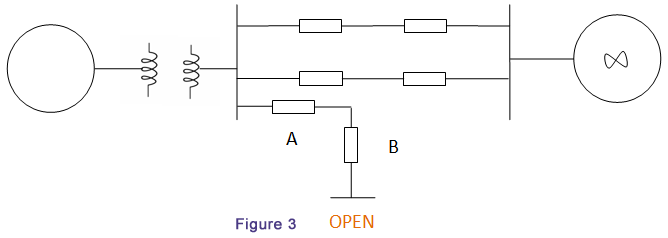
Figures 1 and 2 show a generator initially delivering mechanical power Pm at rotor angle δ0. If the assumed fault reduces electrical transfer to zero while Pm remains constant, accelerating power is 
This positive power difference increases rotor kinetic energy, speed relative to synchronism and rotor angle δ.
At clearing angle δc, the network changes to its post-fault power-angle curve. When post-fault electrical power exceeds mechanical input, accelerating power Pa is negative and the rotor decelerates. Its angle continues to increase while relative speed remains positive. Stability requires the speed difference to reach zero before the angle passes the post-fault unstable equilibrium.
The swing equation is
Pm = mechanical input power
Pe = electrical output power
δ = rotor power angle
H = inertia constant
ωs = synchronous speed
The derivative relation is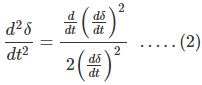
Substitution in the swing equation gives
Multiplying by the angle-rate term and integrating between δ0 and an arbitrary angle δc gives
At the initial steady state, relative rotor speed is zero at δ0, as represented by 
The fault injects kinetic energy. After clearing, the rotor decelerates until it reaches its first-swing maximum angle δmax, where relative speed again becomes zero:
The accelerating area obtained from the energy integral is
The available decelerating area is
For a clearing angle δc, instability follows if the required accelerating area A1 exceeds the available decelerating area A2. The rotor then passes the limiting angle δm, where mechanical power again exceeds electrical power, and continues to accelerate out of synchronism.
If the available A2 is greater than A1, the rotor reaches zero relative speed before that limiting angle. With physical damping, later swings reduce and the machine can settle.
The boundary occurs when A2 equals A1. The associated clearing angle δcr is the critical clearing angle.
Setting A2 equal to A1 gives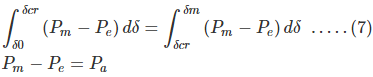
This accelerating-and-decelerating energy balance is the equal area criterion. For the assumed network and disturbance, it determines the critical clearing angle. Critical clearing time also depends on machine inertia and the fault-on trajectory.