

- Magnetic Field Definition: A magnetic field is an invisible field around magnetic material that attracts or repels other magnetic materials and can store energy.
- Energy Buildup in Electromagnets: When an electromagnet is activated, energy gradually accumulates in its magnetic field due to the opposing forces of the induced voltage and the flow of electric current.
- Permanent Magnet Flux: In permanent magnets, energy is stored through magnetic flux, which includes both remanent flux and demagnetizing flux, contributing to the overall energy capacity.
- Energy Calculation: The energy stored in a magnetic field is calculated using the dimensions of the magnet and the properties of the magnetic flux, applicable to both electromagnets and permanent magnets.
- Applications of Magnetic Energy: Stored magnetic energy has practical uses in mechanical systems and electronic applications, demonstrating the versatility of magnetic fields in technology.
A Magnetic field can store energy whether it is produced by a permanent magnet or an electromagnet. A permanent magnet supplies magnetic flux without an excitation winding, although its operating flux can change with temperature, an external field and the surrounding magnetic circuit. An electromagnet’s field depends on its current, turns, core material and geometry.
First consider a coil or inductor connected to a battery or another voltage source through a switch. The current rises from zero after the switch closes.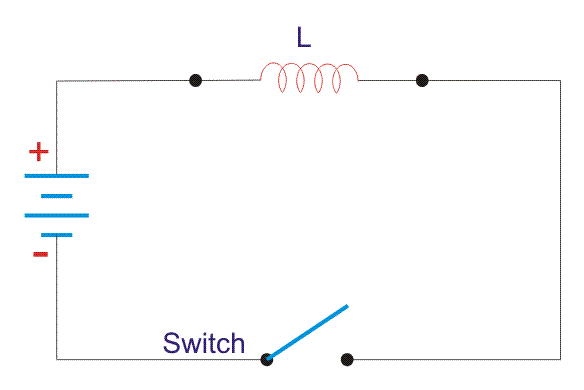
Let the source voltage be V, the coil inductance be L henrys and the final current be I amperes.
When the switch closes, self-induction produces an emf while current changes:
The minus sign expresses Lenz’s law: the induced emf opposes the change that produces it.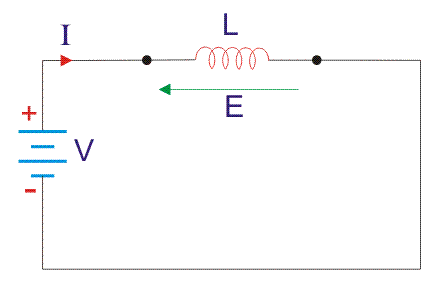
Let U denote the energy delivered to the ideal inductor as its current rises.
The source must supply power against the induced emf, so the magnetic-field energy grows from zero to its final value.
For the passive sign convention, dU = Pdt and the absorbed power is P = LI(dI/dt).
The incremental energy stored in the inductor is therefore
For constant inductance, integrate from zero current to the final current I.
For a long, uniform coil,
where N is the number of turns, A is the effective cross-sectional area, l is the magnetic path length and μ is the material permeability.
The magnetising field is
where H is the magnetic field strength, N is the number of turns and l is the effective magnetic path length.
Substituting the expressions for L and I into the energy equation gives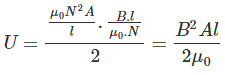
For a linear, uniform medium, this is equivalent to the energy density u = BH/2 = B²/(2μ) multiplied by the field volume.
Permanent magnets need a different treatment because their B-H relation is nonlinear and history-dependent.
For a nearly uniform field, the total flux through magnet cross-sectional area A is φ.
The relation is φ = BA, where B is the average normal flux density.
In the simplified model below, φr represents the remanence-related source flux and φd represents a demagnetising component.
The model combines them as 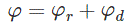
using flux continuity within the stated magnetic circuit.
For a linear section, Bd = μH, where H is magnetic field strength. A permanent magnet itself must instead be analysed from its demagnetisation curve.
Magnetomotive force is related to H and the effective magnetic path length.
Here, l is the effective path length between the poles.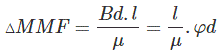
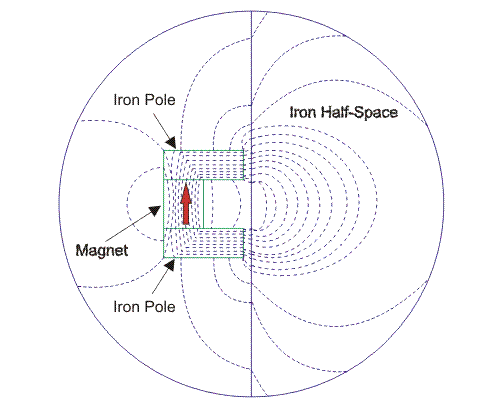
A magnetic-circuit estimate also needs the reluctance of each magnetic flux path.
Let the magnet’s internal demagnetising reluctance be Rm.
The simplified relation is 
In this model, Wm denotes the magnetic energy associated with the internal reluctance.
The corresponding energy-density expression is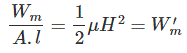
In the model below, the dotted box represents the magnet and Rl represents the external load-path reluctance.
Applying flux continuity and the magnetomotive-force balance gives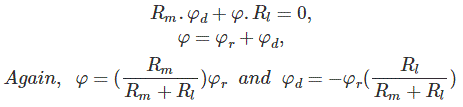
Mechanical work changes the field configuration, so force or torque calculations use the change in magnetic energy or co-energy.
A current-carrying coil near a permanent magnet can experience force. Co-energy provides a calculation method for relating that force to current, position and flux linkage. It does not represent an additional physical energy store. Let the permanent-magnet field strength be H and the coil contribution be HC.
The model writes the co-energy as
Here, B is the flux density at the coil position. For real magnetic materials, use the measured B-H curve and the complete magnetic circuit.


