- Energy Bands in Crystals Definition: Energy bands in crystals are formed by the merging of discrete energy levels of closely packed atoms due to electromagnetic interactions.
- Valence Band: The valence band contains outer orbit electrons and can be fully or partially filled, playing a crucial role at room temperature.
- Conduction Band: The conduction band is the lowest energy band, usually empty at room temperature, containing electrons free from the nucleus’s attraction.
- Forbidden Band: The forbidden band, or band gap, is the space between energy bands where no electrons exist.
- Theory of Energy Bands in Crystals: This theory helps classify materials as conductors, insulators, or semiconductors based on their energy band diagrams.
Isolated atoms have separate energy levels around the nucleus (see “Atomic Energy Levels”). When two or more atoms sit close together those levels spread into bands. Energy bands in crystals form because neighbouring atoms exert electromagnetic forces on each other.
Figure 1 shows a typical band layout. Band 1 maps onto the isolated-atom level E1 and band 2 onto E2.
This means electrons closer to the nucleus form the lower energy bands, while those in outer orbits form higher energy bands.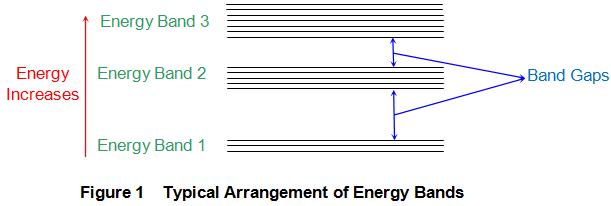
In reality, each of these bands constitutes multiple energy levels which are very closely spaced.
The number of energy levels in a band increases with higher energy bands. For example, the third energy band is broader than the second, which is broader than the first. The space between these bands is called the forbidden band or band gap. Electrons in a crystal must be in one of the energy bands, meaning they cannot exist in the band gap.
Types of Energy Bands
Energy bands in a crystal can be empty, filled, or mixed. Empty energy bands have no electrons, while filled energy bands, usually lower in energy and near the nucleus, have no free electrons and cannot conduct electricity. Mixed energy bands contain both empty and filled energy levels.
Nevertheless in the field of electronics one is particularly interested in conduction mechanism. As a result, here, two of the energy bands gain extreme importance. These are
Valence Band
This energy band comprises of valence electrons (electrons in the outer most orbit of an atom) and can either be completely or partially filled. At room temperature, this is the highest energy band which comprises of electrons.
Conduction Band
The lowest energy band which is usually unoccupied by the electrons at the room temperature is called conduction band. This energy band comprises of electrons which are free from the attractive force of the atom’s nucleus.
In general, valence band is a band with lower energy in comparison with the conduction band and is thus found below the conduction band in the energy band diagram (Figure 2). The electrons in the valence band are loosely bound to the atom’s nucleus and jump into conduction band when the material is excited (say, thermally).
Importance of Energy Bands
Electrical conduction in materials is due to free electrons. According to energy band theory, only electrons in the conduction band contribute to conduction. This allows us to classify materials as conductors, insulators, or semiconductors based on their energy band diagrams.
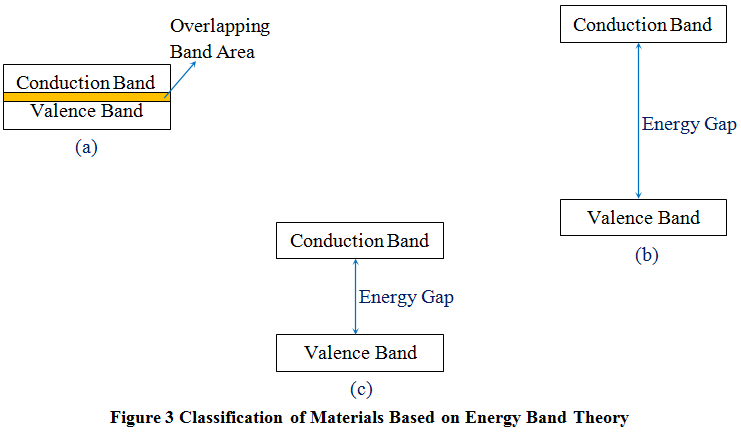
For example, say, the energy band diagram shows a considerable overlapping between the valence and the conduction bands (Figure 3a), Then, it means that the material has abundant free electrons in it, due to which it can be considered to be a good conductor of electricity i.e. a metal.
On the other hand if we have an energy band diagram in which there is a huge gap between the valence and the conduction bands (Figure 3b), this means that one needs to provide the material with large amount of energy so as to obtain the filled conduction band. At times, this may be tough or sometimes even practically impossible. This would leave the conduction band void of electrons due to which the material will fail to conduct. Thus, these kind of materials would be insulators.
Now, let us say that we have a material which shows a slight separation between the valence and the conduction bands as shown by Figure 3c. In this case, one can make the electrons in the valence band occupy the conduction band by providing slight amount of energy. This means that although such materials are usually insulators, they can be converted to act as conductors by exciting them externally. Hence these materials will be called semiconductors.