

- Diode Resistance Definition: Diode resistance is the effective opposition a diode offers to the flow of current.
- Forward Resistance: Forward resistance is the resistance a diode shows when conducting in the forward-biased condition, starting after a threshold voltage.
- Static or DC Resistance: Static resistance is the opposition to DC current, calculated by the ratio of DC voltage to DC current through the diode.
- Dynamic or AC Resistance: Dynamic resistance is the opposition to AC current, determined by the change in voltage over the change in current through the diode.
- Reverse Resistance: Reverse resistance occurs when the diode is reverse biased and allows a small leakage current due to minority carriers.
Resistance opposes the flow of current through a device. Diode resistance is the effective opposition a diode offers to current flow. Ideally, a diode offers zero resistance when forward biased and infinite resistance when reverse biased. Real devices fall short of that: every diode has a small forward resistance and a high reverse resistance, and the pair of values characterises the diode.
Forward Resistance
Even with forward biasing, a diode won’t conduct until it reaches a minimum threshold voltage. Once the applied voltage exceeds this threshold, the diode starts to conduct, and the resistance it offers in this condition is called forward resistance: the resistance a diode shows when forward biased.
Forward resistance takes two forms, static or dynamic, depending on whether the current through the device is DC (direct current) or AC (alternating current).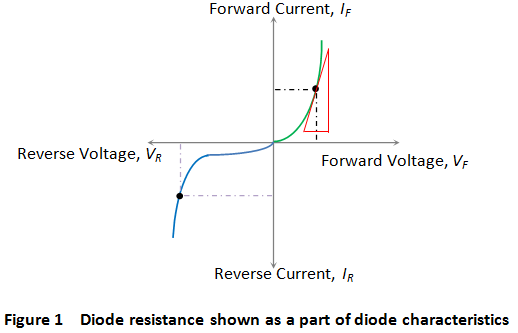
Static or DC Resistance
Static resistance is the opposition the diode offers to DC flow when a DC voltage is applied. Mathematically, it is the ratio of the DC voltage across the diode terminals to the DC through it (the black dotted line in Figure 1):

Dynamic or AC Resistance
Dynamic resistance is the opposition a diode offers to AC current in a circuit with an AC voltage source. It equals the change in voltage across the diode divided by the change in current through it.
Reverse Resistance
Connected in reverse bias, the diode still passes a small current called the reverse leakage current. The cause is that a reverse-biased diode is never completely free of charge carriers: minority carriers keep flowing through the device.
Because of this current, the diode shows a reverse resistance characteristic, marked by the purple dotted line in Figure 1. Its mathematical expression mirrors the forward case:
Where, Vr and Ir are the reverse voltage and the reverse current respectively.
One basic fact about diode resistance is worth noting:
“A diode’s reverse resistance is generally far higher than its forward resistance, which makes the device essentially unidirectional”.


