- Synchronous Motor Definition: A synchronous motor is defined as a motor that runs at synchronous speed, determined by supply frequency and the number of poles.
- Stator Components: The stator includes a frame made of cast iron, a core of silicon laminations, and windings of enamelled copper.
- Rotor Types: The two types of rotors are salient pole, used for lower speeds, and cylindrical, used for higher speeds.
- Salient Pole Rotor: This rotor type has projecting poles and is suitable for medium and low-speed operations, featuring damper windings.
- Cylindrical Rotor: Made from solid steel, this rotor type is ideal for high-speed applications with a uniform air gap and DC excitation via slip-rings.
Synchronous motors are stator-and-rotor machines that run at synchronous speed. That speed is
where Ns = synchronous speed, f = supply frequency and p = number of poles. Construction must suit that lock-in speed, which depends on supply frequency and pole count.
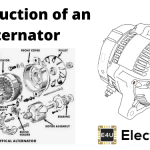
The construction of a synchronous motor matches that of an alternator. Both are synchronous machines. One is used as a motor and the other as a generator. The synchronous motor has a stator and a rotor. The parts below are those two assemblies.
Stator of Synchronous Motor
The main stationary part of the machine is stator. The stator consists of the following parts.
Stator Frame
The stator frame is the outer part of the motor. Small and medium frames are often cast iron. Large machines use a fabricated steel frame. The frame supports the core and encloses the active parts.
Stator Core
The stator core is made from thin silicon laminations with an insulating surface coating. This reduces hysteresis and eddy current losses. The core also gives a low-reluctance path for flux and holds the stator windings.
Stator Winding
The stator core has slots on the inner periphery to accommodate the stator windings. Industrial machines use three-phase windings. Single-phase synchronous motors exist in small sizes.
Enamelled copper is used as the winding material. In the case of 3 phase windings, the windings are distributed over several slots to produce a near-sinusoidal air-gap mmf.
Rotor of Synchronous Motor
The rotor is the moving part of the machine. Rotors are available in two types:
- Salient Pole Type
- Cylindrical Rotor Type
The salient pole type rotor consists of poles projecting out from the rotor surface. It is made up of steel laminations to reduce eddy current losses. 
A salient pole machine has a non-uniform air gap. The gap is largest between the poles and smallest at the pole centres. Salient-pole rotors suit medium and low-speed duty because they carry many poles. Damper windings in the pole faces start the motor as an induction machine.
A cylindrical rotor is a solid alloy-steel forging, often a nickel-chromium-molybdenum grade. Slotted field windings form the poles when they carry DC. These rotors suit high-speed 2-pole and 4-pole machines. The uniform air gap cuts windage and noise compared with a salient pole at the same speed. DC reaches the winding through slip rings, or through a brushless exciter on many large machines.