

- Arc Suppression Coil Definition: An arc suppression coil, also known as a Petersen coil, is an inductive coil used to neutralize the capacitive charging current in underground power networks during an earth fault.
- Purpose and Function: The coil reduces the large capacitive charging current during an earth fault by creating an opposite inductive current.
- Working Principle: The inductive current generated by the coil cancels out the capacitive current, preventing arcing at the fault point.
- Capacitive Current in Underground Systems: Underground cables have a continuous capacitive current due to the dielectric insulation between the conductor and the earth.
- Inductance Calculation: The inductance of the Petersen coil is adjusted to match the capacitive current in the system, often using a tap-changing arrangement.
The voltages of a three phase balanced system are shown in figure 1.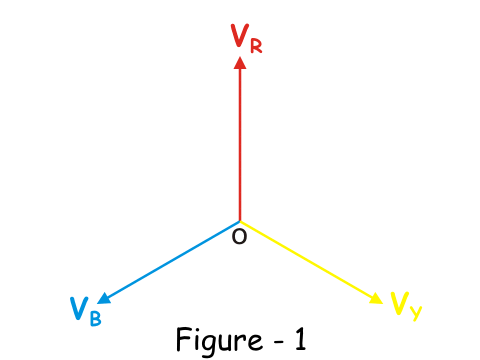
In underground high voltage and medium voltage cable networks, each phase has capacitance between the conductor and the earth, leading to a continuous capacitive current. This current leads the phase voltage by 90 degrees as shown in figure 2.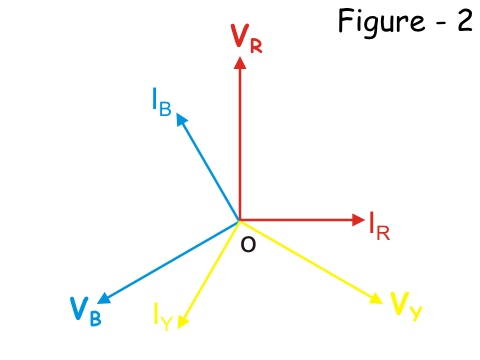
If an earth fault occurs in the yellow phase, the voltage of the yellow phase to ground becomes zero. The system’s neutral point shifts to the tip of the yellow phase vector. Consequently, the voltage in the healthy phases (red and blue) increases to √3 times the original value.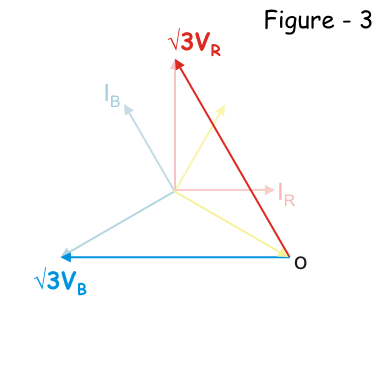
Naturally, the corresponding capacitive current in each healthy phase (red and blue) becomes √3 times the original, as shown in figure 4 below.
The vector sum that is resultant of these two capacitive currents now will be 3I, where I is taken as rated capacitive current per phase in the balanced system. That means, at healthy balanced condition of the system, IR = IY =
IB = I.
This is illustrated in figure 5 below,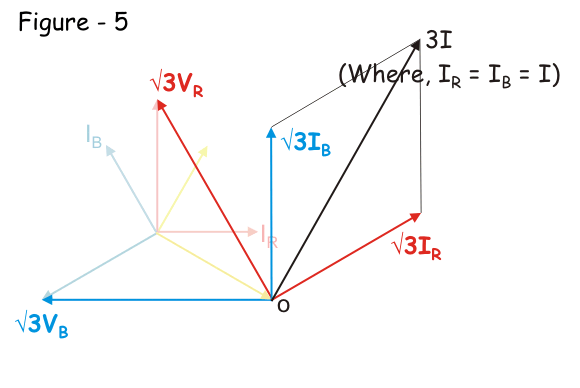
This resultant current then flows through the faulty path to the earth as shown below.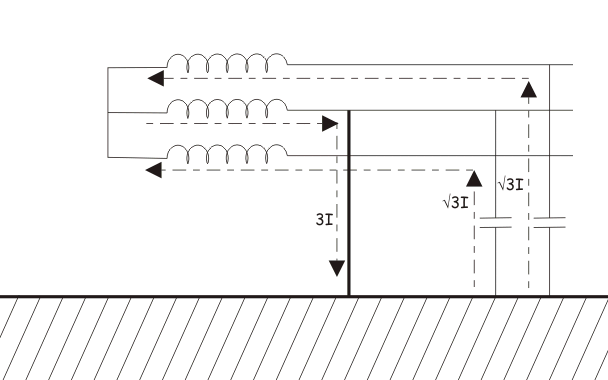
Now, if we connect one inductive coil of suitable inductance value (generally an iron core inductor is used) between the star point or neutral point of the system and ground, the scenario will be entirely changed. At faulty condition, the current through the inductor is just equal and opposite, in magnitude and phase, to the capacitive current through the faulty path. The inductive current also follows the faulty path of the system. The capacitive and inductive currents cancel each other at the faulty path; hence there will not be any resultant current through the faulty path created due to the capacitive action of the underground cable. The ideal situation is illustrated in the figure below.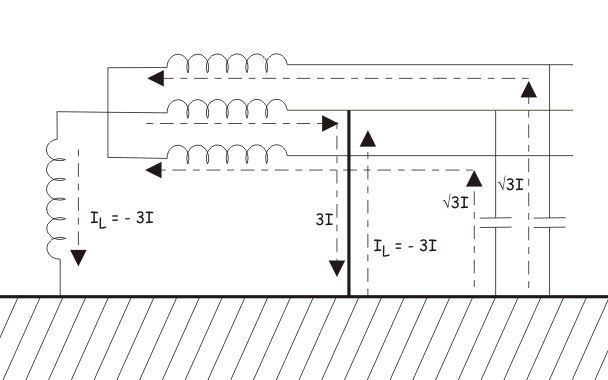
This concept was first implemented by W. Petersen in 1917, which is why the inductor coil used for this purpose is called a Petersen Coil.
The capacitive component of the fault current is high in an underground cabling system. When an earth fault occurs, the magnitude of this capacitive current through the faulty path becomes 3 times the rated phase to earth capacitive current of a healthy phase. This causes a significant shift of the zero crossing of current away from the zero crossing of voltage in the system. Due to this high capacitive current in the earth fault path, there will be a series of re-strikings at the fault location. This may lead to unwanted overvoltages in the system.
The inductance of the Petersen Coil is selected or adjusted at such a value that its inductive current exactly neutralizes the capacitive current.
Let us calculate the inductance of the Petersen Coil for a 3 phase underground system.
For that, let us consider the capacitance between conductor and earth in each phase of a system as C farad. Then the capacitive leakage current or charging current in each phase will be
So, the capacitive current through the faulty path during a single phase to earth fault is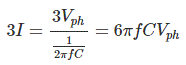
After the fault, the star point will have phase voltage, as the null point is shifted to the fault point. So the voltage appearing across the inductor is Vph. Hence, the inductive current through the coil is
Now, for cancellation of the capacitive current of value 3I, IL must have the same magnitude but be 180o electrically apart. Therefore,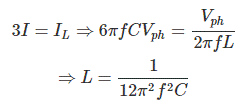
When the design or configuration of the system changes, such as length, cross-section, thickness or insulation quality, the inductance of the coil must be adjusted. Therefore, Petersen coils often have a tap-changing arrangement.


