

- Ampere’s Circuital Law Definition: Ampere’s Circuital Law is defined as the relationship between electric current and the magnetic field it generates.
- Magnetic Field Density Integral: The integral of magnetic field density (B) along a closed path is equal to the product of the enclosed current and the medium’s permeability.
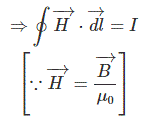
- Magnetic Field Intensity: The integral of magnetic field intensity (H) along a closed path is equal to the enclosed current.
- Amperian Loop: An amperian loop is an imaginary loop used to visualize the path around a current-carrying conductor.
- Multiple Conductors: The law applies to the sum of currents enclosed by the path when there are multiple conductors.
Ampere’s Circuital Law states that a steady current produces a magnetic field whose circulation around any closed path equals the current enclosed by that path.
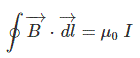
In a linear medium, the same law says the integral of magnetic field density (B) along an imaginary closed path is equal to the product of the current enclosed by the path and the permeability of the medium.

The magnetostatic statement above is Ampere’s circuital law. Maxwell later added a displacement-current term so the relation still holds when the electric field changes with time.
Alternatively, the law states that the integral of the magnetic field intensity (H) along an imaginary closed path equals the enclosed current.
Take an electrical conductor that carries a current of I ampere downward, as shown in the figure below.

Draw an imaginary loop around the conductor. That path is an amperian loop.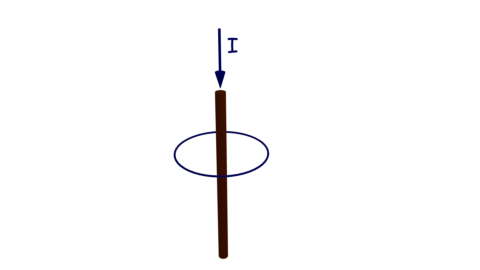
Give the loop a radius r. At any point on the loop, the flux density produced by the current in the conductor is B.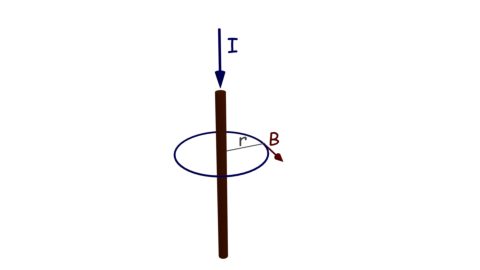
Take an infinitesimal length dl of the amperian loop at that point.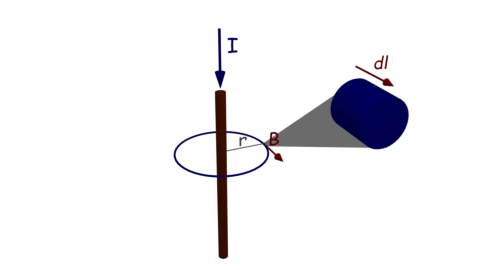
On this circular loop, the magnitude of B is the same at every point because each point sits the same perpendicular distance from the conductor axis. The direction of B is tangent to the loop at that point.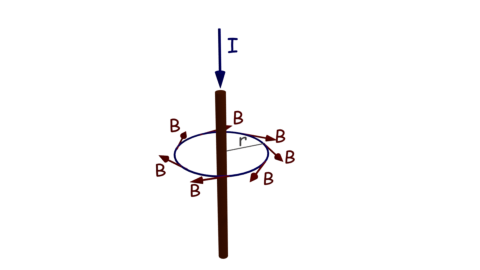
The closed integral of the magnetic field density B along the amperian loop is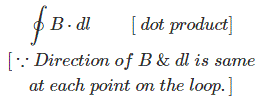

Now, according to Ampere’s Circuital Law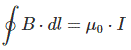
Therefore,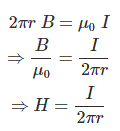
If the same path encloses N conductors that each carry the same current I, then


thx for the help.
No worries Yash. I hope you found it useful.