

- DC Motor Definition: A DC motor is defined as a device that converts direct electrical energy into mechanical energy using magnetic fields and electrical currents.
- Basic Construction: The DC motor consists of an armature, brushes, and a magnetic field setup, crucial for its function.
- Fleming’s Left-Hand Rule: This rule determines the direction of force on the armature, influencing the rotation of the DC motor.
- Torque Explanation: Torque in a DC motor is produced by magnetic and electrical interactions, varying with the armature’s rotation angle.
- Operational Phases: The DC motor experiences varying torque through its rotation, with a critical zero-torque point that is overcome by momentum.
A DC motor converts DC electrical energy into mechanical rotation. This page sets out the working principle of a DC motor from a single-loop machine.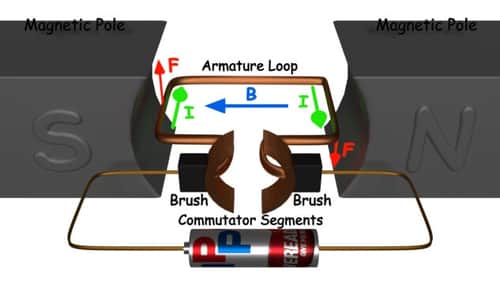
The basic construction of a DC motor is a current-carrying armature fed through commutator segments and brushes. That armature sits between the north and south poles of a permanent magnet or an electromagnet, as in the diagram.
When DC flows in the armature, the surrounding magnets exert a mechanical force on it. The direction of that force, and so how a DC motor operates, follows Fleming’s left-hand rule.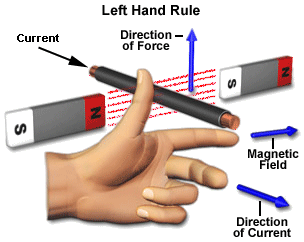
A current-carrying conductor set perpendicular to a magnetic field feels a force at right angles to both the field and the current carrying conductor. Fleming’s left-hand rule gives the rotation. Point the first finger, middle finger and thumb of the left hand at right angles: middle finger along the current, first finger along the field from north to south, thumb along the mechanical force.
The size of that force, which sets the principle of DC motor torque, follows from the diagram below.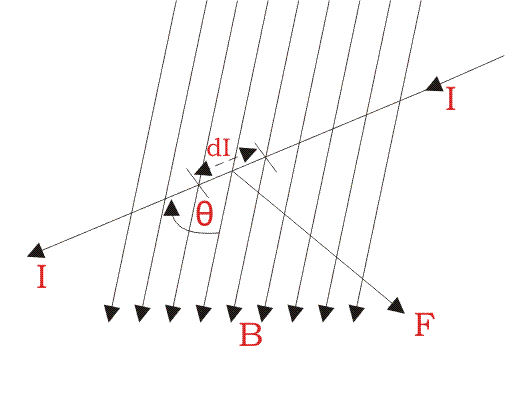
A small charge dq moving at velocity v in an electric field E and a magnetic field B feels Lorentz force dF:-
For the operation of DC motor take E = 0.
That is the cross product of dq v and magnetic field B.
Where dL is the length of the conductor that carries charge q.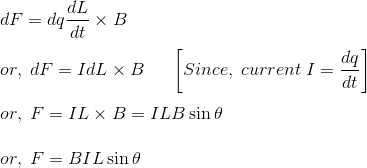
From the 1st diagram the armature current stays perpendicular to the field at every instant shown. The force on the conductor is then perpendicular to both the uniform field and the current, and it stays constant in that geometry.
Take the current on the left-hand side of the armature conductor as I and that on the right-hand side as -I, because those sides carry current in opposite directions.
The force on the left-hand side armature conductor is
The force on the right-hand side conductor is
At that position the two forces are equal in size and opposite in direction. The conductors are a width w apart, so those opposite forces form a couple and the armature turn rotates.
When the armature turn makes an angle α (alpha) with its starting position, the torque is:
That torque is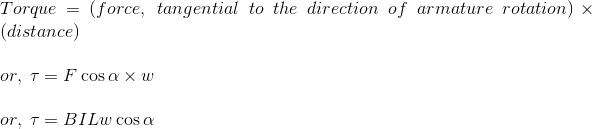
Here α (alpha) is the angle between the plane of the armature turn and the reference plane, taken along the magnetic field.
The cosα term shows that torque is not constant. It changes with α (alpha). The steps below follow that change through one quarter turn.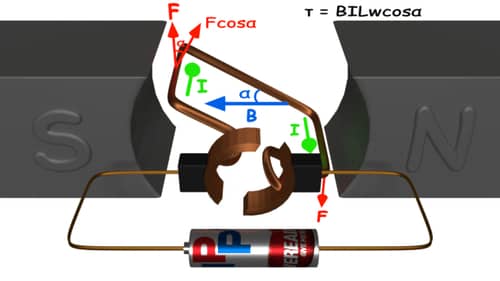
Step 1:
Start with the armature at the reference position, α = 0.
With α = 0, cos α = 1, so torque is a maximum τ = BILw. That starting torque can overcome rest inertia and start the turn.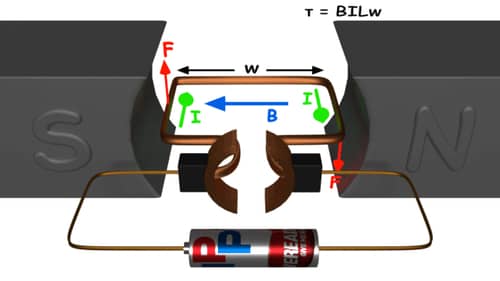
Step 2:
As the armature turns, α rises toward 90o from the start. Then cosα falls and so does the torque.
Torque is then τ = BILwcosα, which is less than BILw once α is greater than 0o.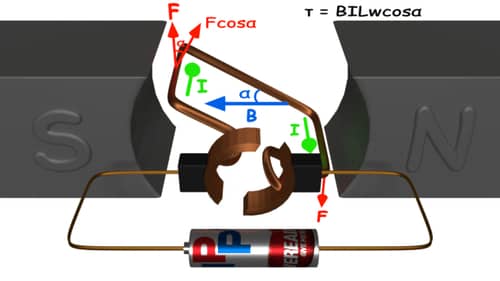
Step 3:
When the rotor is exactly perpendicular to the start position, α = 90o and cosα = 0.
Torque on the conductor at that position is
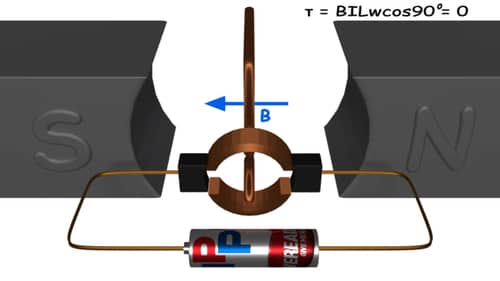
i.e. rotating torque is then zero. A single-coil loop coasts through that null on its own inertia. That teaching picture of operation of DC motor action uses one coil. A real armature has many coils, so total torque never falls to zero. After the coil passes this point, α falls again and torque returns.


