

- Star Connected System Definition: A star connected system is a type of electrical circuit where each component connects to a common neutral point.
- Voltage Relationship: In a star-connected system, the line voltage is √3 times the phase voltage.
- Current Relationship: The line current is the same as the phase current in a star-connected system.
- Balanced System: In a balanced star system, the magnitude of voltage and current is the same in each phase.
- Power Calculation: The total power in a three-phase system is calculated using the phase voltage, phase current, and the angle φ.
In a balanced star (wye) system, line current equals phase current and line voltage is √3 times phase voltage. The relations between line and phase currents and voltages of a star connected system follow from the phasor diagram below.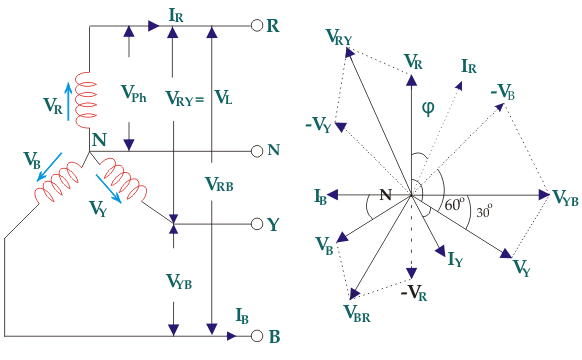
With a lagging load, current in each phase lags that phase voltage by ϕ. In a balanced set the voltage and current magnitudes are the same on every phase. The red-phase voltage, from neutral N to terminal R, is VR.
Yellow-phase voltage is VY and blue-phase voltage is VB.
Each of those phase voltages equals Vph.
∴ VR = VY = VB = Vph
In a star connection, the line current is the same as the phase current. The magnitude of this current is the same in all three phases, denoted as IL.
∴ IR = IY = IB = IL, Where, IR is line current of R phase, IY is line current of Y phase and IB is line current of B phase. Again, phase current, Iph of each phase is same as line current IL in star connected system.
∴ IR = IY = IB = IL = Iph.
Let’s denote the voltage across the R and Y terminals of the star connected circuit as VRY.
The voltage across Y and B terminal of the star connected circuit is VYB<!–
The voltage across B and R terminal of the star connected circuit is VBR.
From the diagram, it is found that
VRY = VR + (− VY)
Similarly, VYB = VY + (− VB)
And, VBR = VB + (− VR)
Now, as angle between VR and VY is 120o(electrical), the angle between VR and – VY is 180o – 120o = 60o(electrical).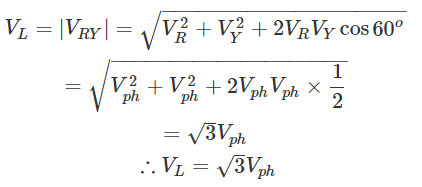
Thus, for the star-connected system line voltage = √3 × phase voltage.
Line current = Phase current
As, the angle between voltage and current per phase is φ, the electric power per phase is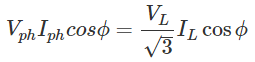
So the total power of three phase system is


