

- Parity Checking Definition: Parity checking is a method that uses an extra bit, called a parity bit, to detect single-bit errors in data transmission.
- Even Parity: Even parity ensures that the total number of 1s in the data word and the parity bit is even, helping detect errors.
- Odd Parity: Odd parity ensures that the total number of 1s in the data word and the parity bit is odd, providing another method for error detection.
- Parity Generator: A parity generator is a combinational logic circuit at the transmitter end that creates the parity bit based on the data word.
- Parity Checker: A parity checker is a combinational logic circuit at the receiver end that checks the parity of the received data word to detect errors.
Parity generators and checkers guard data movement in digital systems. They append one extra bit, the parity bit, so that single-bit errors caused by noise or interference become detectable at the receiving end. The sections below cover the parity concept, the generator and checker circuits and where they earn their keep.
What is Parity Checking?
Parity checking detects errors by adding a parity bit to the data before transmission. The bit is set to 0 or 1 so the total number of 1s comes out even or odd, whichever scheme is in use. The receiver recomputes the parity: a mismatch flags an error, and matching parity catches any odd number of flipped bits, though it cannot prove the data arrived untouched.
There are two types of parity checking: even parity and odd parity.
Even Parity
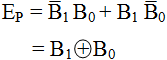
Even parity ensures that the total number of 1s in the data word and the parity bit is even. For example, if the data word is 1001011, the parity bit is 0; if the data word is 1001010, the parity bit is 1. The logic expression for the even parity bit (EP) of a two-bit data word (B1B0) is:

Where ⊕ denotes the XOR operation.
Odd Parity
Odd parity ensures that the total number of 1s in the data word and the parity bit is odd. For example, if the data word is 1001011, the parity bit is 1; if the data word is 1001010, the parity bit is 0. The logic expression for the odd parity bit (OP) of a two-bit data word (B1B0) is:

Where the overbar marks the complement of the expression under it.
What is a Parity Generator?
A parity generator is a combinational logic circuit that generates the parity bit for a given data word at the transmitter end. It takes the original data word as input and outputs the data word with the appended parity bit. Depending on whether even or odd parity is used, different logic gates are required to implement the parity generator.
Even Parity Generator
An even parity generator ensures an even number of 1s in the data word plus the parity bit. If the data word has an odd number of 1s, it adds a 1; if it has an even number of 1s, it adds a 0.
For example, let us design an even parity generator for a three-bit data word (B2B1B0). The truth table and logic expression for the even parity bit (EP) are:
| B2 | B1 | B0 | EP |
|---|---|---|---|
| 0 | 0 | 0 | 0 |
| 0 | 0 | 1 | 1 |
| 0 | 1 | 0 | 1 |
| 0 | 1 | 1 | 0 |
| 1 | 0 | 0 | 1 |
| 1 | 0 | 1 | 0 |
| B2 | B1 | B0 | EP |
|---|---|---|---|
| … | … | … | … |
| … | … | … | … |
| … | … | … | … |
| … | … | … | … |
| … | … | … | … |
| … | … | … | … |
| … | … | … | … |
| … | … | … | … |

Odd Parity Generator
An odd parity generator ensures an odd number of 1s in the data word plus the parity bit. If the data word has an odd number of 1s, it adds a 0; if it has an even number of 1s, it adds a 1.
For example, let us design an odd parity generator for a three-bit data word (B2B1B0). The truth table and logic expression for the odd parity bit (OP) are:

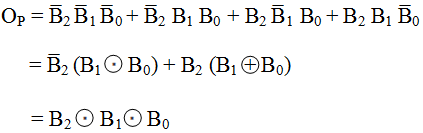
Two two-input gates implement this expression: an XOR feeding an XNOR, which together form the three-input XNOR written above.

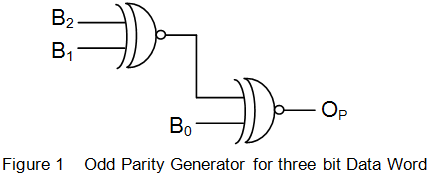
Figure: Three-bit odd parity generator using XNOR gates
Similarly, we can design an odd parity generator for any number of bits by using XNOR gates.
What is a Parity Checker?
A parity checker is a combinational logic circuit that checks the parity of the received data word at the receiver end. It takes the data word with the appended parity bit as input and outputs a signal that indicates whether there is an error or not. Depending on whether even or odd parity is used, different logic gates are required to implement the parity checker.
Even Parity Checker
An even parity checker verifies that the total number of 1s in the received data word with the parity bit is even. If it is even, it outputs a zero signal, indicating no error; if it is odd, it outputs one signal, indicating an error.
For example, let us design an even parity checker for a three-bit data word (B2B1B0) with an even parity bit (EP).

We can implement this expression using three XOR gates.
Similarly, we can design an even parity checker for any number of bits by using XOR gates.
Odd Parity Checker
An odd parity checker verifies that the total number of 1s in the received data word with the parity bit is odd. If it is odd, it outputs a zero signal, indicating no error; if it is even, it outputs one signal, indicating an error.
For example, let us design an odd parity checker for a three-bit data word (B2B1B0) with an odd parity bit (OP). The truth table and logic expression for the error signal (E) are:


We can implement this expression using three XOR gates, as shown in Figure below:

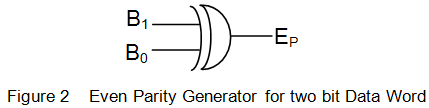
Figure: Three-bit odd parity checker using XOR gates
Similarly, we can design an odd parity checker for any number of bits by using XOR gates.
Applications of Parity Generators and Checkers
Digital communication and storage systems lean on parity every day. Some examples:
- Serial Peripheral Interface (SPI) buses carry no built-in error checking, so designs that need it add parity or checksums in software between master and slave devices.
- Universal Asynchronous Receiver Transmitter (UART) frames carry an optional parity bit for error detection, followed by one or two stop bits that mark the end of transmission.
- Redundant Array of Independent Disks (RAID) technology uses parity to protect against data loss due to disk failures.
- Hamming codes use parity to correct single-bit errors and detect double-bit errors in binary messages.
- Cyclic Redundancy Check (CRC) codes extend the parity idea, using polynomial division to detect errors in blocks of binary messages.
Conclusion
A single well-chosen bit buys a surprising amount of protection: parity generators set it at the transmitter, parity checkers verify it at the receiver, and any odd number of flipped bits stands out immediately. Even and odd schemes simply agree on which total to aim for, and XOR or XNOR trees do the arithmetic in hardware.


