- Electrical Energy Definition: Electrical energy is defined as the product of electrical power and time, measured in joules (J).
- Measuring Electrical Energy: Electrical energy is measured using the formula 𝐸 = 𝑃 × 𝑡 E=P×t, where 𝑃 P is power in watts and 𝑡 t is time in seconds.
- Units of Electrical Energy: Common units include joule (J), watt-hour (Wh), kilowatt-hour (kWh), megawatt-hour (MWh), and gigawatt-hour (GWh).
- Energy Meters: Devices like electromechanical, electronic, and smart meters measure electrical energy consumption.
- Measurement of Electrical Energy: To measure electrical energy consumption, multiply the power used by devices by the time they are operated.
Electrical energy is energy transferred or converted by electrical systems. An electric current can deliver energy to a motor, battery, lamp or heater. Electric resistance converts some electrical energy to heat. Power is the rate of energy transfer, while an energy meter accumulates that transfer over time.
What is Electrical Energy?
Electrical energy over a time interval is the integral of instantaneous electrical power. When power stays constant, energy equals power multiplied by time. The SI unit is the joule (J), and one joule equals one watt-second:
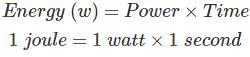
E=P×t
where,
- E is the electrical energy in joules (J)
- P is the electrical power in watts (W)
- t is the time in seconds (s)
Electrical power is the rate at which a source or load transfers energy. Instantaneous power equals the product of instantaneous current and voltage. For steady DC, the same relation uses constant values. Electrical power is measured in watts (W), and one watt equals one joule per second:
P=V×I
where,
- P is the electrical power in watts (W)
- V is the voltage across the load in volts (V)
- I is the electrical current in amperes (A)
If a lamp draws a constant 100 W for 10 minutes, its electrical-energy use is:
E=P×t=100 W×10×60 s=60,000 J
Units of Electrical Energy
The joule is the SI unit of energy. Watt-hour (Wh), kilowatt-hour (kWh), megawatt-hour (MWh) and gigawatt-hour (GWh) are convenient for metering and electricity-system totals. They combine a power unit with time; they do not describe a rate.

- Watt-hour (Wh) is the energy transferred by one watt acting for one hour. One watt-hour equals 3,600 joules. A lamp that draws a constant 15 W uses 15 Wh in one hour.
- Kilowatt-hour (kWh) equals 1,000 Wh or 3.6 MJ and is common on utility bills. A load drawing 300 W continuously for one hour uses 0.3 kWh. A cycling appliance needs its actual duty cycle or a meter reading.
- Megawatt-hour (MWh) equals 1,000 kWh or 3.6 GJ. A generator delivering a constant 600 MW for one hour supplies 600 MWh. A 600 MW nameplate rating alone does not prove that output.
- Gigawatt-hour (GWh) equals 1,000 MWh or 3.6 TJ. Grid operators use GWh or TWh for large generation and consumption totals over stated reporting periods.
The following table summarizes the units of electrical energy and their conversions:
| Unit | Symbol | Equivalent to |
|---|---|---|
| Joule | J | 1 J |
| Watt-hour | Wh | 3,600 J |
| Kilowatt-hour | kWh | 3.6 MJ |
| Megawatt-hour | MWh | 3.6 GJ |
| Gigawatt-hour | GWh | 3.6 TJ |
How to Measure Electrical Energy with a Meter
An electrical energy meter, or energy meter, integrates active power over time and records energy, commonly in kilowatt-hours. It does not record total power as an energy quantity. Utility meters may also keep interval, demand, import, export or reactive-energy registers. Domestic and industrial AC circuits require a meter and connection arrangement approved for the service.
Meter terms describe different parts of the design:

- Electromechanical meters: An induction or Ferraris watt-hour meter uses voltage and current magnetic systems to produce disc torque proportional to active power. The register accumulates revolutions as energy. Moving parts can wear, and the meter has susceptibility to external influence unless protected. Other meter designs can measure reactive energy, so technology alone does not define every register.
- Electronic meters: A static meter samples voltage and current, calculates the required power quantity and integrates it into an energy register. Accuracy class, sampling, current range, waveform response and direct or transformer connection matter. Communications and tariff registers are optional functions, not automatic features of every electronic meter.
- Smart meters: A smart meter combines metering with scheduled or on-demand communications. Advanced metering infrastructure (AMI) also includes the communications network, head-end and data-management systems. Interval data can support time-based tariffs or outage analysis when the utility deploys those functions; the meter is not the whole AMI system.
A meter repeatedly determines power from voltage and current and accumulates it over time. The correct calculation depends on waveform, phases, wiring and the quantity being registered:
- Single-phase meters: For a sinusoidal load, active power is Vrms Irms multiplied by the power factor. Apparent power is Vrms Irms, while reactive power describes energy exchanged with electric or magnetic fields. Reactive power is not simply wasted heat, although the extra current can increase losses in real conductors and equipment. Electronic meters calculate power from sampled waveforms for nonsinusoidal loads.
- Three-phase meters: A three-phase system has three line conductors and may also have a neutral. For a balanced sinusoidal load, total active power can use line-to-line voltage with line current, or phase voltage with phase current. For an unbalanced or distorted system, calculate and sum each phase or use a meter with the correct wiring elements. Do not call line current phase current in a delta connection.


Pbalanced=√3VlineIlinecosϕ
Pbalanced=3VphaseIphasecosϕ
where,
- P is the electrical power in watts (W)
- Vline is RMS line-to-line voltage in volts (V)
- Vphase is RMS voltage across one load phase in volts (V)
- Iphase is RMS current through one load phase; Iline is RMS current in one line conductor
- ϕ is the phase angle between the voltage and the current in radians or degrees
Both balanced formulas give the same total when their voltage and current definitions match the connection. In star, line current equals phase current and line voltage is √3 times phase voltage. In delta, line voltage equals phase voltage and line current is √3 times phase current. Unbalanced totals require phase-by-phase measurement.
How to Calculate Electrical Energy Consumption
For a constant-power load, multiply power by operating time:

E=P×t
where,
- E is electrical energy in joules (J) when time is in seconds, or watt-hours (Wh) when time is in hours
- P is the electrical power in watts (W)
- t is the time duration in seconds (s) or hours (h)
Keep power and time units consistent. Watt-seconds give joules; watt-hours give Wh; kilowatts multiplied by hours give kWh. When power changes, add the energy from each interval or use an integrating meter.
To convert between different units of electrical energy consumption, we can use the following conversion factors:
- 1 kWh = 1,000 Wh = 3.6 MJ
- 1 MWh = 1,000 kWh = 3.6 GJ
- 1 GWh = 1,000 MWh = 3.6 TJ
A nameplate estimate assumes each device draws its stated input power for the whole interval. Thermostats, variable-speed drives, standby modes and changing load make actual energy different. Use a plug-in meter, submeter or utility interval data when measured consumption is required.
For example, assume an 8 kW water heater, a 5 kW electric press and four 100 W lamps all draw their rated input continuously for 10 hours:
The total electrical power is:
P=8 kW+5 kW+4×100 W=13.4 kW
The time duration is:
t=10 h
The electrical energy consumption is:
E=P×t=13.4 kW×10 h=134 kWh
Summary
The main measurement rules are:
- Energy is accumulated power; E = Pt applies when power is constant
- One Wh equals 3,600 J, and prefixes scale the watt-hour for larger totals
- An energy meter integrates the required power quantity and records one or more registers
- AC formulas must match RMS values, waveform, phase balance and wiring
- Rated power gives an estimate only when the assumed operating time and duty cycle are valid
For billing or engineering decisions, use a meter of the required accuracy class, confirm its current and voltage connections, apply instrument-transformer ratios where needed and compare register changes over the exact interval. Energy data can then support cost or efficiency analysis without confusing kW demand with kWh consumption.