

- Gauss’s Theorem Definition: Gauss’s theorem states that the total electric flux through any closed surface is equal to the net positive charge enclosed by that surface.
- Flux and Charge: The flux from an electric charge depends on the quantity of the charge.
- Mathematical Expression: Gauss’s theorem is expressed mathematically using a surface integral involving flux density and the outward vector.
- Component Flux: If a charge is not at the center, the flux lines resolve into horizontal and vertical components.
- Total Flux Calculation: The total electric flux through a closed surface equals the total charge, proving Gauss’s theorem.
Electric charge is a source of an electric field. Electric flux is a surface integral of that field, not a flow of energy. Gauss’s theorem, also called Gauss’s law for electricity, relates the net outward flux through any closed surface to the algebraic charge enclosed by that surface.

In electric-field form, the total electric flux is ∮E·dS = Qenc/ε0. In electric-displacement form, used by the equation below, ∮D·dS equals the net enclosed free charge. Positive and negative charges enter with their signs.
If charges Q1, Q2 through Qi and Qn are enclosed, their algebraic sum appears on the right side of the closed-surface integral: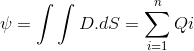
Here D is electric flux density in coulombs per square metre, and dS is an outward-directed vector area element in m2. The dot product selects the component of D normal to the surface.
Explanation of Gauss’s Theorem
For a simple application of Gauss’s theorem, place a point charge Q at the centre of a spherical surface.
The radial D field is normal to the surface and has the same magnitude everywhere on that sphere. Its total flux is Q coulombs in D-field notation. Moving the charge away from the centre makes the local flux density and angle vary across the surface, but it does not change the net closed-surface integral while Q remains enclosed.
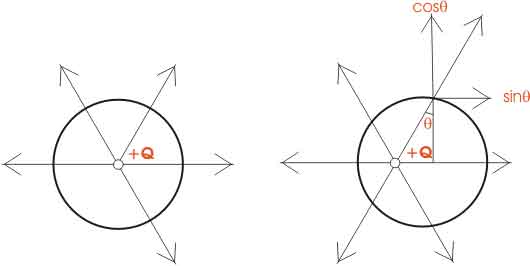
For an off-centre charge, use the outward normal at each surface element. Only the normal component D cosθ contributes to D·dS; the tangent component contributes zero. The total is found by integrating over the closed surface, not by adding fixed horizontal and vertical components. For an enclosed charge, the result is Q in D-field form, as required by Gauss’s theorem.
Proof of Gauss’s Theorem
Consider a free point charge Q in a homogeneous isotropic linear medium with permittivity ε.
The electric field intensity at distance r is radial and is shown by: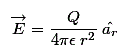
The electric displacement flux density is D = εE, giving: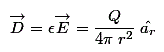
The differential outward flux through vector area dS is the dot product shown below:
Here θ is the angle between the radial D vector and the outward normal to dS.
The projected area dS cosθ and distance r define the signed solid angle at Q:
Here dΩ is the differential solid angle subtended by dS at Q. Substitution converts the total displacement flux into a solid-angle integral:
A closed surface has total signed solid angle 4π steradians as viewed from a point inside it, so the integral equals Q. If the point charge is outside, the total signed solid angle and net flux are zero.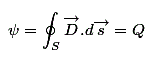
By superposition, the right side becomes the algebraic sum of all enclosed free charges. This is the D-field integral form of Gauss’s theorem. In vacuum, D = ε0E and the equivalent E-field form is ∮E·dS = Qenc/ε0.


