

- Deep Bar Double Cage Induction Motor Definition: A deep bar double cage induction motor is defined as a motor that uses a double-layered rotor to enhance starting torque and efficiency.
- Starting Torque Improvement: The double cage rotor design improves starting torque by utilizing high resistance in the outer bars.
- Construction of Double Cage Rotor: The rotor has two layers; the outer layer with small cross-section bars and high resistance, and the inner layer with large cross-section bars and low resistance.
- Operational Principle: At standstill, the outer bars carry more current due to higher inductive reactance in the inner bars, shifting to inner bars as speed increases.
- Speed-Torque Characteristics: The motor achieves higher starting torque with higher rotor resistance at standstill, and efficient running torque with lower inductive reactance at full speed.
Many induction motor applications use squirrel cage induction motors. A simplified starting-torque relation is: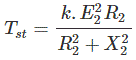
Where R2 and X2 are rotor resistance and rotor leakage reactance at starting, and E2 is rotor induced EMF:
Ns is the synchronous speed in revolutions per second. The equation does not make starting torque Tsh proportional to R2 for every value. Resistance appears in both the numerator and denominator, so there is an optimum value for a given voltage and reactance.
A simple low-resistance cage may have less starting torque than a load requires. Deep-bar and double-cage rotors make the effective rotor impedance vary with slip frequency, giving higher effective resistance during starting and lower effective resistance near rated speed.
The design aims to improve starting torque without keeping high rotor resistance during normal running. A deep-bar rotor uses current crowding within a tall bar; a double-cage rotor provides separate outer and inner current paths.
Why a Simple Low-Resistance Cage Can Have Limited Starting Torque
In a cage motor, external rotor resistance cannot be added as it can in a wound-rotor motor. At standstill, rotor-current frequency equals supply frequency, so rotor leakage reactance is high. A low-resistance simple cage can therefore draw high current without producing the starting torque needed by a high-inertia or high-breakaway-torque load. A deep bar double cage motor changes its effective rotor impedance between starting and running conditions.
Construction of Deep Bar Double Cage Induction Motor
A double-cage rotor has two conductive cages connected by end rings.
The outer cage is close to the air gap and normally has smaller bars with higher resistance. Its leakage flux linkage and leakage inductance are lower, so its resistance-to-reactance ratio favours starting torque.
The inner cage uses larger bars with lower resistance. Because it lies deeper in the rotor iron, it has more leakage flux linkage and higher leakage inductance. At low rotor frequency, its low resistance gives better running efficiency.
Operating Principle of a Deep-Bar or Double-Cage Rotor
At standstill, the rotor’s induced voltage and current have the supply frequency. The inner or deeper path has greater inductive reactance (XL = 2πfL), so more rotor current uses the outer or upper part of the cage. A deep bar also exhibits current crowding towards the slot opening at this high frequency.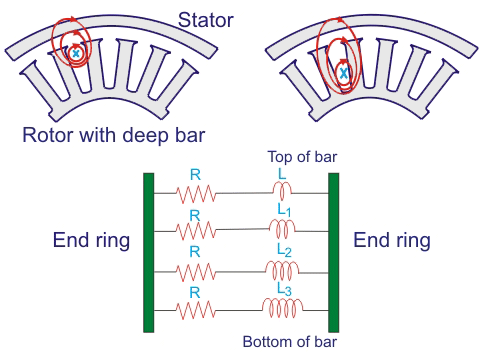
The outer path has higher resistance but lower leakage reactance, which can improve starting torque and limit starting current. As the deep bar double cage induction motor accelerates, slip and rotor-current frequency fall. The inner-path reactance XL then falls, so more current uses the lower-resistance path. This frequency-dependent current distribution provides strong starting performance and efficient running, subject to the motor’s detailed design.
Speed-Torque Characteristics
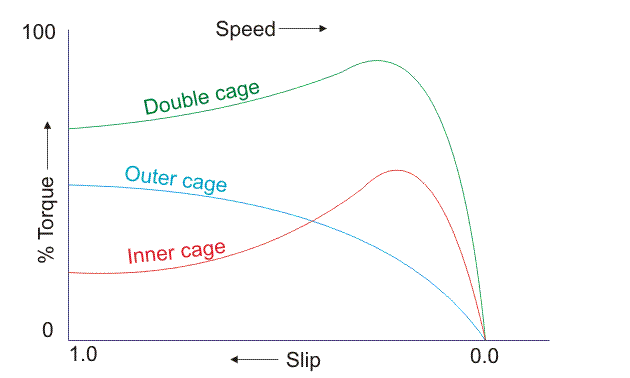
Where R2 and X2 are the effective rotor resistance and leakage reactance, and E2 is rotor induced EMF:
Ns is synchronous speed in revolutions per second, and S is slip. Increasing effective rotor resistance moves maximum torque to a higher slip. The maximum torque value and starting current also depend on supply voltage, leakage reactance and saturation.
Comparison between Single Cage and Double Cage Motors
- A double-cage design can raise starting torque and limit starting current compared with a simple low-resistance cage. Direct-on-line suitability still depends on the supply network, driven load and motor rating.
- Current concentrated in the high-resistance outer cage produces substantial rotor heating during starting. The permitted start duration and starts per hour depend on the thermal rating.
- Near rated speed, current shifts towards the low-resistance inner cage. Full-load copper loss and efficiency depend on the complete design, so they are not necessarily worse than those of every single-cage motor.
- Breakdown torque is design-specific. A double-cage motor does not universally have lower breakdown torque than a single-cage motor.
- Double-cage construction is more complex, but there is no universal cost premium. Compare current manufacturer data for motors with the same rating, enclosure, duty and efficiency class.


