- Binary to BCD Definition: A binary to BCD converter transforms each digit of a decimal number into its corresponding binary value.
- Conversion Table: The conversion table is crucial for mapping binary inputs to their respective BCD outputs.
- Significance of MSB and LSB: Understanding MSB (most significant bit) and LSB (least significant bit) is key to grasping how numbers are represented in BCD.
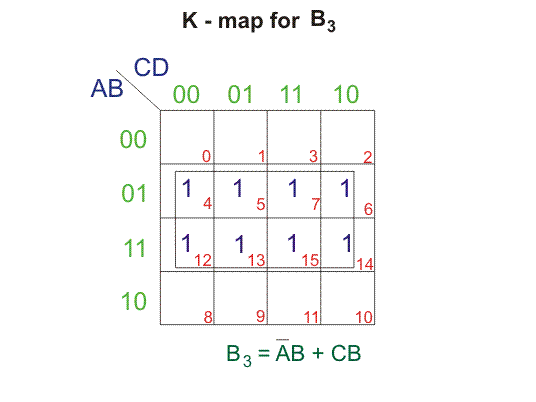
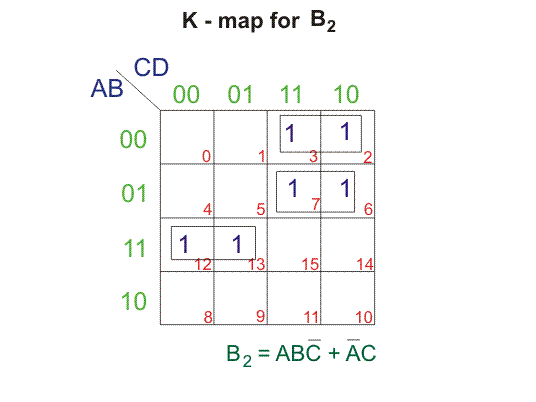
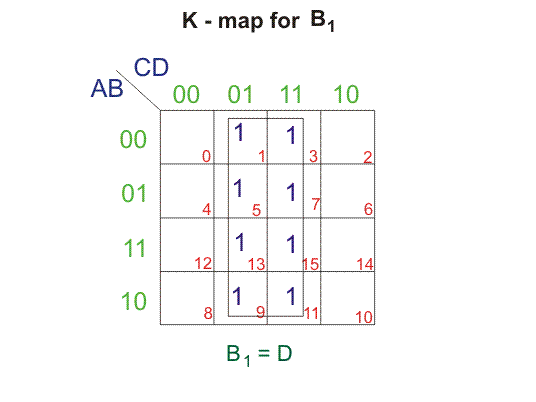
- SOP Form: The SOP form is a method used to express different bits of BCD code, simplifying digital circuit design.
- Practical Utility: Converting binary to BCD is essential in systems that display or process decimal data electronically, ensuring accuracy and ease of interpretation.
BCD stands for binary-coded decimal. In the common 8421 code, each decimal digit is represented separately by a four-bit group: 0000 through 1001 encode digits 0 through 9. The remaining six four-bit patterns are invalid digit codes. This differs from ordinary binary numbers, which encode the value as one base-2 quantity.
For example, decimal 14 is written as 0001 0100 in BCD: 0001 encodes the tens digit 1, and 0100 encodes the units digit 4. Ordinary binary 14 is 1110.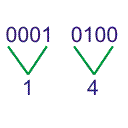
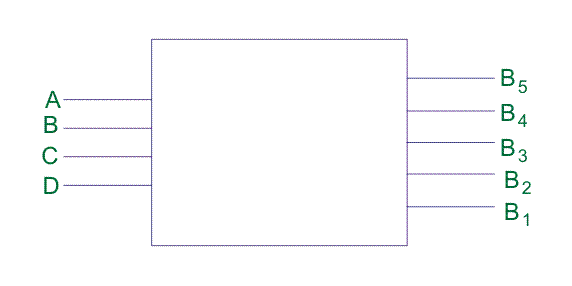
Consider a four-bit unsigned binary to BCD code converter. Its input range is 0 to 15, so outputs 0 to 9 need one BCD digit and outputs 10 to 15 need two. The conversion table lists the required output for every input combination.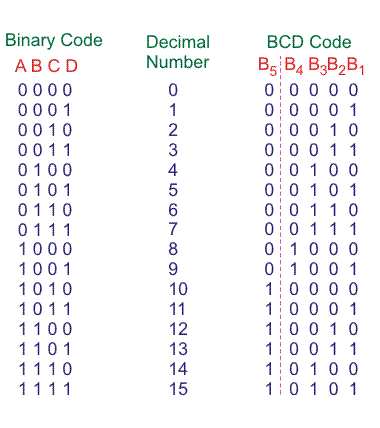
In this circuit, B5 carries the tens digit. It equals 1 for decimal values 10 through 15 and 0 for values 0 through 9. B4, B3, B2 and B1 form the four-bit BCD code for the units digit. Together, these outputs encode separate decimal digit fields.
For this four-input converter, derive one Boolean function for each output bit from the truth table. The Karnaugh maps below minimise those functions into sum-of-products (SOP) form. This circuit is specific to inputs 0 through 15; wider binary inputs require more BCD digits and a larger conversion method.