- Substitution Theorem Definition: The substitution theorem is defined as the process of replacing an element in a circuit with an equivalent voltage or current source without changing the initial conditions.
- Statement of Substitution Theorem: If an element is replaced by a voltage source with the same voltage or a current source with the same current, the rest of the circuit remains unchanged.
- Insight into Circuit Behavior: This theorem helps understand how circuits behave when elements are replaced with equivalent sources.
- Voltage Source Example: Replacing an impedance with a voltage source keeps the initial circuit conditions the same.
- Practical Example: In a circuit, replacing a resistor with a voltage or current source shows that the initial voltage and current conditions remain unchanged.
The Substitution theorem says you may replace one branch by an equivalent source without changing the voltages and currents in the rest of a uniquely solved network. The usual replacements are a voltage source equal to that branch voltage, or a current source equal to that branch current. The same idea is used to prove other network theorems.
Statement of Substitution Theorem
The Substitution theorem says that if an element in a network is replaced by a voltage source whose voltage at any instant equals the voltage across that element before the swap, the rest of the network stays the same when the solution remains unique. The same holds if the element is replaced by a current source whose current at any instant equals the current that previously flowed through that element.
Explanation of Substitution Theorem
Take the circuit in fig – a.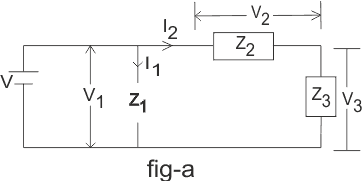
Let V be the supply voltage and Z1, Z2 and Z3 the branch impedances. V1, V2 and V3 are the voltages across Z1, Z2 and Z3 respectively, and I is the supply current. I1 flows through Z1, and I2 flows through Z2 and Z3.
If Z3 is replaced by a V3 voltage source or an I2 current source, the voltages and currents on the other impedances and on the source stay the same, by the substitution theorem.
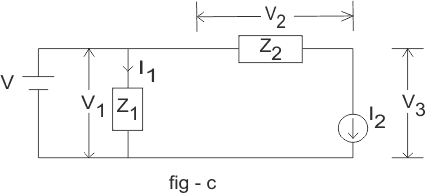
That is: current at the source is still I, voltage across Z1 is still V1, and current through Z2 is still I2.
Example of Substitution Theorem
A numerical check follows.
Take the circuit in fig – d.
By the voltage division rule, the voltages across the 3Ω and 2Ω resistance are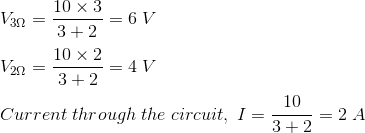
If the 3Ω resistance is replaced by a voltage source of 6 V, as in fig – e, then
By Ohm’s law the voltage across the 2Ω resistance and the circuit current are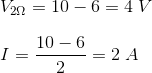
If instead the 3Ω resistance is replaced by a current source of 2A, as in fig – f, then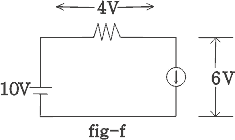
Voltage across 2Ω is V2Ω = 2 A × 2 Ω = 4 V, and voltage across the 2A current source is V2A = 10 − 4 = 6 V
The voltage across the 2Ω resistance and the current through the circuit are unchanged. The rest of the original solution is intact.