- Dryness Fraction Definition: The dryness fraction of steam is a measure of how much of the steam is in the vapor phase versus the liquid phase.
- Wet Steam: Steam generated in boilers is often wet, containing water droplets, which reduces its dryness fraction and usable energy.
- Enthalpy and Dryness Fraction: The enthalpy (heat content) of steam depends on its dryness fraction, with dry steam having higher energy.
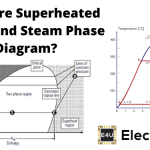
- Phase Diagram: A phase diagram shows the enthalpy-temperature relationship of water and steam at different pressures, highlighting changes from liquid to vapor.
- Flash Steam: When water at high pressure drops to a lower pressure, the excess heat creates flash steam, which needs careful handling to prevent issues like water hammer.
What is Dryness Fraction?
Steam is dry saturated when it is saturated vapour at the stated pressure, with no suspended liquid water. Wet steam is a saturated liquid-vapour mixture that may occur in a boiler or form after heat loss. The dryness fraction of the steam, also called steam quality x, is the vapour mass divided by the total liquid-plus-vapour mass. If moisture is 7% by mass, x = 0.93. Quality ranges from 0 for saturated liquid to 1 for dry saturated vapour and is not defined for superheated steam.
The vapourisation contribution to wet-steam enthalpy is xhfg. Total specific enthalpy is h = hf + xhfg at the mixture pressure. A lower quality therefore gives lower enthalpy than dry saturated steam at the same pressure, although the useful energy depends on the process and outlet state.
Vapourisation contribution to mixture enthalpy 
Total specific enthalpy of wet steam 
Here, hf is saturated-liquid enthalpy at the mixture pressure.
The exact mixture specific volume is v = (1-x)vf + xvg.
Because saturated liquid has a much smaller specific volume than saturated vapour at common steam-system pressures, the liquid-volume term is often neglected as an approximation.
With that approximation, mixture specific volume = x vg
Here, vg is the specific volume of dry saturated steam at the same pressure.
Steam Phase Diagram
The diagram relates enthalpy and temperature and includes paths at several pressures. It is a teaching sketch; use an IAPWS-based steam table or property program for design values.
Liquid Enthalpy (hf) on Phase Diagram
At atmospheric pressure, water heated from 0oC follows a constant-pressure path through the compressed-liquid region until it reaches the saturated-liquid state B. The saturated-liquid enthalpy hf uses the reference state adopted by the steam table. A constant-pressure heating path does not follow the saturated-liquid boundary while temperature rises.
Enthalpy of Vaporisation (hfg)
From B to C at fixed saturation pressure, added heat converts saturated liquid to saturated vapour while temperature remains at the saturation value. The specific enthalpy of vaporisation is hfg = hg – hf; point C has the saturated-vapour enthalpy hg.
Dryness Fraction (x)
During constant-pressure boiling, dryness fraction rises from x = 0 at saturated liquid B to x = 1 at saturated vapour C. Because mixture enthalpy varies linearly with x at fixed pressure, the midpoint of B-C on the enthalpy coordinate represents x = 0.5.
Line C-D
Point C lies on the saturated-vapour line. Further heat addition at the same pressure raises vapour temperature above saturation, producing the superheated-steam path C-D.
Liquid Zone
The region left of the saturated-liquid line contains compressed or subcooled liquid.
Super Heat Zone
The region right of the saturated-vapour line contains superheated vapour.
Two Phase Zone
The region between the saturated-liquid and saturated-vapour lines contains equilibrium liquid-vapour mixtures with quality from 0 to 1.
Critical Point
The critical point is where the saturated-liquid and saturated-vapour lines meet. Their properties converge and the enthalpy of vaporisation reaches zero; above the critical point, no distinct liquid-vapour phase boundary exists.
The critical temperature is not a general maximum temperature for dense, liquid-like fluid, but it is the highest temperature at which separate liquid and vapour phases can coexist in equilibrium.
Critical Point Parameters
The IAPWS critical values for ordinary water are approximately 373.946oC and 220.64 bar, or 22.064 MPa. A state above both values is supercritical. Higher steam conditions can raise the average heat-addition temperature in a Rankine Cycle, but efficiency also depends on component performance, losses and material limits.
Flash Steam
What is Flash Steam?
Flash steam forms when hot pressurised water or condensate is reduced to a lower pressure. Across an approximately adiabatic throttling device with no shaft work, specific enthalpy remains nearly constant. If the inlet enthalpy exceeds saturated-liquid enthalpy at the lower pressure, part of the liquid evaporates until the outlet reaches a lower-pressure equilibrium mixture.
Flashing of Steam
For saturated condensate with negligible heat transfer and kinetic-energy change, flash mass fraction is (hf1 – hf2)/hfg2, using saturated-liquid enthalpy at the inlet and outlet pressures and vaporisation enthalpy at the outlet pressure.
For the values used in Figure 1:
hf at 6 bar gauge, approximately 7 bar absolute = 697.22 kJ/kg
hf at 0 bar gauge, approximately atmospheric pressure = 417.5 kJ/kg
hfg at 0 bar gauge, approximately atmospheric pressure = 2258 kJ/kg
Flash steam = (697.22 – 417.5)/2258 = 0.124 kg of steam per kg of inlet condensate
OR
= 12.4%
Flash Steam Effects
Flash steam greatly increases volumetric flow in a condensate system. The following items need two-phase-flow checks. Poor drainage, trapped condensate or rapid valve operation can also contribute to water hammer:
- Condensate receiver, flash vessel and vent sizing, including pressure rating, relief and safe discharge location.
- Steam-trap discharge piping, including slope, backpressure and two-phase capacity.
- Condensate return-line sizing and drainage to prevent liquid slugs.