- Feed Water and Steam Flow Circuit Definition: The feed water and steam flow circuit in a boiler includes the economizer, boiler drums, water tubes, and super heater, each with specific roles to ensure efficient operation.
- Economizer: A heat exchanger that uses flue gas to heat feed water, improving boiler efficiency. Steam Drum: Separates steam from water, stores water and steam, and supports chemical treatments.
- Steam Drum: A heat exchanger that uses flue gas to heat feed water, improving boiler efficiency.
- Water Tubes: Carry the steam-water mixture, with down-comers and risers aiding circulation.
- Super Heater: Heats steam to higher temperatures, enhancing overall boiler efficiency and turbine performance.
The feed water and steam circuit is the water path through a boiler: economizer, drums, water tubes and superheater. Feed is heated, boiled and superheated before it leaves as steam.
Economizer
- An Economizer is a flue-gas heat exchanger. It raises feed water from the common header toward the saturation temperature that matches boiler pressure. It is not meant to boil the feed.
- Hot flue gas dumped to the stack is wasted heat. Recovering it in the feed raises boiler efficiency, which is why the exchanger is called an economizer.
- The bank is bent tubes with feed inside and exhaust gas outside. More water tubes means more heating surface. Tube count and bore are set with the boiler rating.
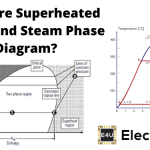
- On the T-S plot above, the shaded band is the economizer zone. Heat taken up by the feed is ‘Qeco’.

The next block of the Feed Water and Steam
Circuit is the boiler drum.
Boiler Drums
Water-tube boilers usually have a steam drum at the top and a mud drum at the bottom.
Steam Drum
The steam drum in the feed water steam circuit does this:
- Hold enough water and steam to ride load swings.
- Give a static head that drives natural circulation in the water tubes.
- Separate steam from the two-phase mix coming from the risers.
- Hold drum chemistry (pH and residual scavenger). Dissolved O2 is mainly stripped in the deaerator, not in the drum.
How the drum dries the steam:
- Steam must be separated from the mixture before it leaves the drum, because:
- Moisture in steam carries dissolved salts. In the super heater the water boils off and the salt plates the tube bore as scale, which shortens superheater life.
- Silica and similar impurities in that moisture can plate turbine blades.
- The drum also has to dry the steam-water mix. Below about 20 bar (1 bar = 1.0197 kg/cm2) gravity is usually enough, because water drops are denser and fall out of the steam.
- At higher drum pressure steam density rises (steam is compressible) so the density gap versus water shrinks. Gravity separation then fails.
- High-pressure drums therefore use mechanical internals (baffles, cyclones, scrubbers) to strip water from steam.
- The sketch shows typical anti-priming gear used in thermal power plants:

- Baffles keep the wet mix off the dry-steam path and steer the steam.
- A cyclone spins the mix on a helix so centrifugal force throws water to the wall. Small vanes catch that water.
- A scrubber zigzags the flow and is the last drying stage.
- After the scrubber, steam goes to the superheater through a perforated screen.
Mud Drum
The Mud drum is the lower header. It closes the natural-circulation loop through the water tubes. It holds saturated water plus settled salts (sludge). Periodic blowdown through the discharge valve dumps that sludge.
Water Tubes

The feed water and steam circuit of boiler also needs the generating tubes.
Water tubes are bent or straight pipes that carry the steam-water mix. Two groups are used, viz. down-comers and risers. Together they are the evaporator (the boiler proper), where water becomes steam. On the T-S diagram beside, that band is the evaporator zone. ‘Qeva’ is the heat absorbed there, mainly latent heat of vaporization.
Down comers Water Tubes
Down-comers take water from the steam drum down to the mud drum (see fig.). Steam bubbles must not ride with that water. Bubbles would cut the density difference that drives natural circulation.
Risers Water Tubes
Risers carry the saturated two-phase mix from mud drum up to steam drum. They sit near the furnace. Down-comers sit away from the fire.
Super Heaters
The superheater is the last steam heater on the Feed Water and Steam Circuit of Boiler
- The superheater is a flue-gas exchanger that raises dry saturated steam above saturation. On some high-pressure boilers the superheater (and reheater, where fitted) can take more than 40% of the heat pickup; that share is a typical figure, not a fixed law. The T-S diagram beside marks that heat as ‘Qsh’.

- Heat flux in the superheater is high, so modern water tube boilers give it a large heating surface.
- Superheater tubes see the hottest steam inside and the hottest gas outside, so they use high-alloy steels.
Functions of Super Heater
- Higher steam temperature at the turbine stop valve raises cycle efficiency. Superheat also cuts wetness in the last turbine stages, which helps the turbine internally.
- Metal limits the steam temperature. Older plant often ran about 450oC at the turbine inlet. Many later units run hotter than that.