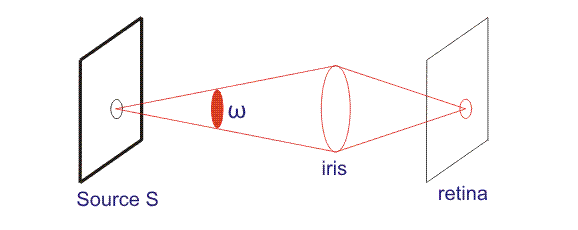
- Radiance Definition: Radiance is defined as the radiant flux emitted from a point source in a specific direction per unit solid angle and per unit projected area perpendicular to that direction.
- Luminance Definition: Luminance is defined as the luminous flux radiated from a point light source per unit solid angle and per unit projected area perpendicular to the specified direction.
- Radiance vs Luminance: Radiance and luminance differ in that radiance is a measure of radiant flux, while luminance is a measure of luminous flux, with luminance calculated from radiance using a specific conversion factor.
- Conservation of Luminance: Luminance is conserved in a system, meaning it remains the same from the source to the detector if no radiation is gained or lost in the medium.
- Geometric Nature of Luminance: Luminance is a geometric quantity that describes the beam between the source and the detector and is not increased or decreased by optical systems.
Radiance is the radiant flux leaving a surface in a given direction, per unit solid angle and per unit projected area at right angles to that direction.
Spectral radiance is written Le,λ. It is the second derivative of radiant flux with respect to projected area As and solid angle ωs.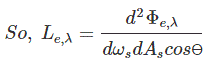
θ is the angle between the surface normal and the chosen direction.
dAs is the surface element. dωs is the solid-angle element around that direction.
The unit of radiance is W/(sr·m2).
Luminance is the photometric counterpart of radiance: the same geometry, using luminous flux instead of radiant flux.
Monochromatic radiance at 555 nm converts to luminance with
Km is the CIE photopic maximum luminous efficacy, 683 lm/W at 555 nm. Broadband light needs V(λ), not this single factor on total radiance.
Luminance is therefore luminous flux per unit solid angle per unit projected area, in a stated direction.
It is written
The SI unit is cd/m2, also written lm/(sr·m2).
In a lossless medium the radiance and the luminance at the source equal those at the detector:
If the medium between source and detector adds or loses no radiation, Φs = ΦD.
Luminance is then conserved along the beam.
The value at the source equals the value at the detector.
It is a property of the beam, not of the source or the detector alone.
Lenses and other lossless optics redirect flux. They do not raise or lower luminance (etendue is conserved).
Luminous flux and luminance are related by
Φ = LG,
where G is the geometric extent of the beam in steradian-square-metre units, not a single angle.
Brightness is the Luminance
Luminance can’t be increased or decreased by any optical system. A system can only redirect the luminous flux. Suppose a page of a book has been considered with certain luminance. Then we can follow the equation below,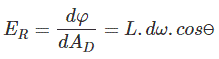
Here, ER is the Illuminance on the book that redirects to our retina. This equation means that our eye converts the luminance into Illuminance on the retina. All the other detectors do the same as what the retina does. The retina reacts to the flux density of the radiant field, that is to the Illuminance. The principle physiological sensation of brightness is linked to the luminance of the source we are looking at.
The radiance and luminance has a relation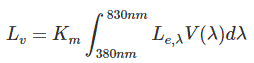
Where, Km is the constant which is called maximum spectral luminous efficacy and its value is 683 lm/W.
Lv is luminance measured in cd/m2 and Le,λ is the radiance measured in W/m2-sr.