

- Earthing Definition: Earthing of electrical transmission towers is defined as a safety measure where each tower is grounded to prevent electrical hazards.
- Footing Resistance: Measuring the footing resistance ensures it is below 10 ohms, crucial for tower safety.
- Pipe Earthing: Involves using a 25 mm diameter galvanized steel pipe buried 3 meters into the ground with layers of charcoal and salt for moisture maintenance.
- Counterpoise Earthing: Utilizes a 10.97 mm diameter galvanized wire, 25 meters long, buried 1 meter deep, connecting the tower legs.
- Tower Earthing Lug: The earthing lug extends beyond the tower’s concrete base, ensuring a proper connection.
Each tower of an electrical transmission line is earthed so fault current and lightning current have a path into the soil. Crews measure footing resistance in dry weather, before the earthwire or OPGW is strung. Indian CEA construction practice sets a 10 ohm ceiling for that reading. Other networks use a different limit or a site-specific value.
For earthing electrical transmission towers the usual methods are pipe earthing and counterpoise earthing. The earthing lug should extend past the concrete chimney of the tower leg. A counterpoise uses a lug connector. Pipe earth is often fitted on the leg marked A so erection crews pick the same stub. River-crossing and railway-crossing towers are often earthed on two diagonally opposite legs.
The two methods are described below.
Pipe Earthing of Electrical Transmission Tower
One common Indian pipe earth uses a galvanized steel pipe about 25 mm in diameter and 3 m long, set vertically with its top about 1 m below ground. Other specifications use a different diameter or set the top 600 mm down. If the tower sits on rock, the pipe is placed in nearby damp soil.
A galvanized steel tape then joins the tower leg to the pipe. On rock the tape is laid in a cut groove and protected from damage.
Around a pipe earthing system many Indian jobs still pack charcoal or coke and salt to keep the soil moist and lower local resistivity. Salt can leach, so some owners now use coke only or a compound such as bentonite.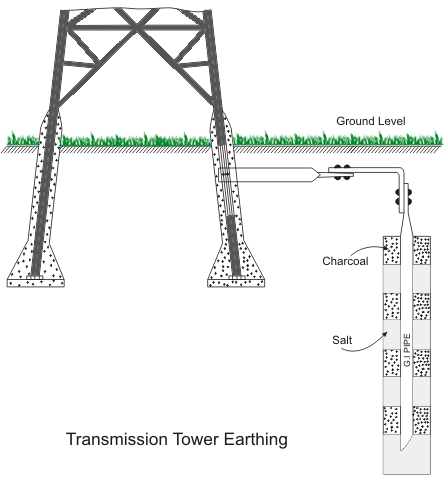
Counterpoise Earthing
A common Indian counterpoise earthing of electrical transmission tower uses 7-strand galvanized steel wire of about 10.97 mm overall diameter, often 7/3.66 mm. Each tail is lugged to a tower leg with 16 mm bolts. Lengths start around 25 m in older notes. Utility specs often call for 30 m or more, and 70 m in high-resistivity soil. Burial is often 0.6 m to 1 m. One run may leave each of the four legs, laid radially or tangentially.


