

- Wave Particle Duality Definition: Wave-particle duality is defined as the concept that light and all matter exhibit both wave and particle properties.
- Historical Development: The idea evolved through studies like the photoelectric effect, Compton effect, and Bohr’s atomic model.
- De Broglie Hypothesis: Louis de Broglie suggested that particles have an associated wavelength, given by λ = h/p, indicating wave-particle duality.
- Supporting Experiments: Davisson and Germer’s experiments demonstrated electron diffraction, validating de Broglie’s theory.
- Practical Examples: The photoelectric effect and Compton effect show the particle nature of light, while electron diffraction experiments highlight its wave nature.
Wave-particle duality is the statement that light and matter both behave as waves and as particles. The Photoelectric effect, Compton scattering and Bohr’s model of atom showed light and other radiation as packets, or Quanta.
Huygens’ principle and Young’s double-slit experiment showed the same light as a wave, not only a stream of particles.

The interference pattern from light through two slits is wave behaviour. That clash with the particle picture is old: Newton’s 1704 Opticks treated light as corpuscles.
Neither picture alone covered every optical experiment, so light was taken to have both wave and particle behaviour. In 1924 Louis de Broglie went further: every particle has a wave. A photon and an elephant both have a wavelength; only the elephant’s is too short to see. For mass m and momentum p he wrote
where h is Planck’s constant and p = mv, with v the speed of the body.
An elephant has large mass, so large p and a tiny wavelength. An electron has small mass, so a wavelength that can be measured. The same rule also fits the Bohr orbits: an electron stays on an orbit if the circumference is an integer number of its de Broglie wavelengths. If a standing wave cannot close, that orbit is not allowed.
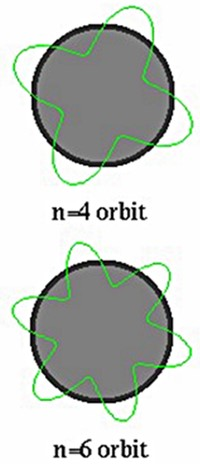
Davisson and Germer later saw electrons diffract from a crystal, and two-slit work with electrons showed interference. Those results support de Broglie’s wave-particle duality.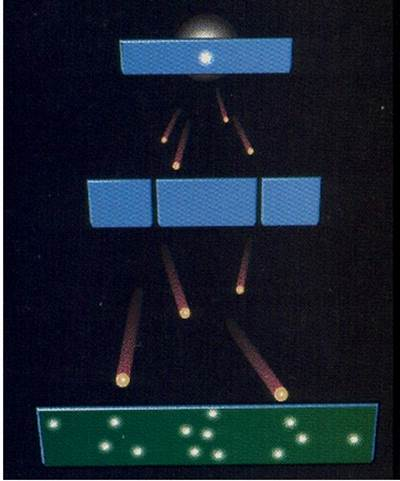
Compton Effect
In the photoelectric effect, light hits a metal as a stream of photons. One photon supplies the work function of one electron and the rest appears as kinetic energy of that electron. Those photons are the particle behaviour of light. Einstein treated light as many energy packets, each of energy hf, with h Planck’s constant and f the frequency of the light. The same particle behaviour of electromagnetic waves is shown by the Compton effect.
In Compton’s experiment an x-ray beam of frequency fo and wavelength λo strikes an electron. After the collision the electron and the x-ray leave at two different angles from the incident axis. Energy is conserved, as in a collision of ordinary particles. The electron recoils in one direction. The x-ray scatters in another direction; this is scattering, not diffraction. The scattered ray has a lower frequency and a longer wavelength than the incident ray. Photon energy falls with frequency, so the x-ray loses energy in the collision and that energy appears as kinetic energy of the electron. The encounter is like two billiard balls, not a wave on a grating.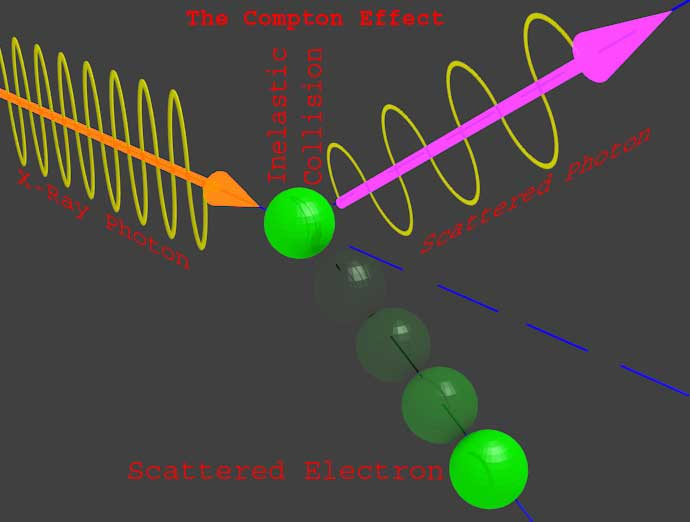
The energy of a photon is
so the momentum of the photon is
or
Equation (1) says an electromagnetic wave of wavelength λ carries a photon of momentum p.
Equation (2) says a particle of momentum p has an associated wavelength λ. A wave can act as a particle, and a moving particle can act as a wave.
That conclusion is de Broglie’s, and the statement is the de Broglie hypothesis. The wavelength of the moving particle is
where p is the momentum, h is Planck’s constant and λ is the de Broglie wavelength. On that view an electron in orbit around a nucleus is both a particle and a wave.
Divission and Germer Experiment
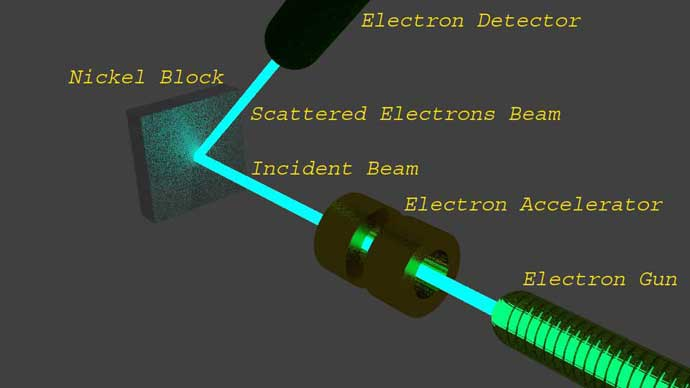
Electron waves can be shown in several ways. The best-known is the Davisson and Germer experiment of 1927. They sent a beam of accelerated electrons onto a nickel crystal and recorded the scattered intensity with an electron detector. A classical particle beam would spread in angle. The measured density instead peaked at particular angles, like optical diffraction. That pattern is wave particle duality for electrons. The same diffraction is seen with protons and with neutrons.


